
Three forms of slavery: chattel slavery, serfdom, and wage-slavery


Philosophers often use thought-experiments for the clarification and testing of theories. For example, to clarify and justify the present political institutions, philosophers appeal to a Social Contract. This is an imaginary agreement among an imaginary group of people with imaginary traits. Several years ago John Rawls wrote A Theory of Justice appealing to such a Social Contract.

A thought experiment is a species of hypothetical reasoning. It is the testing of a hypothesis under imaginary circumstances.

I propose to use a thought experiment concerning two individuals on an island, whom I will call Robinson Crusoe and Friday. And my task is to characterize the economic-political systems of slavery, feudalism, and capitalism as a relation between two individuals.

Slavery will exist if Crusoe forces Friday to do anything he wants him to do. Friday will fish, hunt, and gather plants. He will bring them to Crusoe and prepare and cook these things for him. He will build for Crusoe a hut, he will fetch water, and he will wipe Crusoe’s butt. Crusoe, in turn, will allow Friday to feed on the scraps which are left over. If Friday misbehaves, he will be punished by the whim of Crusoe.

Feudalism will exist if Crusoe lets Friday fend for himself on the island, i.e., Friday may build himself a shelter and keep a store of food for himself, provided that Friday brings to Crusoe a certain quantity of food, and does a certain amount of labor.  Crusoe will set up some form of punishment for non-compliance.

The creation of a capitalist situation on the island is initially puzzling to formulate because of mistaken definitions of what capitalism is.  A useful way of giving a definition is through the method of genus and difference. Capitalism is in the genus of trade: it is a market economy. But trade is just barter with or without money, and is well nigh universal.  It existed under slavery and under feudalism.

So called anarcho-capitalists say that capitalism is free trade under conditions of private property.  How will that be modeled in the Crusoe-Friday scenario? We can suppose that Crusoe and Friday have divided between themselves the island in half.  They do not trespass on each other, and periodically trade.  Crusoe is good at fishing, while Friday is good at gathering coconuts. There is an agreed division of labor and trade. This satisfies the anarcho-capitalist’s definition, but it is not the capitalism which socialists were objecting to. What is missing? Wage-labor.  So if there is to be “voluntary” labor by Friday for Crusoe, what possibly can induce Friday to work for Crusoe, given that they possess equal shares of the island?

One scenario is this. Crusoe has a rifle and there are feral pigs on the island. Using the rifle, it is easy to kill pigs. So, Crusoe makes a deal with Friday, allowing Friday to do all the pig hunting for the two of them.  As a result, Crusoe has leisure, while Friday does the work of hunting.

This, however, does not model historical capitalism. Why? Because under present day conditions of capitalism, if Friday does not enter into this agreement as a worker, he will become homeless and risk starvation. How can such a situation be modeled on the island? I can think of only one scenario. Crusoe claims the whole island as his private possession, and Friday is welcome on the island on the condition that he will work for Crusoe. What is the alternative for Friday if he refuses? He is compelled to leave the island in whatever way he can manage, and risk the perils of the sea.  Alternatively, Friday can, of course, trespass without Crusoe’s permission; but if caught, there will be punishment.

So, Friday is forced into working for Crusoe because he does not have free  access to subsistence land on the island.  This, as I see it, is the difference which must be added to the genus of trade in order to define capitalism per genus and differentia.

________________________________

chatGPT evaluates:

This thought experiment provides a useful framework for comparing slavery, feudalism, and capitalism as economic systems, with each system defined by its distinct form of coercion and control over labor. Here’s an evaluation of each system and the insights they offer:

1. Chattel Slavery

  • Characterization: In this model, Friday is entirely at Crusoe’s mercy, with no autonomy over his labor or life. Crusoe’s power is absolute, and Friday’s survival depends entirely on the whims of his master.
  • Key Features:
    • Total control over the labor and body of the enslaved.
    • No formalized rights or protections for Friday.
    • Punishment is arbitrary and based solely on Crusoe’s preferences.
  • Economic Insight: Chattel slavery represents the most extreme form of labor exploitation, where the enslaved are dehumanized and treated as property. It highlights the absence of individual autonomy and the complete subjugation to another’s will.

2. Feudalism (Serfdom)

  • Characterization: Friday retains some autonomy. He can maintain his own subsistence, but only if he fulfills certain obligations to Crusoe, who enforces compliance through punishments.
  • Key Features:
    • Partial autonomy: Friday has access to some resources for his own use but owes labor or tribute to Crusoe.
    • Obligations are fixed and not subject to change based on whim, unlike in slavery.
    • Punishment is systemic rather than arbitrary.
  • Economic Insight: Feudalism introduces a system of mutual obligation but remains exploitative. The serf has limited freedom and is bound to provide surplus labor or goods to the lord, who holds power through control of land.

3. Capitalism (Wage Slavery)

  • Characterization: Crusoe claims ownership of the entire island, forcing Friday to work for him under threat of eviction or starvation. Friday’s “choice” to work for Crusoe is coerced by his lack of alternatives.
  • Key Features:
    • Formal freedom: Friday is not legally bound to Crusoe but lacks viable alternatives to survive.
    • Private property rights grant Crusoe control over access to subsistence, creating dependency.
    • The system is maintained through structural coercion rather than direct force.
  • Economic Insight: Capitalism, in this framing, reveals how economic dependency can function as a form of coercion. Despite the nominal freedom of the worker, structural inequalities and property rights compel labor under exploitative conditions. This highlights the core critique of capitalism as a system where “freedom” is constrained by material realities.

Comparative Evaluation

The experiment demonstrates how each system, though varying in its mechanisms, relies on coercion to extract labor:

  • Slavery uses outright force and ownership.
  • Feudalism relies on structured obligations tied to land access.
  • Capitalism, while ostensibly based on voluntary exchange, introduces structural coercion through property relations and economic necessity.

This analysis aligns with Marxist critiques of capitalism, emphasizing how wage labor under capitalism, despite its formal freedom, replicates coercive dynamics in subtler forms. The thought experiment is effective in illustrating how different systems impose economic dependence and restrict genuine freedom.

4o
Why I am not a Marxist

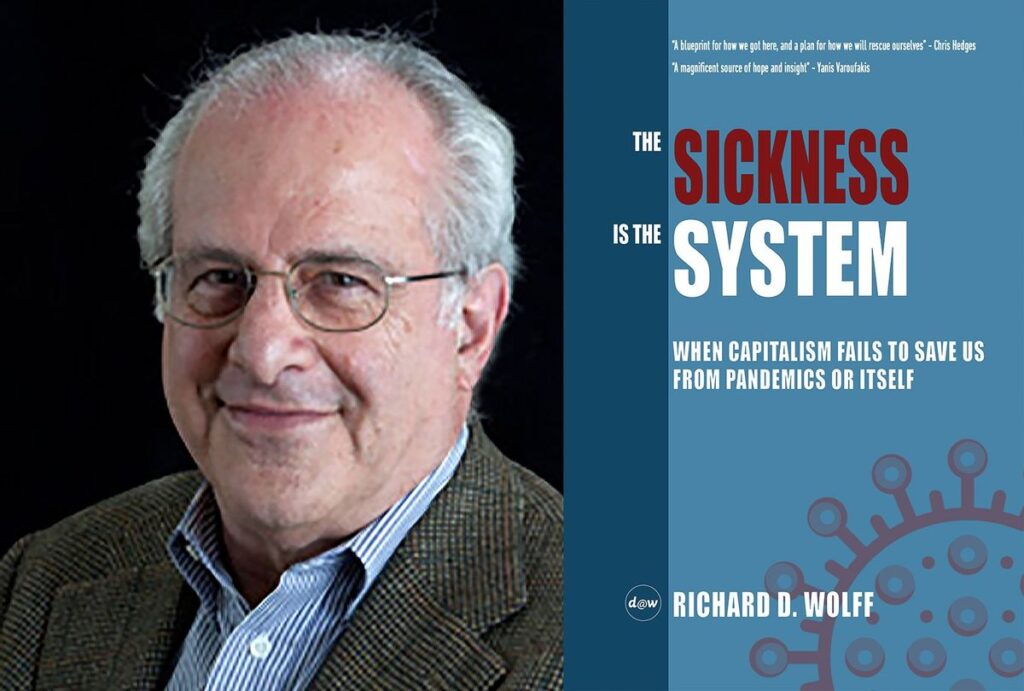
Richard Wolff, whom I admire, calls himself a “Marxist economist.” I find this puzzling and odd. Why?
Because calling oneself a Marxist, suggests that one is a disciple, just as calling oneself a Christian suggests that one is a follower of Christ. It also suggests that one has devoted a considerable time to the study of Marx or Christ. But having devoted a considerable time of study about a person and their teachings, does not imply that one agrees with these teachings. One could very well be a staunch critic. Let us distinguish the latter by calling such a person a Marx or Christ scholar, as contrasted with someone who believes that everthing that Marx wrote or everything that Christ preached is true and worthy of emulation. So, what is a “Marxist”? A Marx-scholar or a disciple?

Now, why is it that if one agrees with the findings of scientists such as Galileo, Kepler, or Newton, one does not call oneself either a Galilean, a Keplerian, or Newtonian, even though one agrees with some of their findings, and can even claim to be a scholar of these men?

Perhaps it has to do with the nature of their writing. Scientists want to find the truth about the universe, while religious figures, such as Christ, Abraham, Muhammad, Zoroasted, prescribe a way of life.

So the question becomes: was Marx a scientist, a prescriber, or both? And calling oneself a Marxist makes some sense if Marx offered prescriptions.

I am not a Marx scholar; so my knowledge of what Marx wrote is limited. But I have read some of what Marx wrote as well as some of what Marx scholars have written. And my understanding is that Marx — on the basis of his analysis of the nature of capitalistic production — predicted that capitalism will self-destruct. And his prediction was based on an idealized version of capitalist production. But given that he did not include the various deviation from his model of capitalism, his prediction in the short-run did not occur, but it is still too early to say that even a modified version of capitalism will not self-destruct.

Richard Wolff, who calls himself a Marxist economist, is perpetually looking not only at the short-comings of capitalism, but also at its cruel repercussions on the environment and humanity. I too see the evil and injustice of capitalism, but I am also more cynical than either Wolff or Marx. I do not anticipate the self-destruction of capitalism, but the destruction of humanity as such.

Although I am not a Marxist either as a disciple or scholar, I find the truth about capitalism spelt out superbly in the last part of Capital I: Part III: The so-called Primitive Accumulation (pp.713-74).

In my own words: It is through conquest that the State arose giving rise to a class division between the rulers and the ruled. This took several forms. The rulers took tribute and taxation; the ruled became slaves, serfs, or free-laborers. And underlying all these relations was the fact that the rulers controlled access to land. [For some reason Richard Wolff focuses on the employer-employee relation, but refrains from examining how such a relation arose in the first place or how it is possible.]

Why I am for entrepreneurs, but not for capitalism

Does this sound like a contradiction? This is due to a linguistic ambiguity. On the one hand, there is a usage in which the owner of a business, i.e., the employer, is referred to as a “capitalist.” But, on the other hand, capitalism is considered as an economic market system. Let us distinguish between a business owner and someone who ideologically supports the capitalist system. Thus, let us refer to the owner of a business as “capitalist1” and the supporter of a capitalist system as “capitalist2.” Once this distinction is made, it is clear that a capitalist1 may not be a capitalist2, i.e., a business owner may not support the capitalist system.


But to properly understand this distinction, it is necessary to understand the nature of capitalism. And the easiest and clearest way is to note the difference as to how “primitive” or “stateless” people live and the rest of the modern world. And the difference is that primitive and stateless people have a free access to subsistence land, and the rest of us do not.

The consequence of this deprivation of access to free subsistence land is that we have to enter into a market economy. This is the essence of capitalism, and its proper name should be, as George Bernard Shaw advocated, “proletarianism.” It is a system which creates a class of people dispossessed of access to free subsistence land and forces them to be workers for others.

Given this predicament of having to enter the market, one can do so by becoming an entrepreneur, an owner of some business, rather than as an employee. A business owner may or may not like the capitalist system, but he, as everyone else, is forced into the market economy.

I think the complaint of employees is not against employers in general, but against employers who “exploit” them, meaning that they mistreat them. And what does this mean? It means that the employer can make their lives better, but deliberately does not because he can have a greater profit for himself.

Let us remember that the employer himself is caught up in the capitalist system and his business must be successful so that he can hire workers.

Some employers are very kind to their workers. One famous example of this is the textile factory at New Lenark in Scotland run by Robert Owen at about 1817. Let us call him a philantropist.

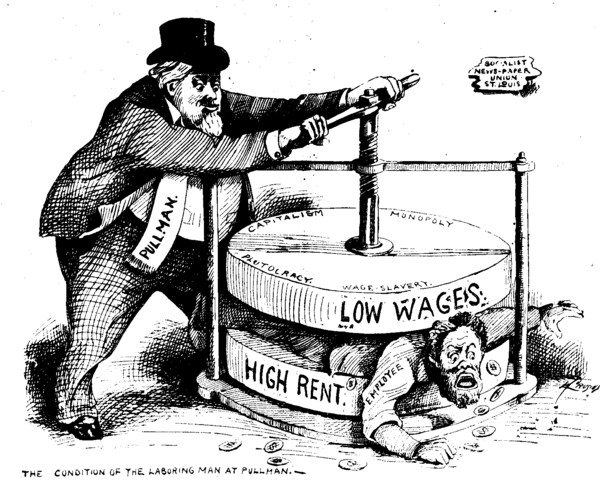
Some employers, on the other hand, are ruthless. A famous example of this is George Pullman. He owned a company town near Chicago for workers at his Pullman sleeping railroad car company. Unlike Owen who tried to provide welfare programs for the workers, Pullman tried to squeeze as much as he could out of the workers, which led to a strike in 1894 which had a national impact.

Two Foundations of Capitalism

Capitalism is best understood as a method to create a pool of people who must work to survive (proletarians). This method — carried out by the State in the form of laws — is twofold: (1) forbid free access to subsistence land, (2) introduce a property tax. [The British in Africa called it a “hut tax.”]

The consequence is that even after buying a property and getting rid of a mortgage on the property, no one can live on such a property for free because there is a rent to be paid to the government — a property tax.

I came across an interesting article explaining the origin of property taxes:

Alana Semuels, “The Feudal Origins of America’s Most-Hated Tax,” The Atlantic, August 24, 2016.

Her source of information seems to be:

Jonathan R. T. Hughes, The Governmental Habit Redux: Economic Control from Colonial Times to the Present, 1991.

Richard Wolff’s failed definition of capitalism

I have watched Richard Wolff many times in his insightful criticisms of capitalism. And I agree with these criticisms. However, I disagree with him about his solution to capitalism, which is the establishment of worker-controlled enterprises as contrasted with privately-owned enterprises. This is not a solution, mainly because this does not address the problem of the unemployed. And the reason for Wolff’s non-solution is that Wolff does not really know what capitalism is as is evident from his attempt to define it.

First, capitalism is not an economic system, as he says; it is a political one, just as are slavery and feudalism.

It is a political system which prohibits people from taking land for free for subsistence. This forces people to work for other people. And the forcing is not done by the kind of laws, as in slavery or feudalism, or by laws against vagrancy (homelessness), but simply by laws forbidding free access to subsistence land.

Watch the episode below. You will hear nothing about a free access to subsistence land.

In the debate below, Gene Epstein argues convincingly that worker-owned enterprises are compatible with capitalism.

Capitalism = def. a political system which by barring people from a free access to subsistence land creates a market economy and a monetary way of life

From a sociological perspective, I don’t think people are aware of this definition or are concerned with this definition. Why?

First, because the so called “intellectuals” do not offer such a definition.

Second, because most city people’s concern (including students’ concern) is to succeed in this (capitalist) system by either getting a good job, or by creating a good business.

Third, because if city people had access to land, they would not know what to do with it. People have become alienated from the use of land except in some aesthetic or romantic way of walking through it or viewing it. People do not know how to grow food or how to care for animals.

However, the correctness of this definition is known instinctively by peasants, who when they have rebelled or protested did so invariably under the slogan “land and liberty.”

The difference between Richard Wolff and me

Richard Wolff condemns the capitalist system, and so do I. But whereas he finds fault with the employer-employee relationship, in that the employer “exploits” the workers, and he recommends that all businesses be worker-owned and operated; I, on the other hand, do not find fault with this. It is a normal human desire to seek profits, or a better deal whenever possible. So, an entrepreneur takes advantage of the situation as best he can. And if he does not, his competitors will.

The root evil of capitalism — which is really a political system — is that politically it bars people from using land for free for subsistence. Not having such free access to subsistence land, drives people to becoming either employers or employees, depending on their capabilities and good fortune.

I am surprised that Wolff, who claims to be a Marxist economist, does not find this truth in the writings of Marx. It is there in Chapter 26: “The Secret of Primitive Accumulation” of Capital.