On Sunday, Aug. 30, 2020, 4-7 pm, eastern time, there was televised on the internet, a convention to create a new political party. The live stream does not seem to be available from the producers. But there is the following version:
To get oriented about what is going on, watch the interview below.
Nick Brana, founder, executive director of Movement for a People’s Party talks with journalist Chris Hedges about the US’ two political party system, the need for third and fourth parties and his experience campaigning for Bernie Sanders in the 2016 presidential election.
My initial reaction
It is abundantly clear that both the Democratic and the Republican Parties represent the interests of the rich. And this message was superbly expressed by Chris Hedges (see below):
I found most of the other speakers boring and the whole program too long. Anyway, if the goal is to push for a third party, why out of all the speakers only Chris Hedges urged people to vote for the Green Party, and everyone else spoke as if there is no existing third party?
I have watched Richard Wolff many times in his insightful criticisms of capitalism. And I agree with these criticisms. However, I disagree with him about his solution to capitalism, which is the establishment of worker-controlled enterprises as contrasted with privately-owned enterprises. This is not a solution, mainly because this does not address the problem of the unemployed. And the reason for Wolff’s non-solution is that Wolff does not really know what capitalism is as is evident from his attempt to define it.
First, capitalism is not an economic system, as he says; it is a political one, just as are slavery and feudalism.
It is a political system which prohibits people from taking land for free for subsistence. This forces people to work for other people. And the forcing is not done by the kind of laws, as in slavery or feudalism, or by laws against vagrancy (homelessness), but simply by laws forbidding free access to subsistence land.
Watch the episode below. You will hear nothing about a free access to subsistence land.
In the debate below, Gene Epstein argues convincingly that worker-owned enterprises are compatible with capitalism.
I have watched Bill Maher, the comedian and political commentator, for a very long time. What has been appealing is the fact that he — like George Carlin — has couched his political [and, incidentally, religious] commentary in a comedic way by sarcasm, ridicule, pun, images — by whatever works.
He has also brought together all types of celebrities for interviews and discussion panels. All this is admirable and captured my interest.
What has displeased me is his insistence on rooting for the lesser of the two evils — I mean his preference of Democrats over Republicans (among other preferences). Consequently, he becomes annoyed when the evils of Democrats are pointed out — always saying that the evils of Republicans are much worse.
Few of his guests take the position that both Democrats and Republicans are evil — perhaps even to an indistinguishable difference. Two stand out: George Carlin and Cornel West.
Below is a clip of Bill Maher defending what he thinks is the lesser of two evils.
Below is Jimmy Dore commenting on how Trump is almost even with Biden in the polls. How does one really distinguish the lesser of two evils?
From a sociological perspective, I don’t think people are aware of this definition or are concerned with this definition. Why?
First, because the so called “intellectuals” do not offer such a definition.
Second, because most city people’s concern (including students’ concern) is to succeed in this (capitalist) system by either getting a good job, or by creating a good business.
Third, because if city people had access to land, they would not know what to do with it. People have become alienated from the use of land except in some aesthetic or romantic way of walking through it or viewing it. People do not know how to grow food or how to care for animals.
However, the correctness of this definition is known instinctively by peasants, who when they have rebelled or protested did so invariably under the slogan “land and liberty.”
Everywhere I look — the news, commentaries, social media — there is a concern with what is happening: protest over a war here, a war there; protests over an oil pipe line or an oil spill, for or against immigration, for or against abortions; lack of response to the Covid-19 epidemic, the widespread police brutality, climate change, Trump doing this and not doing that, deVos bunglings with education, etc., etc. But what is totally neglected is a critique of the institutions which foster all of these: the institution which fosters the enactment of bad laws, namely Congress; the institution of a Supreme Court which rules and interprets these laws in capricious ways; the office of a President with his Constitutional and extra-Constitutional powers. And if you tell me about checks and balances, just remember that the House of Representatives impeached Donald Trump, while the Senate — exonerated him! So much for checks and balances! In short, if you are dissatisfied with the laws and policies which are operative, look at the institutional structure which fosters all of this: the US Constitution. I know, I know . . . we pledge allegiance . . . but it is not an allegiance to the Constitution … though, unfortunately, the Constitution — if thought about at all — is probably widely revered like the Christian Bible with an implicit taboo on criticism.
If there is a critique of the United States, it is not of the political institutions, but of an allegedly economic institution of capitalism. My quick response to this is that it is a mistake to look at capitalism as an economic phenomenon; it is a political phenomenon, created by barring people from free access to subsistence land.
You may respond by saying: “If that is true, then Congress could revive some form of the Homestead Act of 1862.”
My answer to this is: it won’t happen, as it did not happen after the Civil War in 1865 when General Sherman proposed to give to former slaves 40 acres and a mule. And the reason it won’t happen is that it is not in the interest of entrepreneurs and corporations which need employees to carry on their profitable projects. And Congress is full of friends of entrepreneurs and corporations.
And it won’t happen through elections because most voters are oblivious of the connection between capitalism and free access to subsistence land, and are more concerned with their immediate security — to the extent that they have it. Besides, voters are more prone to vote for a charismatic politician than for any specific policies promised. As to awareness of political institutions, these exist — if at all — in the recesses of voters’ minds.
And the status quo (i.e., more of the same) will prevail, unless the institutions are changed.
And what country has a better Constitution? Switzerland!
I found the video below very insightful in addressing various political concerns accurately, and exposing lies. But I was puzzled by what Cooke was recommending. I agree with him about the desirability of some of the recommendations of “some” of the Democrats. But these recommendations are not shared by the majority of Democratic politicians, because in reality both the Democratic and the Republican Parties serve the interests of the rich, i.e., the 1%. So I am left puzzled by his unstated conclusion: Vote for the lesser of the two evils?
At the outset of the book, Gray expresses skepticism about a neat
definition of “socialism.” He is, of course, correct in his skepticism. Most words suffer from ambiguity and vagueness; much more so abstract
words which end in “-ism.”
He is probably right to begin with a survey of individuals who were
called socialists, and reserve any attempt at classification and definition to the end of the book — as he does.
Although explicitly he classifies socialists into four categories, he actually uses five. The fifth category is whether the socialist was a Revolutionary Socialist or an Evolutionary (or Reformist, or Revisionary) Socialist. In this broad sense, socialism is simply a dissatisfaction with the existing state of affairs. That is a necessary condition; it is not sufficient. It has to do with the nature of this dissatisfaction.
Well what can you do with the State? Incidentally, asking this question
without saying anything about the nature of a particular State, is totally
unproductive. When people talk about a “State” they are really talking
about a particularly constituted government. It is entirely misleading to
equate the State with government. The genus here is “government” and
“State” is a species. Government exists when rules exist. And without
rules, we have a Hobbesian brute state of nature.
As to the dissatisfaction with the status quo, from a historical perspective society is divided between masters and slaves, lords and serfs, and presently employers and employees. This is the perspective of Karl Marx, and constitutes what Marx called a “class struggle.” Well,
certainly such a classifications can be made. But, as Gray asks, do these
classes actually struggle? Well, there were various rebellions — but were they between classes? They were local and limited. And currently, when there are strikes, it is for improving wages of a narrow sector of this working class; and not for the improvement of workers in general, and
certainly not to get rid of wages as such.
Gray is right to point out that there is no “solidarity” among workers in
even one factory, or one country; no less than a solidarity between
workers of different countries. And the solidarity which does exist is
usually not greater than the strike of one trade union. We cannot ignore
the fact that many workers are, indeed, satisfied with their wages, and do
not want any radical changes.
And those that are unemployed or underemployed seem to place their
hope in an opportunity to vote. This was the case with women and now
this is the case with blacks. They think they can elect a candidate who
will represent their interests, but the more likely scenario is that they will elect a candidate who will seek his own interests. Even if a true
representative is elected, he or she will be in a minority.
But I stray from Gray.
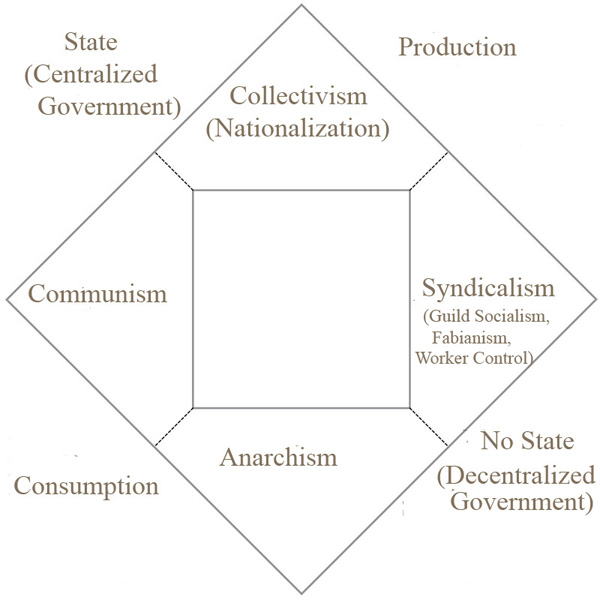
In the concluding chapter 18 of his book, Gray classifies socialists into
four types. I have tried to place his classification into a chart below. In order for the category of Anarchism to fit as I have placed it, people
must be granted a free access to subsistence land. Although Gray
discusses the Agrarians in chapter 11, who advocated a free access to
subsistence land, he seems to forget them when discussing anarchism in
general. Well, I put them on the chart where they seem to belong.