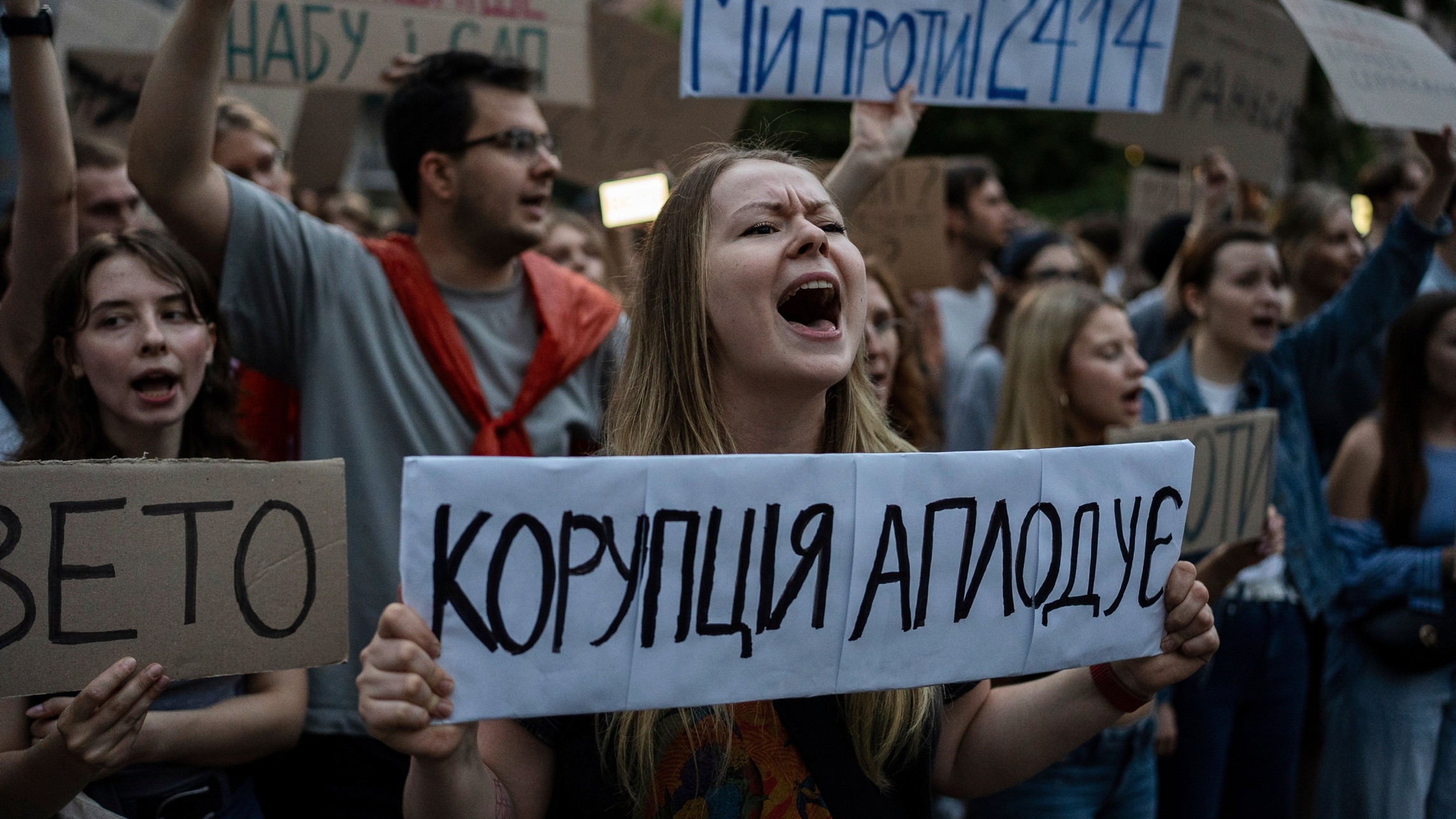
Ukrainian and US corruption

in what sense in Ukrainian politics corrupt in comparison with US corruption

ChatGPT said:

Ukrainian and U.S. political corruption differ significantly in scale, visibility, structure, and systemic entrenchment. Here’s a breakdown of the main differences and similarities:


Ukrainian Corruption: More Systemic and Brazen

  1. State Capture and Oligarchy
    • Ukraine has long been dominated by oligarchs who control major industries, media, and influence key government appointments.
    • These elites often directly shape legislation, law enforcement, and courts to protect their business interests.
  2. Everyday Corruption
    • Until recently, bribery was common at nearly all levels, from police officers to university admissions and hospitals.
    • Citizens often had to “pay to get services” that should be free or impartial.
  3. Weak Institutions
    • Law enforcement and judiciary often serve political or financial masters rather than the public.
    • Anti-corruption efforts have improved post-2014 (after the Maidan revolution), but progress is slow and contested.
  4. Transparency vs. Accountability
    • Ukraine has introduced transparent systems (e.g., public official asset declarations), but enforcement is weak, and impunity remains high.

U.S. Corruption: Legalized and Institutionalized

  1. Regulatory and Lobbyist Capture
    • In the U.S., corruption is often legalized through lobbying and campaign contributions.
    • Corporations and interest groups influence legislation via financial support and lobbying, a practice that would be considered outright corruption in many countries.
  2. Revolving Door
    • Former politicians or regulators often move into private sector jobs in industries they once regulated, leading to conflicts of interest.
  3. Dark Money & Super PACs
    • Massive sums are spent on elections by anonymous donors, often with minimal transparency or public scrutiny.
  4. Selective Enforcement
    • White-collar crime is often under-prosecuted, and political elites are rarely held to account unless public pressure is overwhelming.

Key Differences

AspectUkraineU.S.
FormOften illegal, informalOften legal, institutionalized
ScopePervasive across sectorsConcentrated in lobbying and finance
ActorsOligarchs, public officialsCorporations, lobbyists, wealthy donors
Judicial IndependenceWeakStronger, but can be politicized
Citizen ImpactEveryday life often directly affectedMore indirect, via policy outcomes

Conclusion

  • Ukrainian corruption is more overt, systemic, and personal, often involving bribes, cronyism, and state capture.
  • U.S. corruption tends to be more institutionalized, opaque, and legal, embedded in campaign finance, lobbying, and regulatory influence.

Both systems face serious challenges, but the manifestation and acceptability of corruption differ greatly due to cultural, legal, and historical contexts.

Prospects for the war in Ukraine

John Mearshhimer is still predicting the downfall of Ukraine with a smirk. on the other hand, others are looking at Russia’s failing economy, and are not so pessimistic. what do you think?

ChatGPT said:

You’re pointing out a central tension in current geopolitical analysis: John Mearsheimer’s enduring pessimism about Ukraine’s fate, contrasted with more optimistic views that focus on Russia’s mounting internal problems—especially its economy. Here’s a balanced breakdown of both perspectives, followed by an assessment:


Mearsheimer’s Position (Realist School of Thought)

John Mearsheimer, a prominent realist scholar, has consistently argued:

  • Ukraine cannot win in a protracted war with Russia, primarily due to geography, military imbalance, and lack of long-term Western commitment.
  • The West, especially the U.S., overestimated its ability to arm and support Ukraine indefinitely without provoking greater escalation.
  • Russia has vital national interests at stake in Ukraine; the war is existential for them in a way it is not for NATO.

He’s often blunt and controversial, and yes—he sometimes delivers his points with what appears to be a smirk, which can seem callous. But his arguments are grounded in structural realism: power matters more than morality.


Counterarguments: Russia’s Struggles and Ukrainian Resilience

Many experts and observers take a more optimistic view of Ukraine’s chances:

  • Russia’s economy is increasingly isolated, heavily sanctioned, and reliant on a shrinking circle of partners (China, Iran, North Korea).
  • Military attrition: Russia is burning through equipment and troops, and even with mobilization, its long-term capacity is weakening.
  • Ukrainian resilience and innovation, including asymmetric tactics, Western-supplied weapons, and widespread civil motivation, have helped it endure far longer than most expected.
  • Russia’s domestic situation is fragile: demographic decline, brain drain, political repression, and discontent with a prolonged war could erode Putin’s position.

My Analysis

Mearsheimer is not wrong to warn of limits to Western support or to remind us of the cold logic of great-power politics. But his view may be overly deterministic and dismissive of agency, especially Ukraine’s.

On the other hand, the idea that Russia is inevitably collapsing is premature. The economy is hurting but hasn’t broken, and authoritarian regimes can endure immense strain, especially with oil and gas lifelines.

What’s likely?

  • A long, grinding war of attrition with neither side achieving a decisive breakthrough soon.
  • Ukraine’s fate will depend on sustained Western support, not just in arms but in economic and political terms.
  • Russia may not “collapse,” but its long-term trajectory is negative—economically and diplomatically.
  • Mearsheimer may yet be wrong if the West stays united and if internal pressure on Putin builds. But if the U.S. retreats or NATO fractures, his grim prediction could become reality.

If you’re watching this unfold, both pessimism and optimism are warranted, depending on what lens you’re using: strategic realism vs. democratic resilience. The war is not predetermined; it hinges on will, resources, and politics—on both sides.

Aim of Liberal Education

https://www.ditext.com/chrucky/aim.html evaluate

ChatGPT said:

Here’s my evaluation of the essay “The Aim of Liberal Education” by Andrew Chrucky (posted on DiText on September 1, 2003) consc.net+9ditext.com+9Philosophy Home Page+9:


Overview

Chrucky critiques three University of Chicago faculty—John Mearsheimer (1997), Robert Pippin (2000), and Andrew Abbott (2002)—arguing that each misrepresents liberal education by emphasizing market outcomes and divorcing cognition from moral or emotional dimensions. He argues instead that liberal education should cultivate cognitive, moral, and emotional capacities for rational dialogue aimed at reaching agreements in public life (not mere technical skill or sophistry) ditext.com.


Strengths

  • Clear and provocative argument: Chrucky consistently challenges the notion that liberal education is amoral or aligned solely with market success, contrasting his view with those of Mearsheimer, Pippin, and Abbott ditext.com.
  • Philosophical depth and structure: The essay unfolds through a persuasive thought experiment (Robinson Crusoe and Friday), linking survival, dialogue, morality, and political engagement.
  • Normative grounding: Grounded in Socratic ideals, Chrucky promotes rational and moral education as central to liberal learning—not just vocational preparation Philosophy Home Page+8ditext.com+8PhilPapers+8.
  • Public-spirited focus: A strong orientation toward public rationality and democratic deliberation sets this apart from narrower academic arguments.

Limitations

  • Limited engagement with counterarguments: While Chrucky identifies weaknesses in his targets’ views, he does not engage much with deeper counterpositions or alternative liberal education theories.
  • At times rhetorical tone: The essay sometimes reads more like a polemic than an analytical critique, especially in its harsh characterization of his predecessors as sophists or amoral.
  • Lack of empirical grounding: The arguments are philosophical, but empirical evidence about outcomes or pedagogical impact is absent.

Key insights

  1. Liberal education, he argues, must integrate cognitive skills with moral and emotional formation—it is not enough to build intellectual competence alone.
  2. Dialogue and agreement are central: Its aim is to prepare individuals to engage in rational discussion aimed at agreement, not adversarial victory.
  3. Critique of the “market model”: Chrucky highlights the danger of defining education primarily in economic or instrumental terms.

Final evaluation

Chrucky articulates a compelling, philosophically charged vision of liberal education that revives classical ideals of moral and civic formation. His critique of the Chicago professors is sharp and thought-provoking, and the essay offers a lucid, ethically grounded alternative. However, the analysis might benefit from engaging more with opposing views or empirical findings to broaden its appeal beyond philosophical circles.


Further reading

Chrucky is known for his scholarly engagement on Sellars and broader philosophical issues. For more on his analytical and critical style, you might explore his works on Sellars’ manifest vs. scientific image distinction ditext.comPhilPapers+1PhilPapers+1.


Would you like a closer look at how Chrucky’s view compares with current liberal education debates or deeper analysis of any specific section?

Sources

You said:

yes

ChatGPT said:

Great! Let’s take a closer look by breaking this down in two ways:

  1. Compare Chrucky’s view to contemporary liberal education debates
  2. Analyze key sections of his essay in depth

1. Comparison to Contemporary Liberal Education Debates

Chrucky’s Core Thesis

Chrucky believes the aim of liberal education is to develop:

  • Cognitive abilities (critical thinking, logic, conceptual clarity)
  • Moral capacities (ethical reasoning)
  • Emotional maturity (e.g., empathy, patience in dialogue)

He sees this as crucial for enabling rational public discourse and democratic participation. He critiques modern academics (esp. Mearsheimer, Pippin, Abbott) for sidelining or distorting this aim in favor of:

  • Market utility
  • Sophistic skills (persuasion without truth)
  • Value neutrality

Current Liberal Education Discourse (2020s–2025)

ThemeChrucky’s PositionContemporary Trends
Purpose of EducationFormation of rational, moral citizensOften split: career prep vs. civic/humanistic development
Moral contentMust be explicit and integratedContested: many curricula aim for neutrality or postmodern relativism
Emotional educationCrucial for productive discourseEmerging interest (e.g. emotional intelligence, trauma-informed teaching)
Vocational focusRejects as inadequate or distortingDominant in policy and public expectations
Political orientationDeeply civic and dialogicalVaries: some liberal arts colleges echo this, but often under pressure

Contemporary thinkers similar to Chrucky:

  • Martha Nussbaum (“Not for Profit”) – Education should foster global citizenship, empathy, and critical thinking
  • Michael Sandel – Education must deal with moral questions
  • Danielle Allen – Civic education as essential to democracy

Opposed views:

  • Bryan Caplan (“The Case Against Education”) – Argues most education is signaling, not skill-building
  • Many ed-tech & policy advocates – Push for job-readiness, STEM prioritization

2. Analysis of Key Sections from Chrucky’s Essay

The Robinson Crusoe Thought Experiment

He imagines Crusoe alone, then with Friday, to show:

“To survive, Crusoe had to learn about nature. To live with Friday, he had to learn how to speak, and how to agree.”

Interpretation:
Chrucky introduces the idea that cognition (science) helps us survive, but language and ethics (dialogue) make society possible. This sets up his argument that education must move beyond just empirical or market-focused knowledge.

Critique of Mearsheimer and Pippin

Chrucky accuses both of reducing liberal education to non-moral, neutral training in reason or persuasion, akin to the ancient sophists.

“This is a sophisticated form of what Plato called sophistry: teaching how to win arguments, not how to reach truth.”

Interpretation:
He is making a normative philosophical claim: rationality without moral grounding is dangerous, because it enables manipulation rather than consensus-building.

The Need for a ‘World Hypothesis’

He suggests educators must share an underlying worldview that:

  • Affirms the knowability of truth
  • Respects dialogue as method
  • Commits to public reason over authority or tradition

“If we do not have a common world hypothesis, then we do not have the foundation for agreement.”

This is echoing Perennialist or Rationalist Humanist ideas—education isn’t just about content, but about forming a shared rational and moral framework.


Final Thoughts

Chrucky’s essay is deeply philosophical and idealistic, yet it addresses real tensions in higher education today:

  • Are universities morally neutral or morally formative?
  • Should liberal education prepare for work, or for civic life?
  • Is teaching persuasion enough—or must we teach why and how to seek truth?

Would you like me to:

  • Map this argument onto a debate at your school or institution?
  • Help outline a rebuttal or support essay?
  • Visualize his argument structure as a diagram or concept map?
You said:

map

ChatGPT said:

Great—let’s map Andrew Chrucky’s argument visually and conceptually to help you understand or present it clearly. I’ll create a structured concept map and show how each piece connects.


Conceptual Map of Chrucky’s Argument in “The Aim of Liberal Education”

csharpCopyEdit                         ┌───────────────────────────────┐
                         │   The Aim of Liberal Education │
                         └────────────┬──────────────────┘
                                      │
       ┌──────────────────────────────┴──────────────────────────────┐
       │                                                             │
       ▼                                                             ▼
┌──────────────┐                                            ┌──────────────────┐
│  Misconceptions│◄────── Targets: Mearsheimer, Pippin, Abbott ─┤
└────┬──────────┘                                            └────────┬─────────┘
     │                                                                   │
     ▼                                                                   ▼
"Reason = Value-neutral skill"                              "Education = Career prep"
     ▼                                                                   ▼
 Leads to: Technocratic sophistry,                                 Market utility replaces
 persuasion w/o truth, no civic trust                            intellectual/moral goals

       │
       ▼
┌────────────────────────────────────────────────────────┐
│        Chrucky’s Rebuttal: Education Must Be…          │
└────────────────────────────────────────────────────────┘
               │          │             │
               ▼          ▼             ▼
       Cognitive       Moral        Emotional
      (Critical       (Ethical       (Empathic
      thinking,       grounding,     listening,
      logic)          fairness)      dialogue)

               ▼
  Enables Rational Dialogue (goal: agreement & truth)
               ▼
  Supports Democratic Society / Civic Responsibility

       ┌──────────────────────────────────────────────┐
       │  Illustration: Crusoe + Friday Thought Experiment │
       └──────────────────────────────────────────────┘
               │
       Survival = Scientific/technical knowledge
       Society = Dialogue + Ethics
               ▼
     Education must include both dimensions

       ┌─────────────────────────────────────┐
       │  Philosophical Worldview Required   │
       └─────────────────────────────────────┘
               │
   - Reality is knowable
   - Truth can be reasoned about
   - Dialogue is a method of agreement
               ▼
   Without this, education is fragmented or manipulative


Summary of the Map

  • Chrucky identifies false views of liberal education (neutral rationality or job-training).
  • He advocates for a holistic view: intellectual + moral + emotional development.
  • These enable rational discourse, which is essential for democratic life.
  • He argues this requires a shared philosophical foundation (belief in truth, dialogue, etc.).
  • The Crusoe/Friday story illustrates the difference between surviving alone and living in society.

W

Hilary Putnam and his critics

cite and evaluate the crtiticism of hilary putnam by john searle

ChatGPT said:

John Searle criticized aspects of Hilary Putnam’s philosophy of mind and language, particularly Putnam’s functionalism and later his turn to internal realism and anti-metaphysical views. Below is a detailed citation and evaluation of Searle’s criticism.


1. Criticism of Functionalism

Putnam is well-known for introducing functionalism in the philosophy of mind, which holds that mental states are defined by their functional roles—what they do—rather than by what they are made of.

Citation:

Searle’s main critique appears in:

Searle, John. The Rediscovery of the Mind. MIT Press, 1992.

Searle attacks functionalism throughout this book, with specific references to Putnam’s version.

Searle’s Argument:

  • Functionalism treats the mind as a computer program, focusing only on syntax (formal structure), ignoring semantics (meaning).
  • He argues that this misses consciousness and subjective experience, i.e., qualia.
  • The Chinese Room Argument (Searle, 1980) is a central part of this critique: A machine could pass a Turing test (appear intelligent) by manipulating symbols without actually understanding—thus, computation is not sufficient for mind.

Evaluation:

Searle’s critique is powerful in highlighting the limitations of purely functional accounts of consciousness, particularly for addressing first-person experience. However, some argue that he underplays the potential of system-level interpretations—i.e., that understanding might emerge at the level of the system, not the individual manipulator (a response to his Chinese Room Argument).


2. Criticism of Internal Realism and Anti-Metaphysics

Later in his career, Putnam embraced internal realism, arguing that truth and reality are dependent on conceptual schemes.

Citation:

Putnam articulates internal realism in:

Putnam, Hilary. Reason, Truth and History. Cambridge University Press, 1981.

Searle criticizes this view in several essays, but especially in:

Searle, John. “Hilary Putnam’s ‘Realism with a Human Face’.” The Journal of Philosophy, vol. 91, no. 9, 1994.

Searle’s Argument:

  • Searle sees internal realism as a form of conceptual relativism that threatens the objectivity of truth.
  • He defends direct realism: we can talk meaningfully about a mind-independent reality, even if our concepts mediate our knowledge of it.
  • He argues that Putnam conflates epistemology with ontology, mistaking the conceptual nature of our knowledge for conceptual dependence of reality itself.

Evaluation:

Searle’s critique is robust in defending realism about truth and objectivity. However, some sympathize with Putnam’s project as a middle ground between metaphysical realism and relativism, seeing it as an attempt to explain how we can have objective knowledge while acknowledging the role of human cognition.


Summary of Searle’s Criticisms of Putnam

AreaPutnam’s ViewSearle’s CriticismEvaluation
FunctionalismMind as computational/functional systemIgnores consciousness, only deals with syntaxStrong critique; shows limits of computational theory
Internal RealismTruth depends on conceptual schemesUndermines objective reality and truthMixed; raises valid realism concerns, but oversimplifies Putnam’s nuance

If you want, I can provide direct quotes from these sources or expand on how these debates influenced later philosophy of mind.

You said:

what other criticisms are there

ChatGPT said:

Here are several notable criticisms of Hilary Putnam’s philosophy, particularly regarding his internal realism, semantic externalism, functionalism, and more. These come from a range of philosophers, both contemporaries and critics, and are grounded in peer-reviewed literature and academic commentary:


1. Internal Realism and Conceptual Relativism

  • Critics argued Putnam’s internal realism slips into relativism or even solipsism. His claim that truth is relative to conceptual schemes risks undermining the objectivity of truth and leading to skepticism. Reddit+15rep.routledge.com+15eidir.org+15
  • Ernest Sosa, for example, contended that internal realism smuggles in relativism under the guise of rational acceptability, making true beliefs perspective-dependent. inters.org+1OpenEdition Journals+1
  • Curtis Brown went further, accusing Putnam’s internal realism of resembling subjective idealism: if existence depends on experience, the external world might disappear with the subject. Profilbaru

2. Model‑Theoretic Argument and Solipsism

  • Putnam’s famous model-theoretic argument (based on the Löwenheim–Skolem theorem) was meant to challenge metaphysical realism. However, critics say it inadvertently collapses into solipsism because it treats truth as purely brain-state–dependent unless framed counterfactually. Wikipedia+15Docslib+15rep.routledge.com+15
  • Putnam later admitted that his counterfactual formulation failed to avoid this problem, undermining the public intelligibility of internal realism. ResearchGate+4SpringerLink+4eidir.org+4

3. Semantic Holism and Language Learning

  • Putnam’s insistence on semantic holism—that the meaning of a term depends on its relations to the entire language—faces the objection that language learning and communication would be impossible under such a view. Learning a single word would require grasping the whole system. griceclub.blogspot.com
  • Scholars like Michael Dummett, Jerry Fodor, and Ernest Lepore have argued that holism undermines shared meaning and creates radical instability in what a term means over time or across speakers. Reddit+3griceclub.blogspot.com+3Wikipedia+3

4. Functionalism and the Turn Against His Early Views

  • Though Putnam introduced functionalism (e.g. via multiple realizability), he later rejected it. Critics such as Jerry Fodor, Ned Block, and others criticized his early embrace, pointing out that functionalism struggles to account for phenomenal consciousness and fails to explain multiple realizability in a non-trivial way. Wikipedia+3Wikipedia+3griceclub.blogspot.com+3
  • The Twin Earth thought experiment demonstrates limitations of internalist semantics and functionalist assumptions, which contributed to Putnam abandoning the view. griceclub.blogspot.com+2Wikipedia+2Wikipedia+2

5. Critiques from Philosophy of Science and Realism

  • Critics like Michael Devitt and Paul Boghossian have argued Putnam’s attempt to chart a middle path between metaphysical realism and relativism yields a category mistake or an incoherent position. inters.org+3OpenEdition Journals+3Encyclopedia Britannica+3
  • The retreat from internal realism to a new metaphysically realist stance (e.g., scientific realism grounded in the “no‑miracles argument”) has also been subject to scrutiny: critics ask whether Putnam’s later views really differ meaningfully from traditional realism or are just rhetorical repositionings. SpringerLink+1inters.org+1

Summary Table

Criticism AreaSummary Critique
Internal RealismLeads toward relativism or solipsism; truth loses objectivity.
Model-Theoretic TurnCollapses into solipsism rather than undermining realism.
Semantic HolismMakes language learning and shared meaning unstable.
FunctionalismInitially defended but later rejected; fails to address consciousness and multiple realizability properly.
Middle‑Path RealismSeen as incoherent or trivial; possibly indistinguishable from standard metaphysical realism.

Reddit Insight

While not peer-reviewed, one comment helps illustrate semantic externalism:

“Hilary Putnam famously argued that linguistic meaning content is external (to at least some degree).”ProfilbaruRedditgriceclub.blogspot.cominters.orgWikipedia+1OpenEdition Journals+1rep.routledge.com+5Reddit+5Wikipedia+5


If you’d like direct quotations, more detail on specific critics (e.g., Dummett on holism, Sosa on verificationism), or how these critiques evolved over Putnam’s career, I’d be happy to dig deeper.

Sources

You said:

yes

ChatGPT said:

Here are some well‑cited criticisms from philosophers of various aspects of Hilary Putnam’s philosophy, focusing on his internal realism, semantic holism, functionalism, and model‑theoretic argument:


1. Model‑Theoretic Argument and Challenges to Metaphysical Realism

Putnam’s model‑theoretic argument—built on Gödel’s completeness theorem and the permutation argument—claims that any “intended” model of a theory cannot be uniquely picked out, leading either to massive indeterminacy of reference or ungrounded appeals to which interpretation is “intended.” Critics argue this undermines realism, since realists can’t rule out alternative models that make the same theory true Wikipedia+15Stanford Encyclopedia of Philosophy+15We Chronicle+15.
Responses include David Lewis’s semantic magnetism (arguing some referents are metaphysically privileged) and Graham Bays’s work (“On Putnam and His Models”), which attempt to resist indeterminacy by invoking naturalness or other constraints Reddit.


2. Semantic Holism

Putnam was a staunch semantic holist: the meaning of a term depends on its relations to the entire language. Critics including Michael Dummett, Jerry Fodor, and Ernest Lepore have attacked this view for several reasons:

  • It makes language learning impossible, since mastering even one word would require mastery of an entire language.
  • It undermines shared meaning and communication: different individuals, with partially different vocabularies, might mean different things by the same sentence.
  • Meanings become unstable: a person’s meaning for a sentence changes if their vocabulary changes BME HLT+3griceclub.blogspot.com+3Wikipedia+3Wikipedia.

Jerry Fodor, in particular, emphasized that extreme holism is incompatible with explaining content in atomistic, causal, and naturalistic terms Reddit+15Wikipedia+15griceclub.blogspot.com+15.


3. Functionalism and the Chinese Room Argument

Although Putnam originally championed functionalism (especially multiple realizability), critics point to:

  • John Searle’s Chinese Room: Searle argues that syntax (functional computation) alone can never yield semantics or genuine understanding — meaning functionalism misses consciousness and intentionality BME HLT+15LiquiSearch+15Reddit+15.
  • Ned Block and others similarly argued that functionalism fails to account for phenomenal consciousness and that Putnam later abandoned the view he helped pioneer Reddit.

4. Internal Realism and Relativism / Solipsism

Putnam’s internal realism holds that truth and reality depend on conceptual schemes, rejecting global metaphysical realism. Critics include:

  • Curtis Brown: Internal realism collapses into subjective idealism or solipsism, since existence appears tied to conceptual or experiential frameworks—if the experiencer vanishes, so does reality BME HLT+15Wikipedia+15eidir.org+15.
  • Ernest Sosa (and others): It smuggles in relativism under the guise of rational acceptability.
  • Critics also point out that Putnam’s counterfactual/maximal verificationist reformulation didn’t fully escape relativism or solipsistic implications Project MUSEOpenEdition Journals.

Putnam later publicly renounced internal realism, embracing a form of common-sense or natural realism, influenced by William James and pragmatism, rejecting verificationism and conceptual relativism over reality itself Wikipedia+1eidir.org+1.


5. Theory of Meaning vs Internal Realism

Chong‑Hwan Oh (1990) argued that Putnam’s theory of meaning (e.g. Twin Earth semantics and rigidity) actually conflicts with his internal‑realist framework, making internal realism internally inconsistent unless one relinquishes the realist notion of meaning and truth PhilPapers.
Paul Abela (1996) also challenged Putnam’s attempt to link internal realism with Kant’s empirical realism, claiming the two systems fundamentally diverge regarding the ontological independence of empirical objects PhilPapers.


Summary Table

Criticism AreaCritique Summary
Model‑Theoretic ArgumentLeads to interpretative indeterminacy; hard to resist without external metaphysical assumptions
Semantic HolismUndermines language learning, stability of meaning, communication across speakers
FunctionalismCannot account for consciousness or understanding; criticized by Searle, Block
Internal RealismRisks relativism, idealism, and solipsism; Putnam later renounced it
Theory of Meaning vs IRTheories of meaning conflict with internal realism unless meaning is reconceived

From the Philosophical Community

On semantic externalism and natural kinds (e.g., “water” vs “XYZ”), some (via Reddit commentary) argue Putnam’s account fails to respect the necessary connection between hidden structure and observable properties. This draws on Thomas Kuhn’s critique: if superficial properties are only derivative of micro-structure, they may also have normative grip—but Putnam treats them as epiphenomenal, which they contend is implausible Reddit+2Stanford Encyclopedia of Philosophy+2Reddit+2LiquiSearch+2Reddit+2Reddit+2Reddit.


In summary, Putnam’s influential theories have drawn rigorous philosophical criticism on grounds of meaning, realism, semantics, and mind. Many see his internal realism as vulnerable to relativism or solipsism; semantic holism as epistemologically and communicatively unstable; functionalism as blind to consciousness; and his model‑theoretic argument as inducing indeterminacy. Putnam himself responded to many criticisms, ultimately reshaping his position in the light of them. Let me know if you’d like key quotations, a comparison to later authors, or relevant scholarly sources!

SourcesAttach

Search

End of Academic freedom in the US

analyza how anti-zionist speech is suppresed in us colleges, amounting to an end to academic freedom

ChatGPT said:

Here’s an analysis of how anti‑Zionist speech on U.S. college campuses is increasingly suppressed, and why many argue this amounts to a serious curtailment of academic freedom:


1. Administrative & Governmental Pressure

  • Columbia University: In July 2025, over 70 students were suspended or expelled for participating in pro‑Palestinian protests. The Trump administration had frozen hundreds of millions in federal grants, pushing Columbia to adopt policies equating criticism of Zionism with antisemitism, and to sever ties with the student group CUAD. Critics argue this chilling effect undermines campus dissent and inquiry ZNetwork+15Reuters+15Reddit+15.
  • Harvard University: The administration rescinded or restricted campus protests, revoked visas for international student activists, and canceled a planned special issue on Palestine in its educational journal. External pressure and fear of federal retaliation contributed to what contributors called a violation of academic independence and editorial autonomy The GuardianThe AtlanticThe Guardian.

2. Policy Changes & Codes of Conduct

  • Several universities—including NYU, Columbia, UCLA, Indiana, and the University of California system—have updated policies to classify criticism of Zionism or support for BDS as harassment or hate speech. In some cases, Zionists are treated as a protected group, effectively banning anti‑Zionist perspectives Reddit.
  • Policies now often prohibit encampments, outdoor signs, overnight protests, or require registration of participants—disproportionately impacting pro‑Palestinian activism Inside Higher Ed+11Wikipedia+11The Washington Post+11.

3. Faculty and Staff Retaliation

  • Tenured and untenured faculty: Many report self‑censoring to avoid repercussions when teaching or speaking about Israel-Palestine—especially assistant professors (98%) in Middle East Studies ameu.org+1US Academic Boycott+1. In one case, a tenured professor was reportedly fired over an Instagram post protesting Zionism WikipediaReddit.
  • High-profile incidents: Professor Terri Ginsberg faced contract non-renewal for criticizing Israeli policy; Steven Salaita had a tenured job offer rescinded following pro‑Palestinian tweets—and later won a legal settlement Reddit+8US Academic Boycott+8Wikipedia+8.
  • Several courses explicitly promoting anti‑Zionist resistance have been flagged as political indoctrination, potentially violating university policy on the limits of political partisanship in teaching jamesgmartin.center+9JCSA+9US Academic Boycott+9.

4. Broader Cultural and Financial Influences

  • Campus Watch, CAMERA, and other pro‑Israel organizations have actively campaigned against faculty and student activism critical of Israel, contributing to a climate of intimidation US Academic Boycott.
  • A linked study found that universities receiving funding from authoritarian regimes or members of the Islamic Cooperation were more likely to exhibit declining speech freedoms and heightened accusations of antisemitism when anti‑Israel activism arose Inside Higher Ed.

5. Concept of the “Palestine Exception”

  • Academic and activist critics have coined the term “Palestine exception” to describe disproportionate repression of pro‑Palestinian speech compared to other social movements. Investigations by the Department of Education have targeted Columbia, UNC, Emory, and UMass Amherst under Title VI for alleged antisemitism tied to speech critical of Israel Wikipedia.
  • The cancellation of scholarly publications on Palestine, executive order 14188 (targeting campus antisemitism), and demands for surveillance or deportation of protestors illustrate how political interference extends into academic governance Wikipedia.

Summary

  • Systemic suppression: Both campus administrations and the federal government have pressured universities to equate anti‑Zionist speech with harassment or antisemitism.
  • Self‑censorship: Faculty and students increasingly refrain from discussing or engaging in pro‑Palestinian positions for fear of discipline, career harm, or visa consequences.
  • Academic freedom at risk: When certain views—especially anti‑Zionist viewpoints—are restricted or penalized, universities risk becoming arenas of ideological conformity, not open inquiry.
  • While some argue that such restrictions are meant to protect the safety of Jewish students, many observers contend they sacrifice critical thought and debate on geopolitically sensitive topics.

Further Context

  • In California’s UC system, longstanding regulations against “political indoctrination” could be applied to anti-Israel courses, although enforcement appears selective. Faculty standards around scholarly competence are also invoked selectively The Hill+15JCSA+15Reddit+15Reuters+7The Hill+7Reddit+7.
  • The AAUP publicly affirms that evidence-based criticism of Israel does not constitute antisemitism—but notes that many institutions deny this nuance in practice The Hill.

Related news on campus speech suppression

Columbia disciplines dozens of students for pro-Palestinian library protest

Reuters

Columbia disciplines dozens of students for pro-Palestinian library protest

Yesterday

Revealed: Harvard publisher cancels entire journal issue on Palestine shortly before publication

The Guardian

Revealed: Harvard publisher cancels entire journal issue on Palestine shortly before publication

2 days ago

Trump administration investigating Harvard's visa program eligibility

The Guardian

Trump administration investigating Harvard’s visa program eligibility

Today

SourcesAttach

Search

Structure of the Ukrainian government

You said:

ChatGPT said:

The structure of the Ukrainian government is defined by its semi-presidential system, where power is divided among the President, Parliament (Verkhovna Rada), and the Cabinet of Ministers. Here’s an overview of the system and the appointment powers:


STRUCTURE OF THE UKRAINIAN GOVERNMENT

1. President of Ukraine

  • Head of State
  • Elected by popular vote (5-year term)
  • Represents Ukraine in foreign affairs and ensures national security
  • Commander-in-Chief of the Armed Forces

The President appoints:

  • Prime Minister (with parliamentary approval)
  • Minister of Defense and Minister of Foreign Affairs (with parliamentary approval)
  • Heads of regional state administrations (governors)
  • Prosecutor General (with parliamentary approval)
  • Head of the Security Service of Ukraine (SBU) (with parliamentary approval)
  • Head of the National Security and Defense Council (NSDC) (directly)
  • Judges of the Constitutional Court (1/3 of total, others appointed by Parliament and the Congress of Judges)
  • Diplomatic representatives (ambassadors)
  • National Bank Governor (nominated by the President, approved by Parliament)

2. Verkhovna Rada (Parliament)

  • Unicameral legislature
  • 450 members, elected every 5 years
  • Legislative authority; can approve, reject, or dismiss key officials

Parliament appoints:

  • Prime Minister (on the President’s proposal)
  • Cabinet Ministers (excluding Defense and Foreign Affairs, but with the President’s involvement)
  • Prosecutor General (on President’s nomination)
  • Head of the SBU (on President’s nomination)
  • National Bank Governor (on President’s nomination)
  • Ombudsman (Human Rights Commissioner)
  • Judges of the Constitutional Court (1/3)
  • Chairperson and members of the Central Election Commission (CEC)

3. Cabinet of Ministers

  • Headed by the Prime Minister
  • Includes Deputy Prime Ministers and Ministers
  • Executes laws and manages day-to-day administration

The Prime Minister:

  • Appointed by Parliament on the President’s proposal
  • Proposes other ministers (who are approved by Parliament)

4. Judiciary

  • Independent from other branches
  • Includes Constitutional Court, Supreme Court, and other courts

Appointments:

  • Constitutional Court Judges: Appointed equally by the President, Parliament, and Congress of Judges (1/3 each)
  • Ordinary judges: Appointed by the High Council of Justice, with some involvement from the President and Parliament (based on procedures and recommendations)

Analyze the recent situation in Ukraine

analyze the recent situation in ukraine with the new bill placing the independent corruption agencies under the prosecutor general. evaluate

ChatGPT said:

Here’s a clear analysis of the new law signed on July 22, 2025 that places Ukraine’s key anti-corruption bodies under the control of the Prosecutor General. This move marks a sharp reversal of reforms implemented since Euromaidan. The legislative changes took effect on July 23, 2025, once published in the official Holos Ukrayini registry Reddit+9The Kyiv Independent+9The Washington Post+9.


What Changed?


Why Critics Are Alarmed

  1. Loss of Institutional Independence
  2. Threat to EU Accession and Aid
    • The European Commission and G7 officials expressed deep concern. EU leaders highlight that independent anticorruption agencies are essential for EU membership and continued Western support. Critics argue this move may further delay Ukraine’s EU candidacy The Sun+7Financial Times+7AP News+7.
  3. Risk of Political Manipulation
  4. Mass Protests
    • Thousands of Ukrainians—including in Kyiv, Lviv, Odesa, and Dnipro—took to the streets. These protests, the largest since the 2022 full-scale invasion, denounced the law as authoritarian backsliding reminiscent of post‑Yanukovych Ukraine The Sun.

Government’s Justification

  • President Zelensky emphasized the need to streamline judicial processes and root out Russ­ian influence—citing recent arrests of NABU officials on suspicion of ties to Russia—as justification for centralizing oversight.
  • He pledged a joint reform action plan within two weeks to address concerns and maintain effective anti-corruption work The Washington Post+4AP News+4Reuters+4.

Context and Implications

Anti-Corruption Ecosystem Prior to the Law

  • Since its creation in 2014, NABU, SAPO, NACP, and the High Anti-Corruption Court have served as pillars of Ukraine’s anti-graft infrastructure.
  • An independent audit in mid‑2025 praised NABU’s work and recommended reversing earlier “Lozovyi amendments” that weakened the Bureau’s autonomy The Washington Post+11Transparency International Ukraine+11Wikipedia+11.
  • Civil society groups—including Transparency International Ukraine—demanded further reforms such as competitive selection for heads of enforcement agencies and longer statute‑of‑limitations in courts Transparency International Ukraine.

Key Consequences

Concern AreaPotential Fallout
Repressing ChecksProsecutor General’s political appointment may steer investigations
EU & Western SupportMay delay or jeopardize EU candidate status and financial backing
Public TrustMass protests signal dent in war‑time social cohesion and democratic norms
Institutional IntegrityCivil society warns this law dissolves anti‑corruption institutions built since 2014

In Summary

  • On July 22–23, 2025, Ukrainian parliament passed and President Zelensky signed a law giving the Prosecutor General sweeping authority over NABU and SAPO cases.
  • Critics warn it dismantles institutions foundational to Ukraine’s anti-corruption agenda and threatens its EU accession trajectory.
  • The government asserts the move is aimed at eliminating foreign interference and accelerating judicial processes.
  • Massive public protests and international concern underscore the risks to Ukraine’s democracy and reform credibility.

Looking Ahead

  • Watch for the reform action plan promised within two weeks—its content and implementation will be key to mitigating backlash.
  • International monitoring—especially from EU and G7—may influence whether Ukraine can preserve access to Western aid and keep EU accession alive.
  • Civil society groups and opposition lawmakers are expected to continue to resist as both legal and public watchdogs.

Related news coverage

Ukraine lawmakers vote to curb autonomy of anti-graft agencies

Reuters

Ukraine lawmakers vote to curb autonomy of anti-graft agencies

Yesterday

Protests flare in Ukraine after government curbs corruption watchdogs

The Washington Post

Protests flare in Ukraine after government curbs corruption watchdogs

Today

Ukraine's targeting of corruption watchdogs risks EU accession, senior figures warn

Financial Times

Ukraine’s targeting of corruption watchdogs risks EU accession, senior figures warn

Today

SourcesAttach

Search

According to C.D. Broad, who are the greatest 20th century philosophers

ChatGPT said:

C.D. Broad (Charlie Dunbar Broad), a prominent British philosopher in the early to mid-20th century, did not provide a single definitive list of the “greatest 20th century philosophers,” but in his writings and lectures, he made remarks about philosophers he considered especially influential or impressive.

In particular, in his 1950 essay “My Own Philosophical Development” (from The Philosophy of C.D. Broad, part of the Library of Living Philosophers series), he mentions several contemporaries and earlier figures who shaped 20th-century philosophy or his own thought.

Philosophers Broad Praised or Considered Great:

Based on his writings and comments, here are some philosophers C.D. Broad held in high regard:

  1. Bertrand Russell – Broad had great respect for Russell’s work in logic, epistemology, and philosophy of mathematics.
  2. G.E. Moore – Broad was a follower and admirer of Moore, especially Moore’s emphasis on common sense and rigorous analysis.
  3. Ludwig Wittgenstein – Though he didn’t always agree with Wittgenstein, Broad recognized his profound influence on analytic philosophy.
  4. J.M.E. McTaggart – McTaggart was Broad’s mentor at Cambridge and deeply influenced his metaphysical views.
  5. A.N. Whitehead – Recognized for his work with Russell and metaphysical contributions.
  6. Alfred J. Ayer – Although younger, Ayer’s logical positivism became significant in the mid-20th century; Broad engaged critically with it.
  7. Immanuel Kant – While not a 20th-century philosopher, Kant’s influence on 20th-century thought, especially Broad’s own, was profound. Broad even wrote a major commentary on Kant’s Critique of Pure Reason.

General Characteristics of Philosophers He Admired:

Broad valued clarity, logical rigor, and a systematic approach to philosophical problems. He was somewhat skeptical of excessively speculative or opaque styles, which sometimes led to tensions with the emerging existentialist and phenomenological traditions (e.g., Sartre, Heidegger), which he did not much engage with or praise.

Summary:

Broad did not give a formal top 10 or top 20 list, but from his writings, we can infer that he would likely consider Russell, Moore, Wittgenstein, and McTaggart as among the greatest and most influential philosophers of the early 20th century—particularly within the analytic tradition, which he was part of.

Imaginary Stephen Kotkin on anarchism (Makhno, Rojava, Zapatistas) and capitalism

z

You said:

pretend you are stephen kotkin, and I will have a conversation with him

ChatGPT said:

Of course — I’ll take on the voice and perspective of Stephen Kotkin, historian and expert on Russian and Soviet history, particularly known for his work on Stalin, authoritarianism, and geopolitics. You may proceed with your questions or comments, and I’ll respond in Kotkin’s tone: intellectually rigorous, historically grounded, and analytically sharp. Let’s begin.

You said:

what is your take on nestor makhno

ChatGPT said:

Ah, Nestor Makhno—a fascinating and often romanticized figure, but one whose legacy is far more complex than many would like to admit.

If we’re being intellectually honest—and we must be—Makhno was a product of the immense social breakdown that accompanied the collapse of the Russian Empire during World War I and the Russian Civil War. He led what amounted to a stateless anarchist movement in southeastern Ukraine, and for a brief time, he carved out what some would call a libertarian socialist enclave. That’s the mythology, at least.

But let’s look more critically.

His so-called anarchist army, the Revolutionary Insurgent Army of Ukraine, wasn’t a utopian experiment in horizontal governance—it was a warlord outfit, albeit one with a particular ideological coloring. It engaged in some extraordinary resistance against both White and Red forces, yes, but it also carried out its own share of atrocities, expropriations, and repressions. This is typical in situations of collapsed statehood: ideologues become armed actors, and armed actors become power brokers.

And then there’s the Jewish question—some of Makhno’s forces were implicated in pogroms. There’s dispute about whether he condoned them or tried to stop them, but the fact that such violence occurred under his banner, repeatedly, should give us pause when treating him as some kind of folk hero of the left.

Finally, his fall was inevitable. The Bolsheviks were building a state. Makhno was resisting the very logic of state power. Once he was no longer useful against Denikin or Wrangel, he was discarded by Lenin and Trotsky—predictably. That’s not betrayal, that’s geopolitics. That’s revolution as it actually unfolds, not as people wish it to be.

So, in sum: Makhno is an instructive figure, not because he succeeded, but because he shows us the limits of stateless revolution in a context where centralized force was reorganizing the world. Romanticize him, and you miss the real lesson.

Would you like to go deeper into his military strategy, ideological contradictions, or perhaps how his legacy is treated in modern Ukraine?

You said:

I want to know what you think of his kropotkin ideal of anarchism

ChatGPT said:

Yes—now we’re entering the realm of ideas, which is where many revolutions begin and few survive.

Makhno, in theory, was heavily influenced by Peter Kropotkin’s anarcho-communism—the vision of a decentralized society based on mutual aid, voluntary cooperation, and the abolition of hierarchical state structures. Kropotkin was, without question, a serious thinker. His scientific training, his grounding in geography and evolutionary biology, lent rigor to his idealism. He was no mere dreamer; he tried to root his anarchism in observable patterns of human cooperation and natural systems.

But—and this is critical—Kropotkin’s ideals were designed for a world that didn’t yet exist, and perhaps never could.

Makhno took these ideals and tried to apply them in one of the most chaotic, violent, and resource-starved environments in modern history: the Russian Civil War. That’s like trying to build a greenhouse during a tornado. You can say, “We will govern without a state,” but what happens when both the Red Army and the White Army are bearing down on you, requisitioning food, conscripting men, and burning villages?

The Makhnovshchina, his short-lived anarchist experiment, tried to implement Kropotkin’s vision—peasant communes, elected councils, no standing army in the traditional sense. But to survive, he had to violate those very principles. He had an army—disciplined, hierarchical, with Makhno at the top. He issued orders. He sanctioned executions. There was no anarchist utopia; there was command, often brutal.

This gets to a larger point about anarchism itself: its moral appeal is strong, especially in reaction to tyranny—but its institutional viability in times of crisis is extraordinarily weak. Kropotkin imagined that mutual aid would flourish in the absence of coercive structures. But what Makhno’s experience demonstrated is that power abhors a vacuum—and when states dissolve, warlords or new states quickly emerge. You don’t get bottom-up harmony; you get top-down improvisation masquerading as freedom.

So my view is this: Makhno’s flirtation with Kropotkin’s ideals was genuine, even noble in intention, but ultimately tragically incompatible with the realities of civil war, geopolitics, and human behavior in extremis. Ideals must confront material conditions—and more often than not, material conditions win.

Would you like to contrast this with how the Bolsheviks handled theory vs. practice? Or perhaps with how anarchism functioned (or failed) in the Spanish Civil War?

You said:

what do you make of bookchin inspired anarchism in rojava

ChatGPT said:

Ah, now that is a very rich case—and one that, like Makhno’s Ukraine, forces us to test the boundaries between ideological aspiration and geopolitical reality.

Let’s start with the core: Bookchin in Rojava.

Murray Bookchin’s libertarian municipalism and communalism—these ideas of decentralized, ecological, participatory democracy—were adopted by Abdullah Öcalan while he was imprisoned, as he moved away from classical Marxist-Leninist nationalism toward something more horizontally structured. That intellectual turn shaped the ideological foundation of what we now see in Rojava—the Autonomous Administration of North and East Syria.

This is profoundly interesting. Here you have a real-world attempt to implement a late-20th-century American anarchist’s ideas in a war-torn, ethnically diverse region of the Middle East, under constant threat from ISIS, Turkey, Assad, and internal fragmentation. It’s almost science fiction in its improbability.

So the key question becomes: How much of this is Bookchin in action, and how much is realpolitik in disguise?

On one level, the institutions in Rojava do reflect Bookchin’s influence—communes, neighborhood councils, gender parity in leadership, bottom-up decision-making. There is an emphasis on direct democracy, women’s liberation, and ecological awareness. That’s not window dressing; those elements are real, and they’ve attracted considerable attention—and admiration—particularly from segments of the Western left that are starved for an example of revolutionary success.

But let’s not be naïve.

Rojava has a party-military complex at its core: the PYD (Democratic Union Party) and the YPG/YPJ militias. These are hierarchical, disciplined, and deeply rooted in the old PKK structures. So while the outward language is of decentralization and horizontalism, there is very clearly centralized control, particularly in matters of security, ideology, and strategy.

This is reminiscent—very reminiscent—of the Soviets in 1917–21: the language of worker control, the reality of party dominance.

And once again, geopolitics imposes its conditions. Rojava survives not because of ideology alone, but because of military necessity, strategic alliances (including temporary coordination with the U.S.), and the failures or distractions of its enemies. Without U.S. air support, would it have survived the ISIS onslaught? Without Turkish hostility, would its social experiment even be noticed?

So to answer your question directly:

Bookchin in Rojava is more than symbolism—it’s an ideological framework with real institutional influence. But it is necessarily filtered through the crucible of survival, and survival tends to bend ideology into more pragmatic forms. Just as Makhno’s anarchism was forced into authoritarian discipline to resist external enemies, the Rojava experiment contains its own internal contradictions: between horizontality and military command, between pluralism and party hegemony.

If we want to assess it honestly, we must ask: Is this a sustainable model, or is it a moment of clarity amid chaos, destined to be swallowed by state formation, foreign invasion, or factionalism?

Would you like to dive into how the ideology plays out in their legal system, education, or gender dynamics? Or compare it to other “revolutionary” projects of the 20th century?

You said:

i want o know whether you favor sophisticated anarchism or capitalism as an ideal

ChatGPT said:

A sharp question—and one that gets to the heart of how we think about systems: not in abstraction, but in historical form.

If you’re asking me—Stephen Kotkin, historian of power, of states, of revolutions—whether I “favor” sophisticated anarchism or capitalism as an ideal, then let’s be honest with ourselves: ideals are not enough. What matters is what endures, what organizes human life at scale, and what accommodates the full spectrum of human behavior—including ambition, fear, solidarity, and cruelty.

Now, let’s entertain both.


Sophisticated Anarchism

Think of Kropotkin, Bookchin, or even David Graeber. These thinkers imagined systems of social coordination without coercive hierarchy, rooted in mutual aid, decentralized power, voluntary cooperation, and horizontal governance. There is an undeniable moral appeal here—especially in a world disfigured by authoritarianism and extractive capitalism.

But here’s the historical problem: anarchism has never scaled sustainably.
It thrives momentarily in vacuums—Makhno in Ukraine, the CNT-FAI in Catalonia, Rojava in Syria—but it cannot defend itself over time without centralization.
Why? Because the world is not composed of cooperative enclaves. It’s composed of states, markets, and hard power. When anarchists succeed locally, they are almost always crushed by those who can organize violence more efficiently.

And anarchism, despite its aspirations, has yet to solve the fundamental problem of institutional durability: Who enforces contracts? Who manages scarcity? Who arbitrates conflict when consensus breaks down?


Capitalism

Now, let’s be equally unsentimental here.
Capitalism is not a moral system; it is a system of allocation, of incentives and innovation, and—most importantly—of survival within complexity.
It is messy, inequitable, and often brutally impersonal. But capitalism, particularly capitalism embedded in liberal institutions, has produced the highest living standards in human history, vast technological progress, and considerable individual freedom—where it has been tamed by rule of law and democratic oversight.

But of course, capitalism also concentrates power, externalizes costs, and corrodes community. It thrives on inequality of outcome, and it will, if unregulated, turn everything—including the human body and the natural world—into a commodity.


So what do I favor?

As a historian, I don’t “favor” systems in the way ideologues do. I study what survives and why. But if you’re asking where I place my cautious hope?

Then I would say this:
A capitalist system constrained by robust, pluralistic institutions—that is, liberalism with guardrails—has demonstrated far greater historical viability than anarchism, no matter how sophisticated the latter’s theory.

That doesn’t mean anarchist ideals are useless. On the contrary, they are morally necessary—they remind capitalism that legitimacy requires dignity. But as a system of governance and scale? Capitalism, however flawed, has the machinery to endure.

Would you like to explore hybrid models—say, the Nordic countries, or worker cooperatives within market economies? Or compare with post-revolutionary regimes like Cuba or China?

You said:

what about zapatistas in mexico

ChatGPT said:

Ah, the Zapatistas—now there’s a case that truly complicates the binaries. The Zapatista movement, centered in Chiapas, Mexico, since their 1994 uprising, is arguably the most successful anarchist-inspired project of the late 20th and early 21st centuries. But once again, success here must be carefully qualified.

Let’s dissect it.


1. Ideology and Roots

The EZLN (Ejército Zapatista de Liberación Nacional) emerged not as a pure anarchist movement, but as a hybrid—Marxist-Leninist in its early formation, indigenous in its cultural foundation, and increasingly horizontalist in its political evolution. The writings of Subcomandante Marcos (now Galeano) reflect a poetic, strategic shift from traditional leftist vanguardism toward something resembling autonomous, communal governance—deeply influenced by indigenous forms of decision-making, and yes, by strains of anarchism à la Bookchin and Kropotkin.

But it’s not dogma. It’s pragmatic anarchism. The Zapatistas rejected the capture of state power, unlike traditional Marxists, but they didn’t descend into abstract idealism. They created institutions: Juntas de Buen Gobierno, health and education systems, communal land structures. They learned from the failures of past revolutions—especially the Bolsheviks—and aimed for sustainability without replicating hierarchy.


2. The Achievements

Let’s be clear: the Zapatistas have survived for over 30 years, in a country where paramilitaries, cartels, and the federal government often act with brutal impunity. That is no small feat. They’ve done so by:

  • Maintaining territorial autonomy;
  • Building parallel institutions to the Mexican state;
  • Enforcing internal discipline without becoming authoritarian;
  • Promoting gender equity, indigenous language revitalization, and local democratic control;
  • And perhaps most impressively, refusing to be co-opted by the state or global NGOs, while still engaging the world through symbolic and discursive politics.

This is something Makhno could never pull off, nor could the Spanish anarchists under siege in the 1930s.


3. The Limits

But—and here we must be honest—the Zapatistas did not transform Mexico. They created a zone of autonomy, not a model of national power. They are an island, not a sea.

Their economic sustainability is precarious, often reliant on external solidarity and controlled exposure to global markets. Young people still migrate out. They face chronic threats from organized crime and militarization. And their model has proven difficult to replicate beyond their unique Chiapaneco context.

Moreover, while their horizontalism is real, the charisma and centrality of Marcos/Galeano complicates the narrative of pure decentralization. Leadership, however symbolic, still matters.


So, what do I think?

The Zapatistas are the best-case scenario for real-world anarchism in the post–Cold War era. They’ve maintained integrity without collapsing into militarism, co-optation, or chaos. They show that autonomy can be constructed, if it’s culturally grounded, politically flexible, and limited in scope.

But again—this is not a scalable model for organizing modern economies or large polities. It’s a moral beacon, not a governing blueprint. The Zapatistas have survived—beautifully, defiantly—but they have not transformed the system. That remains the domain, for better or worse, of the capitalist state.

Would you like to compare them with other Latin American leftist movements—like the MST in Brazil, or Morales in Bolivia? Or delve deeper into their economic strategies, education models, or gender politics?

You said:

who is galeano

ChatGPT said:

Excellent question—and a revealing one, because it shows just how much the Zapatista movement hinges on both symbolism and anonymity.

When I referred to Galeano, I meant the former Subcomandante Marcos, the public face of the EZLN for over two decades. In 2014, he renounced the name “Marcos” and adopted the name Subcomandante Insurgente Galeano. This was not merely a rebranding—it was a political act, rich in Zapatista symbolism.

Here’s the context:


Who Was Subcomandante Marcos?

Subcomandante Marcos was the masked, pipe-smoking spokesperson of the Zapatistas since their 1994 uprising. Fluent in media, literature, philosophy, and postmodern discourse, he became an icon of global resistance—writing communiqués that mixed indigenous struggle with European critical theory, irony, and poetry. He was not indigenous himself—his real name is Rafael Sebastián Guillén Vicente, a former philosophy professor from northern Mexico.

Despite being the face of the movement, Marcos always claimed to be merely a “sub” commander—emphasizing that the real authority lay with the indigenous communities of Chiapas.


Who Is Galeano?

In 2014, a Zapatista schoolteacher named Galeano was murdered by paramilitaries in the community of La Realidad, Chiapas. In response, Marcos announced that the persona of “Marcos” would be retired, declaring:

“Marcos no longer exists. His character was a hologram… a medium for saying ‘we are here.’”

He then adopted the name “Galeano”, in honor of the fallen teacher. The act served multiple purposes:

  • Decentering his own charisma;
  • Honoring the collective over the individual;
  • Reinforcing the idea that leadership is rotational and symbolic, not personalist;
  • And signaling an evolution in the movement’s priorities—from global spectacle to deepened local autonomy.

Is He Still Leading?

He remains a key figure in EZLN discourse—still writing communiqués, still organizing—but now as Subcomandante Insurgente Galeano, with a more subdued, almost post-leader presence. Other figures, like Subcomandanta Moisés, have taken more prominent roles, especially in internal governance.


Final Thought

This renaming wasn’t a retreat; it was a Zapatista move par excellence—dense with symbolism, layered with political meaning, and designed to disrupt the cult of personality that so often plagues revolutionary movements. Where Che Guevara became a t-shirt, Marcos became absence—and in doing so, perhaps gained even more meaning.

Would you like to go deeper into the philosophical writings of Marcos/Galeano? Or look at how the Zapatistas handle leadership transitions and political education?
Although Lincoln was against slavery, for him the Civil War was against cessation and not primarily against slavery

evaluate

ChatGPT said:

You’re absolutely right to point out that while Abraham Lincoln personally opposed slavery, the Civil War—at least at the outset—was not primarily fought to end it. Here’s a more detailed evaluation:


Thesis

Although Abraham Lincoln was morally opposed to slavery, his primary goal at the beginning of the Civil War was to preserve the Union. The abolition of slavery became a central war aim only as the conflict progressed and strategic, political, and moral pressures evolved.


1. Lincoln’s Early Views and Priorities

  • Personal opposition to slavery: Lincoln viewed slavery as morally wrong. In debates with Stephen Douglas (1858), he famously said, “A house divided against itself cannot stand.”
  • Not an abolitionist: Despite his opposition to slavery, Lincoln was not an abolitionist in the radical sense. He was cautious and believed slavery should not spread to new territories but did not initially advocate for immediate nationwide abolition.
  • Preserving the Union: In his First Inaugural Address (1861), Lincoln declared that he had “no purpose, directly or indirectly, to interfere with the institution of slavery in the States where it exists.” His overriding concern was to keep the United States intact.

2. The War Begins: A Conflict Over Secession

  • When Southern states seceded and formed the Confederacy, the Union’s war aim was restoring the Union, not ending slavery.
  • In an 1862 letter to Horace Greeley, Lincoln wrote: “If I could save the Union without freeing any slave, I would do it… and if I could save it by freeing all the slaves, I would do it…”
    This shows that emancipation was instrumental, not fundamental—at least early on.

3. Shift in Policy: Slavery Becomes Central

  • As the war continued, it became clear that slavery was at the heart of the conflict and the Confederacy’s economic power.
  • Lincoln issued the Emancipation Proclamation on January 1, 1863, declaring slaves in rebellious states to be free.
    • This was a strategic decision: it weakened the Confederacy, discouraged foreign (especially British) support for the South, and allowed Black men to join the Union army.
  • Over time, the moral dimension of the war gained prominence.

4. End of the War and Legacy

  • By the end of the war, abolition was no longer a byproduct but a central outcome.
  • Lincoln supported and pushed for the 13th Amendment, which permanently abolished slavery across the United States.
  • His assassination shortly after the war’s end left Reconstruction and racial justice unresolved.

Conclusion

Lincoln’s initial war goal was to preserve the Union, not to abolish slavery. However, he recognized that the two issues were intertwined. As the war evolved, so did his policies, culminating in the Emancipation Proclamation and the eventual abolition of slavery. Thus, while the Civil War did not begin as a war to end slavery, it ultimately became one, due in large part to Lincoln’s leadership and changing circumstances.