Chris Hedges, “Why I support Dr. Stein for President”
Category: Bullshit Institutions
Does the United States have a bullshit constitution?
Charles A. Beard, An Economic Interpretation of the Constitution of the United States, 1921
Sanford Levinson, “Our Imbecilic Constitution,” The New York Times, May 28, 2012.
George Carlin: “I don’t vote”
Is Voting Bullshit?
George Carlin says that he does not vote because its a waste of time. His reason is that the public is a bunch of ignorant, self-centered consumers, and since the politicians come from the public, they also are self-centered opportunists. Well, he is right on both counts that the public sucks and that the politicians suck is the context of mass (macro) democracy. Given such a procedure of voting, and the present structure of government, he is right in not wasting his time voting.
But his reasoning that publicly minded people do not want to enter the political arena is wrong. The reason is not that they don’t want to, but that they know that they cannot win in a mass (macro) democracy; so they don’t try. In the US, we have a track record of seemingly good candidates entering the political arena and losing. For example, there is the case of Eugene Debs who ran for president five times unsuccessfully. I remember Eugene McCarthy trying, Ralph Nader, as well as Ron Paul.
Why can’t such people win? Because elections are won through propaganda and advertising – through a control of the news media. Winning takes lots of money and the support of corporations which control the media, and they also have an influence on existing politicians who manipulate votes and voting.
The bottom line is that only those candidates who are rich and have the support of the rich win elections. And our political choices are between a rich Tweedle Dee and a rich Tweedle Dum.
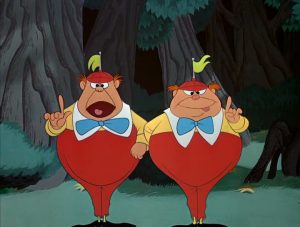

No Way Out Through Election
Political Bullshit
The prevalent forms of government in the world are variously called representative democracy, parliamentary democracy, and liberal democracy. They come in different varieties. On the national level, it is either a unitary system — centralized or decentralized; or a federal system with states or cantons. They all rest on two major flaws or mistakes. The first is that they place executive powers in single individuals, such as a president, a prime minister, a governor, a mayor. The second flaw is that they elect them by mass democracy; whereby thousands or million people are voting for a candidate.
In this post I will be concerned with the first flaw — giving power to a single individual.
What I am writing about politics is not philosophy but practical advice. The advice is so common sensical that I am at a loss to understand why what I have to say is not followed by most people. The principle that I have in mind is:
Don’t let a wolf tend to the sheep.
Yet, when we put single individuals in charge of anything, we are inviting corruption. What do I mean by political corruption? I mean that the politician will take bribes and make threats. And how will he get away with it? If there is no surveillance, then it will be a matter of his word against his accuser. And the corrupt politician will win by the principle of innocent until proven guilty. And, of course, the attorney general or chief prosecutor is himself subject to corruption, to be dismissed or retained by a single individual – either a prime minister or a president, who himself is subject to corruption – and prosecuted either by impeachment, no-confidence vote, or non-election. And unless the official is too cocky, as was the governor of Illinois, Blagojevich, or too brazen, and too megalomaniacal, as was Yanukovich, President of Ukraine, politicians can get away with murder, as does the president of Russia, Putin.
Practically all democracies give executive power to a single individual — be he a monarch, president, or prime minister. Indeed, this is true also of all subordinate executive offices; such as that of a governor or a mayor, and that of other executive posts. To entrust executive posts to single individuals is a great mistake. Why? Because single individuals are prone to corruption. They can be bribed or threatened — and they often are.
By contrast, in the ancient Roman republic, this danger was known and safeguarded against by having two consuls and two or more tribunes, who had veto power over each other. In cases of national emergencies, power was granted to a single individual, and he was called a dictator.
Such a system of government with power residing in single individuals is very welcomed by the rich. Why? Because they are in a position to buy whatever they desire of the politician, or they can threaten such an individual, or even assassinate him or her for non-compliance.
What I have written above strikes me as truisms, as common sense. In recent years, this truism was given some empirical backing by the writings and speeches of John Perkins, in his Confessions of an Economic Hit Man. He recounts in detail that his job was to first bribe heads of state to foster some policies favorable to some business or other; and if the bribe did not work, then they were threatened with losing the next election, threatened with a coup, an assassination, or, finally, a military invasion. And he gives us examples of each. Those presidents who take bribes become filthy rich, like Marcos of the Philippines, Noriega in Panama. By contrast, Mossadegh was deposed as Prime Minister of Iran by an American coup in 1953. In 1954 President Arbenz of Guatemala was removed from office by an American orchestrated uprising.
According to Perkins, the Presidents of Panama and Ecuador were assassinated by plane bombs because they refused to cooperate.
It seems obvious that if you want to be able to control the policies of a country, make sure that that country has either a monarch, a president, or a prime minister. These are all individuals subject to bribes, threats, coups, non-elections, and assassinations. And they, in turn, can exert bribes, threats, and assassinations.
What is the alternative?
In the US we have the Supreme Court which is composed of nine individuals. We can have a similar arrangement for the executive.
The only country that has eliminated dictators (that is, single rulers) is Switzerland: it has neither a monarch, nor a president, nor a prime minister; instead, it has a Federal Council, consisting of seven individuals. Each is the head of a ministry, but the decisions of each ministry are made by the seven Federal Councilors.
It would also be a great deterrence to corruption not to have either a governor or a mayor, but councils.
========================
See my: All power to councils — not to a President Czar
Two Ukrainian Anarchists: Mykhailo Drahomanov and Nestor Makhno
This is total bullshit: Bernie Sanders endorsed Hillary Clinton as the democratic candidate for US President
Pat Condell against political bullshit
Bullshit on Social Media
I am on Facebook for the same reason I have a website, and now a weblog. I want people to focus on (1) important matters, (2) to discuss them, and (3) to reach an agreement on plans of action. Although for the most part, I focus on economic and political issues, I sometimes stray from this by sharing some piece of music which I like, or a photograph of some scene, a joke, or whatever. I understand that we all want to be entertained and to entertain others. But as Neil Postman put it so well in his book, Amusing Ourselves to Death: Public Discourse in the Age of Show Business (1985, rev. 2005)[pdf copy] our obsession with entertainment is acting like soma in Aldous Huxley’s Brave New World.
[Neil Postman, “Are We Amusing Ourselves to Death?” Part I, The Open Mind, 1985. “Are We Amusing Ourselves to Death?” Part II, The Open Mind, 1986.]
On Facebook, I have tried to garner “friends” who have political interests. Although I have a global interest, I have concentrated on Ukraine because that is where my roots are, and where the political situation is not as rigid as it is in the United States; thus, allowing for a political revolution. My ideal of a political structure is anarchism. By this, I do not mean chaos or the absence of government. By “anarchism” I mean a bottom-up federalism, as contrasted with a centralized state – unitary or federated. In Ukraine, this form of government was promulgated by Nestor Makhno during the Russian Civil War (1917-1921), and it was promulgated in Spain during the Spanish Civil War (Revolution) (1936-1939).
I mention this to tell you that I want to discuss these matters somewhere. But it turns out that social media, such as Facebook, do not work. I find that people do not know how to discuss, and, worse, they don’t want to discuss. They simply want to express an opinion or share something, and one can react to this by “liking” it, or making a “comment.” Comments are especially annoying. For example, there was a short video on what is happening in Ukraine which I shared on Facebook. The comment was that it was simplistic and slanted – that’s it. No explanation. Trying to solicit an explanation did not work. This is typical.
The only political value that I see in using Facebook is a source of news, articles, and commentary. And, I hope, that I have stimulated some people to reflect on what I have written or shared.
Drone Warfare
Military Bullshit

STANDING ARMY . A journey into the world of U.S. Military bases with Gore Vidal and Noam Chomsky
The Bases of Empire – The Global Struggle against U.S. Military Posts. Ed. Catherine Lutz. New York University Press, 2009.
Jim Miles, Review: The Bases of Empire – The Global Struggle against U.S. Military Posts, Foreign Policy Journal, March 23, 2010
Economic Bullshit
Government and Land Rights |
||
Centralized Government |
Decentralized Government |
|
Free Land |
Socialism |
Anarchism |
No Free Land |
Capitalism,
|
Anarcho-Capitalism,
|
In the past, the subject of economics was called “political economy”; nowadays it is called simply “economics.” Why the change? Let me explain. There are alternative economic arrangements possible as to who owns what. Specifically, we can have alternative laws about land rights. Compare, for example, how indigenous native Americans dealt with land with the British colonial policy in America. American natives did not have a concept of land ownership; whereas the British did. Which system prevails is a political matter; hence “political economy.”
Since the 19th century, the economic system which has predominated is that of capitalism. And books with the title “Economics” are really about the workings of capitalism. Now, what is capitalism?
Max Weber, in the 22nd chapter: “The Meaning and Presuppositions of Modern Capitalism” of General Economic History (Wirtschaftsgeschichte, 1923), translated by Frank H. Knight, 1927, lists six necessary conditions for modern or “rational” capitalism. What interests me, and on which I want to focus attention, is the 5th necessary condition, which is:
“The fifth feature is free labor. Persons must be present who are not only legally in the position, but are also economically compelled, to sell their labor on the market without restriction. It is in contradiction to the essence of capitalism, and the development of capitalism is impossible, if such a propertyless stratum is absent, a class compelled to sell its labor services to live; and it is likewise impossible if only unfree labor is at hand. Rational capitalistic calculation is possible only on the basis of free labor; only where in consequence of the existence of workers who in the formal sense voluntarily, but actually under the compulsion of the whip of hunger, offer themselves, the costs of products may be unambiguously determined by agreement in advance.”
What people is he talking about? He is talking about people who do not possess property, which really means the people who have no free access to land on which they can have a home, have a garden, have some animals: in short, on which they can subsist. They are people who have no access to free subsistence land. Since such people tend to aggregate in cities, they are called proletarians; George Orwell in 1984 calls them “proles.”
It is ironic or euphemistic to call them “free laborers.” They are free relative to the law in not being slaves or serfs. But, as Weber notes, they are compelled to work to avoid starvation. Marx, I think, is more accurate in calling them “wage-slaves.”
See my articles: “Land and Liberty”
Milton Friedman’s Hidden Anarchism in Capitalism and Freedom