Top-Down or Bottom-Up Democracy?

Democracy can be either Direct or Indirect. Direct democracy is suitable to deciding matters which are of direct relevance to a small community. But still experts have to be chosen to carry out projects, and someone or some committee has to be chosen to see to the implementation and execution of these projects. But there are also matters which concern inter-communal matters, and here some form of delegation or representation is needed — hence a need for indirect democracy.

Indirect democracy can be either in a bottom-up manner, by electing delegates from a small community of about 150; or in a top-down manner, by masses of people (of thousands or millions) electing representatives. [I call this Mass Democracy]

Most of the world practices [Mass] Representative Democracy, giving executive power to a single individual — be it a mayor, a governor, a monarch, a president, or a prime-minister (except for Switzerland, which places executive power in the hands of a council of seven individuals).

Below are two videos. The first explains some of the detrimental features of [Mass] Representative Democracy. [See also Peter Kropotkin’s “Representative Government” (1885)] The second is about the benefits of a bottom-up democracy.

A reading from Peter Kropotkin’s “The Conquest of Bread”

Below, Cameron Watt reads the first chapter, “Our Riches”, from Peter Kropotkin’s Conquest of Bread. Below the video, I have reprinted the text so that you can read it as you listen to him.

CHAPTER I
Our Riches

I

THE human race has travelled far since, those bygone ages when men used to fashion their rude implements of flint, and lived on the precarious spoils of the chase, leaving to their children for their only heritage a shelter beneath the rocks, some poor utensils–and Nature, vast, ununderstood, and terrific, with whom they had to fight for their wretched existence.

During the agitated times which have elapsed since, and which have lasted for many thousand years, mankind has nevertheless amassed untold treasures. It has cleared the land, dried the marshes, pierced the forests, made roads; it has been building, inventing, observing, reasoning; it has created a complex machinery, wrested her secrets from Nature, and finally it has made a servant of steam. And the result is, that now the child of the civilized man finds ready, at its birth, to his hand an immense capital accumulated by those who have gone before him. And this capital enables him to acquire, merely by his own labour, combined with the labour of others, riches surpassing the dreams of the Orient, expressed in the fairy tales of the Thousand and One Nights.

The soil is cleared to a great extent, fit for the reception of the best seeds, ready to make a rich return for the skill and labour spent upon it– a return more than sufficient for all the wants of humanity. The methods of cultivation are known.

On the wide prairies of America each hundred men, with the aid of powerful machinery, can produce in a few months enough wheat to maintain ten thousand people for a whole year. And where man wishes to double his produce, to treble it, to multiply it a hundred-fold, he makes the soil, gives to each plant the requisite care, and thus obtains enormous returns. While the hunter of old had to scour fifty or sixty square miles to find food for his family, the civilized man supports his household, with far less pains, and far more certainty, on a thousandth part of that space. Climate is no longer an obstacle. When the sun fails, man replaces it by artificial heat; and we see the coming of a time when artificial light also will be used to stimulate vegetation. Meanwhile, by the use of glass and hot water pipes, man renders a given space ten and fifty times more productive than it was in its natural state.

The prodigies accomplished in industry are still more striking. With the co-operation of those intelligent beings, modern machines–themselves the fruit of three or four generations of inventors, mostly unknown–a hundred men manufacture now the stuff to clothe ten thousand persons for a period of two years. In well-managed coal mines the labour of a hundred miners furnishes each year enough fuel to warm ten thousand families under an inclement sky. And we have lately witnessed twice the spectacle of a wonderful city springing up in a few months at Paris,1 without interrupting in the slightest degree the regular work of the French nation.

And if in manufactures as in agriculture, and as indeed through our whole social system, the labour, the discoveries, and the inventions of our ancestors profit chiefly the few, it is none the less certain that mankind in general, aided by the creatures of steel and iron which it already possesses, could already procure an existence of wealth and ease for every one of its members.

Truly, we are rich, far richer than we think; rich in what we already possess, richer still in the possibilities of production of our actual mechanical outfit; richest of all in what we might win from our soil, from our manufactures, from our science, from our technical knowledge, were they but applied to bringing about the well-being of all.

II

We, in civilized societies, are rich. Why then are the many poor? Why this painful drudgery for the masses? Why, even to the best paid workman, this uncertainty for the morrow, in the midst of all the wealth inherited from the past, and in spite of the powerful means of production, which could ensure comfort to all in return for a few hours of daily toil?

The Socialists have said it and repeated it unwearyingly. Daily they reiterate it, demonstrating it by arguments taken from all the sciences. It is because all that is necessary for production– the land, the mines, the highways, machinery, food, shelter, education, knowledge–all have been seized by the few in the course of that long story of robbery, enforced migration and wars, of ignorance and oppression, which has been the life of the human race before it had learned to subdue the forces of Nature. It is because, taking advantage of alleged rights acquired in the past, these few appropriate to-day two-thirds of the products of human labour, and then squander them in the most stupid and shameful way. It is because, having reduced the masses to a point at which they have not the means of subsistence for a month, or even for a week in advance, the few only allow the many to work on condition of themselves receiving the lion’s share. It is because these few prevent the remainder of men from producing the things they need, and force them to produce, not the necessaries of life for all, but whatever offers the greatest profits to the monopolists. In this is the substance of all Socialism.

Take, indeed, a civilized country. The forests which once covered it have been cleared, the marshes drained, the climate improved. It has been made habitable. The soil, which bore formerly only a coarse vegetation, is covered to-day with rich harvests. The rock-walls in the valleys are laid out in terraces and covered with vines bearing golden fruit. The wild plants, which yielded nought but acrid berries, or uneatable roots, have been transformed by generations of culture into succulent vegetables, or trees covered with delicious fruits. Thousands of highways and railroads furrow the earth, and pierce the mountains. The shriek of the engine is heard in the wild gorges of the Alps, the Caucasus, and the Himalayas. The rivers have been made navigable; the coasts, carefully surveyed, are easy of access; art)ficial harbours, laboriously dug out and protected against the fury of the sea, afford shelter to the ships. Deep shafts have been sunk in the rocks; labyrinths of underground galleries have been dug out where coal may be raised or minerals extracted. At the crossings of the highways great cities have sprung up, and within their borders all the treasures of industry, science, and art have been accumulated.

Whole generations, that lived and died in misery, oppressed and ill-treated by their masters, and worn out by toil, have handed on this immense inheritance to our century.

For thousands of years millions of men have laboured to clear the forests, to drain the marshes, and to open up highways by land and water. Every rood of soil we cultivate in Europe has been watered by the sweat of several races of men. Every acre has its story of enforced labour, of intolerable toil, of the people’s sufferings. Every mile of railway, every yard of tunnel, has received its share of human blood.

The shafts of the mine still bear on their rocky walls the marks made by the pick of the workman who toiled to excavate them. The space between each prop in the underground galleries might be marked as a miner’s grave; and who can tell what each of these graves has cost, in tears, in privations, in unspeakable wretchedness to the family who depended on the scanty wage of the worker cut off in his prime by fire-damp, rock-fall, or flood?

The cities, bound together by railroads and waterways, are organisms which have lived through centuries. Dig beneath them and you find, one above another, the foundations of streets, of houses, of theatres, of public buildings. Search into their history and you will see how the civilization of the town, its industry, its special characteristics, have slowly grown and ripened through the co-operation of generations of its inhabitants before it could become what it is to-day. And even to-day; the value of each dwelling, factory, and warehouse, which has been created by the accumulated labour of the millions of workers, now dead and buried, is only maintained by the very presence and labour of legions of the men who now inhabit that special corner of the globe. Each of the atoms composing what we call the Wealth of Nations owes its value to the fact that it is a part of the great whole. What would a London dockyard or a great Paris warehouse be if they were not situated in these great centres of international commerce? What would become of our mines, our factories, our workshops, and our railways, without the immense quantities of merchandise transported every day by sea and land?

Millions of human beings have laboured to create this civilization on which we pride ourselves to-day. Other millions, scattered through the globe, labour to maintain it. Without them nothing would be left in fifty years but ruins.

There is not even a thought, or an invention, which is not common property, born of the past and the present. Thousands of inventors, known and unknown, who have died in poverty, have co-operated in the invention of each of these machines which embody the genius of man.

Thousands of writers, of poets, of scholars, have laboured to increase knowledge, to dissipate error, and to create that atmosphere of scientific thought, without which the marvels of our century could never have appeared. And these thousands of philosophers, of poets, of scholars, of inventors, have themselves been supported by the labour of past centuries. They have been upheld and nourished through life, both physically and mentally, by legions of workers and craftsmen of all sorts. They have drawn their motive force from the environment.

The genius of a Séguin, a Mayer, a Grove, has certainly done more to launch industry in new directions than all the capitalists in the world. But men of genius are themselves the children of industry as well as of science. Not until thousands of steam-engines had been working for years before all eyes, constantly transforming heat into dynamic force, and this force into sound, light, and electricity, could the insight of genius proclaim the mechanical origin and the unity of the physical forces. And if we, children of the nineteenth century, have at last grasped this idea, if we know now how to apply it, it is again because daily experience has prepared the way. The thinkers of the eighteenth century saw and declared it, but the idea remained undeveloped, because the eighteenth century had not grown up like ours, side by side with the steam-engine. Imagine the decades that might have passed while we remained in ignorance of this law, which has revolutionized modern industry, had Watt not found at Soho skilled workmen to embody his ideas in metal, bringing all the parts of his engine to perfection, so that steam, pent in a complete mechanism, and rendered more docile than a horse, more manageable than water, became at last the very soul of modern industry.

Every machine has had the same history–a long record of sleepless nights and of poverty, of disillusions and of joys, of partial improvements discovered by several generations of nameless workers, who have added to the original invention these little nothings, without which the most fertile idea would remain fruitless. More than that: every new invention is a synthesis, the resultant of innumerable inventions which have preceded it in the vast field of mechanics and industry.

Science and industry, knowledge and application, discovery and practical realization leading to new discoveries, cunning of brain and of hand, toil of mind and muscle–all work together. Each discovery, each advance, each increase in the sum of human riches, owes its being to the physical and mental travail of the past and the present.

By what right then can any one whatever appropriate the least morsel of this immense whole and say–This is mine, not yours?

III

It has come about, however, in the course of the ages traversed by the human race, that all that enables man to produce, and to increase his power of production, has been seized by the few. Sometime, perhaps, we will relate how this came to pass. For the present let it suffice to state the fact and analyse its consequences.

To-day the soil, which actually owes its value to the needs of an ever-increasing population, belongs to a minority who prevent the people from cultivating it–or do not allow them to cultivate it according to modern methods.

The mines, though they represent the labour of several generations, and derive their sole value from the requirements of the industry of a nation and the clensity of the population–the mines also belong to the few; and these few restrict the output of coal, or prevent it entirely, if they find more profitable investments for their capital. Machinery, too, has become the exclusive property of the few, and even when a machine incontestably represents the improvements added to the original rough invention by three or four generations of workers, it none the less belongs to a few owners. And if the descendants of the very inventor who constructed the first machine for lace-making, a century ago, were to present themselves to-day in a lace factory at Bâle or Nottingham, and demand their rights, they would be told: “Hands off! this machine is not yours,” and they would be shot down if they attempted to take possession of it.

The railways, which would be useless as so much old iron without the teeming population of Europe, its industry, its commerce, and its marts, belong to a few shareholders, ignorant perhaps of the whereabouts of the lines of rails which yield them revenues greater than those of medieval kings. And if the children of those who perished by thousands while excavating the railway cuttings and tunnels were to assemble one day, crowding in their rags and hunger, to demand bread from the shareholders, they would be met with bayonets and grape-shot, to disperse them and safeguard “vested interests.”

In virtue of this monstrous system, the son of the worker, on entering life, finds no field which he may till, no machine which he may tend, no mine in which he may dig, without accepting to leave a great part of what he will produce to a master. He must sell his labour for a scant and uncertain wage. His father and his grandfather have toiled to drain this field, to build this mill, to perfect this machine. They gave to the work the full measure of their strength, and what more could they give? But their heir comes into the world poorer than the lowest savage. If he obtains leave to till the fields, it is on condition of surrendering a quarter of the produce to his master, and another quarter to the government and the middlemen. And this tax, levied upon him by the State, the capitalist, the lord of the manor, and the middleman, is always increasing; it rarely leaves him the power to improve his system of culture. If he turns to industry, he is allowed to work–though not always even that –only on condition that he yield a half or two-thirds of the product to him whom the land recognizes as the owner of the machine.

We cry shame on the feudal baron who forbade the peasant to turn a clod of earth unless he surrendered to his lord a fourth of his crop. We call those the barbarous times. But if the forms have changed, the relations have remained the same, and the worker is forced, under the name of free contract, to accept feudal obligations. For, turn where he will, he can find no better conditions. Everything has become private property, and he must accept, or die of hunger.

The result of this state of things is that all our production tends in a wrong direction. Enterprise takes no thought for the needs of the community. Its only aim is to increase the gains of the speculator. Hence the constant fluctuations of trade, the periodical industrial crises, each of which throws scores of thousands of workers on the streets.

The working people cannot purchase with their wages the wealth which they have produced, and industry seeks foreign markets among the monied classes of other nations. In the East, in Africa, everywhere, in Egypt, Tonkin or the Congo, the European is thus bound to promote the growth of serfdom. And so he does. But soon he finds everywhere similar competitors. All the nations evolve on the same lines, and wars, perpetual wars, break out for the right of precedence in the market. Wars for the possession of the East, wars for the empire of the sea, wars to impose duties on imports and to dictate conditions to neighbouring states; wars against those “blacks” who revolt! The roar of the cannon never ceases in the world, whole races are massacred, the states of Europe spend a third of their budgets in armaments; and we know how heavily these taxes fall on the workers.

Education still remains the privilege of a small minority, for it is idle to talk of education when the workman’s child is forced, at the age of thirteen, to go down into the mine or to help his father on the farm. It is idle to talk of studies to the worker, who comes home in the evening crushed by excessive toil with its brutalizing atmosphere. Society is thus bound to remain divided into two hostile camps, and in such conditions freedom is a vain word. The Radical begins by demanding a greater extension of political rights, but he soon sees that the breath of liberty leads to the uplifting of the proletariat, and then he turns round, changes his opinions, and reverts to repressive legislation and government by the sword.

A vast array of courts, judges, executioners, policemen, and gaolers is needed to uphold these privileges; and this array gives rise in its turn to a whole system of espionage, of false witness, of spies, of threats and corruption.

The system under which we live checks in its turn the growth of the social sentiment. We all know that without uprightness, without self-respect, without sympathy and mutual aid, human kind must perish, as perish the few races of animals living by rapine, or the slave-keeping ants. But such ideas are not to the taste of the ruling classes, and they have elaborated a whole system of pseudo-science to teach the contrary.

Fine sermons have been preached on the text that those who have should share with those who have not, but he who would act out this principle is speedily informed that these beautiful sentiments are all very well in poetry, but not in practice. “To lie is to degrade and besmirch oneself,” we say, and yet all civilized life becomes one huge lie. We accustom ourselves and our children to hypocrisy, to the practice of a double-faced morality. And since the brain is ill at ease among lies, we cheat ourselves with sophistry. Hypocrisy and sophistry become the second nature of the civilized man.

But a society cannot live thus; it must return to truth or cease to exist.

Thus the consequences which spring from the original act of monopoly spread through the whole of social life. Under pain of death, human societies are forced to return to first principles: the means of production being the collective work of humanity, the product should be the collective property of the race. Individual appropriation is neither just nor serviceable. All belongs to all. All things are for all men, since all men have need of them, since all men have worked in the measure of their strength to produce them, and since it is not possible to evaluate every one’s part in the production of the world’s wealth.

All things are for all. Here is an immense stock of tools and implements; here are all those iron slaves which we call machines, which saw and plane, spin and weave for us, unmaking and remaking, working up raw matter to produce the marvels of our time. But nobody has the right to seize a single one of these machines and say, “This is mine; if you want to use it you must pay me a tax on each of your products,” any more than the feudal lord of medieval times had the right to say to the peasant, “This hill, this meadow belong to me, and you must pay me a tax on every sheaf of corn you reap, on every rick you build.”

All is for all! If the man and the woman bear their fair share of work, they have a right to their fair share of all that is produced by all, and that share is enough to secure them well-being. No more of such vague formulas as “The Right to work,” or “To each the whole result of his labour.” What we proclaim is THE RIGHT TO WELL-BEING: WELL-BEING FOR ALL!

Footnotes

  1. For the International Paris Exhibitions of 1889 and 1900.

Why is the world enamored by the Leader principle (except Switzerland)?

A single person in any capacity of making decisions is subject to advancing his own self-interest, subject to bribery, and subject to threats. Let us call this “corruption.”

I advance the following claim.

If it is possible for a leader to be corrupted, he will be corrupted.

This is just a rephrasing of the old adage that power tends to corrupt.

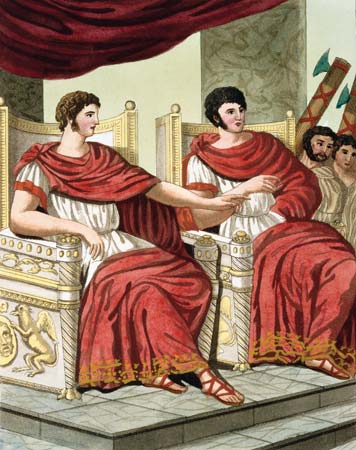
The ancient world of the Greeks and Romans knew this, and called a single leader a “dictator.” To offset this evil, Sparta had two kings, while the Roman Republic had two consuls — with veto powers over each other.

So why is it that everywhere in the world, we democratically give power to dictators?

Venezuela: Another Overthrow!

Stephen Kinzer, wrote the book Overthrow: America’s Century of Regime Change from Hawaii to Iraq (2006), which documents the history of US interventions in foreign governments. What is going in the relation between the US and Venezuela is exactly an attempt to overthrow the President of Venezuela.

Below is a video of an interview of Stephen Kinzer by Amy Goodman of Democracy Now.

Here are some other interviews with Kinzer.

Is a Foreign Military Intervention in Venezuela Imminent?

I was looking for a reasonable analysis of what is going on in Venezuela, on the one hand, and what President Trump intends to do about it. Unlike most main media, the following piece at venezuelanalysis.com seems very reasonable: “Is a Foreign Military Intervention in Venezuela Imminent?

Let me say the following. The United States has never intervened in any country for “humanitarian” reasons. All the US interventions that I can think of, have had the character of destructive aggressions which have killed more people than “saved.” And let us not lose sight of the economic advantage to US corporations in any intervention.

Is there a fear of the Venezuelan Constituent Assembly?

See also the Wikipedia article United States – Venezuela Relations


Problems for Humanity: the views of Yuval Noah Harari

Yuval Noah Harari is author of Sapiens (2014), Homo Deus (2016), and 21 Lessons for the 21st Century (2018).

Nationalism vs. globalism: the new political divide

I have watched a few talks and interviews with Yuval Harari, and at this point I will say that what he says is partly true, but also misleading. I will mention some things which struck me as misleading. His general view of history from the point of view of “authority” is given as a three part progression. First, man finds authority in external gods. Second, man shifts authority to himself (he calls this humanism). Third, we are moving in the direction of giving authority to computer algorithms. This is misleading. Why? Because when we moved away from religious superstitions, we did not replace this with a criterion — which he says we use — of how we “feel.” No, we moved to science, using the criteria of logic and testing. The use of computers is a further extension of the use of science. But he is right that computers and artificial intelligence in the form of expert system are being used more extensively.

Another misleading matter was how he referred to such things as “nations” as “fictions.” This is misleading. Jeremy Bentham also used the word “fiction” to refer to such abstract entities as “nations” and “justice.” But this use of the word “fiction” is not the same as when we talk about “science fiction.” For the creatures of mythology and science fiction, Bentham used the word “fable.” And fictions, in this sense, are not fables. One should consult John Searle on this matter. These so-called fictions are, according to Searle, institutional facts. [Look here]

The other thing that struck me about Harari was his claim that free will does not exist. Again this is a misleading claim. In our ordinary way of talking, we contrast those occasions when someone did something without being compelled to do it and when he was compelled to do something. For example, you are mugged and are forced to surrender your wallet. We will say that you did not do this of your free will. But if you did so without compulsion of any sort, we would say that you did it freely — out of a free will. What Harari is after is the question: did you have any choice in having the desires that you have. But that is another, and different matter.


Dictatorial Mass Representative Democracies: Ukraine and the United States

What passes for “democracy” in most of the world is better expressed by the phrase “dictatorial mass representative democracy.” Why? Because through universal suffrage, people are obliged to elect individuals with discretionary powers, which in the ancient Roman republic were called “dictators.” And these individuals are not chosen from within a small “community,” but from a region of several thousand or millions of people. Such a practice I call “mass democracy.”

I consider both dictators and mass democracy to be evils, which should be done away with.

Any country which has an elected President, Governor, or Mayor (of a large city) qualifies as a “dictatorial mass representative democracy.” A lesser dictatorship exists where there is a Prime Minister, elected by a Parliament. Why? Because, as in England, the Prime Minister has to be responsible to Parliament and can easily be dismissed.

Let me compare three countries which can be ranked as the worst to the best of representative mass democracies. These are Ukraine, the United States, and Switzerland.

Ukraine is the worst for the single reason that it is not federated nor well decentralized. Federation means that there are relatively autonomous regions in the country as in the United States, which is divided into semi-autonomous states, counties, and municipalities; or, as in Switzerland, into cantons and municipalities. The states and cantons have their own constitutions, and elect their governors and mayors locally. Ukraine, by contrast, is not constituted by states or cantons, but rather by bureaucratic regions, called Oblasts, governed by governors, who are not elected by the people, but are appointed by the President. The only relative autonomy in Ukraine is exercised on the municipal level by the local election of a mayor and city council. However, the local prosecutor, the police, and the judges are appointed by the national ministries, rather than by the mayor, the council, or by elections. The result: a very centralized dictatorship.

I may add that Ukraine also suffers from a dictatorial judicial system. Instead of a jury of one’s peers, Ukraine uses a single judge to determine guilt or innocence. There is no option for a jury.

All three countries have a parliament. Ukraine has a unicameral one; while the United States and Switzerland have bicameral parliaments.

Of the three mass representative democracies, only Switzerland is not a dictatorship. Why? Because Switzerland does not have an executive branch run by a single individual — a President or a Prime Minister; instead, it has a Federal Council, composed of seven individuals. These are nominated by the four majority parties of the parliament, and elected by the joint bicameral parliament. The Federal Council deliberates and votes in secret, and presents its results as a joint decision. Thus their individual voting patterns are not known to anyone outside the Federal Council itself. It is extremely difficult to bribe or threaten them, unlike the ease of doing so in Ukraine and the United States.

Ukraine — like the United States — elects its President by a national election. However, in Ukraine the President nominates the Prime Minister, four ministry heads, and appoints all the governors. Since the Prime Minister is confirmed by the Parliament, he or she must be acceptable to the ruling party in Parliament. The Prime Minister, in turn, nominates the remaining heads of the ministries. By contrast, in the United States, the President nominates all the cabinet heads, as well as the Supreme Court Justices.

In Switzerland, the seven executives constitute the cabinet, and decide jointly; rather than by dictatorial decisions of a President as in Ukraine and the United States.

I must also mention the peculiarity of Swiss mass democracy which forms a check on their government, that is the mandatory national referendum for altering their constitution, and their optional national initiatives and referendums for challenging or introducing laws. Although the national referendums and initiatives are better to have than not to have, they have the drawback of any mass democracy: they are prone to being swayed by propaganda and mass media which, of course, are controlled by money. Incidentally, that is also the reason why the elected representatives in any parliament tend to be rich or the friends of the rich. It takes money to win mass elections.

One last caveat. All democratic countries of the world are top-down (mass) democracies. A better form of government would be bottom-up democracy consisting of communities of about 150 families forming a nested council democracy, sometimes referred to as anarchism.

Here us a link to a diagram of the Executive Branch of Government of Ukraine

Paul Honigsheim, “The Sociological Doctrines of Franz Oppenheimer: An Agrarian Philosophy of History and Social Reform”


An Introduction to the History of Sociology, edited by Harry Elmer Barnes, 1917. pp. 332-352.


CHAPTER XVI

Paul Honigsheim, Michigan State College

THE SOCIOLOGICAL DOCTRINES OF FRANZ OPPENHEIMER: AN AGRARIAN PHILOSOPHY OF HISTORY AND SOCIAL REFORM

I. OPPENHEIMER’S LIFE AND THE MAIN CURRENTS OF THOUGHT IN GERMANY AT THAT TIME

The problems raised by Oppenheimer and the answers that he gives are, to a large extent, conditioned by the socioeconomico-political and intellectual trends in Germany before the first World War and by his own personal experiences. Therefore, an introductory consideration of these two, so far as they have influenced his system, is indispensable.

In pre-war Germany the Junker class of eastern Germany had a virtual monopoly on the leading positions in administration and in the army. They were owners of baronial estates, dependent on the labor of very poorly paid agricultural workers, partly seasonal workers of Polish origin. They treated the relatively few middle-class farmers living near their estates as dependent clients. As a result, the younger sons of these middle-class farmers and, to an even greater degree, the agricultural workers themselves migrated to the cities, where they swelled the numbers of industrial workers until the supply exceeded the demand to such an extent that there was no alternative for them but to accept the wages and working hours imposed by the ascendant class of industrialists. There they lived in rookeries owned by middle-class citizens with moderate liberal views. They also organized themselves into moderate socialist or Catholic labor unions.

The intellectual life of that epoch was characterized by a decrease in the importance of religion and the restriction of philosophy to the history of philosophy, experimental psychology, and epistemology — with a few exceptions, such as Driesch, Husserl, Scheler, and Nelson. In the field of epistemology a position of primary importance was held by the [333]
so-called “Neo-Kantian school,” represented by Jellinek, Rickert, Max Weber, and Troeltsch, who worked on the problems raised by their assumption of a qualitative difference existing between statements of fact and value-judgments and between history and the natural sciences. On the other hand, the prestige of the natural sciences was at that time so great that the demand was raised for other sciences to adopt their methods. This actually took place, for example, in anthropology, which spread the doctrine of the parallel development of the social and cultural phenomena in all parts of the world — conceived by Adolf Bastian and his followers in an optimistic sense of progress, but in a pessimistic sense by Gumplowicz, who saw only cyclical periods without progress and the perpetual use of violence which accomplished nothing permanent. A movement of protest against these ideas as being mechanistic appeared only later, at the beginning of the twentieth century; the protest came from the anthropologists, in the rediscovery of the Mother-right theory of the forgotten Romantic mysticist, Bachofen, and in the emphasis given to diffusion and migration in primitive civilization by the schools of Grabner and Father Schmidt. In opposition to these predominant tendencies in anthropology, the historical school of Ranke and Treitschke, which enjoyed tacit official recognition, dealt almost entirely with the foreign relations of great and powerful states, said to be under the exclusive direction of so-called great men, such as Bismarck. This school ridiculed anyone interested in hypotheses concerning the relation between history based on written sources, on the one hand, and prehistory and ethnology, on the other, or anyone interested in historical laws or comparative cultural and economic history. This other tendency found more response among Catholics and also among economists.

The economists were not much interested in pure theory or the use of deductive methods, in the manner of the so-called “classical” school, except for Adolf Wagner and the so-called “marginal-utility” school, the followers of the rediscovered Gossen; however, this group taught primarily in Austria. In spite of the fact that this group claimed to be liberal, the belief in pure laissez fairc diminished; the demand for state interference could be heard on every side, especially from the so-called “historical” school of Schmoller, long tacitly recognized as the official school. They investigated socioeconomic history, primarily the history of urban handicraft and industry, and claimed to supply the scientific [334] background for the political programs of state-supported welfare work. More or less independently of that dominant group or even in opposition to it, the history of the beginnings of horticulture and animal husbandry was investigated by Eduard Hahn; the history of the medieval co-operatives and their suppression through the reintroduction of Roman law, by Gierke; and the history of agriculture and rural social life, by Knapp, Meitzen, Gothein, Lamprecht, Von der Goltz, Max Weber, and the Austrian Catholic, Dopsch. Some of these were also sociologists.

There were a few other sociologists, as, for example, Tonnies, who was primarily responsible for working out the distinction between “community” (Gemeinschaft), conceived as the primary contact group, and society in the strict sense of the word (Gesellschaft), conceived as the secondary group, and who also analyzed the replacement of the former by the latter in modern times. These circles of sociologists, anthropologists, and economic historians studied the works of some foreign sociologists, such as Comte, Herbert Spencer, Ward, Giddings, Small, and Ross; but, generally speaking, sociology was a stranger in the German universities at that time. The universities also excluded the following school of socioeconomic theory: the decreasing numbers of Marxians under the leadership of Kautsky; the increasing numbers of so-called “Revisionists” under the leadership of Eduard Bernstein, who rejected Marxian economic determinism and recommended the use of parliamentarian methods and other practical means to improve the social and economic condition of the lower classes; a few so-called “liberal socialists,” such as Duhring, who advocated, among other things, maintenance of private property and enterprise to some extent, going back, in part, to the Saint-Simonists and Proudhon; the so-called “land-nationalizers,” such as Wehberg, Flurscheim, Hertzka, and Stamm, going back, in part, to Henry George and to some earlier English writers; and the few so-called “federalists,” adherents of Constantin Frantz — a critic of Bismarck, who was almost completely unnoticed outside the circle of his immediate followers. This last group attached great importance to the political, economic, and cultural autonomy of professional, local, and provincial associations and of the various districts of Germany, such as Hanover, Bavaria, etc., and to the reunion with Austria.

Such were the main currents of thought in Germany when Franz Oppenheimer began to study. He was born on March 30,1864, the son of a poor liberal Jewish rabbi in a suburb of Berlin. Having little chance,
[335] owing to his family background, of becoming a high-school teacher, much less a university professor, he studied medicine and for many years was a practicing physician in Berlin. Here he had occasion to become aware of the connection between the problems of disease and moral decline, on the one hand, and housing and ground rent, on the other. He, therefore, began to read socioeconomic literature and became personally acquainted with adherents of many of the above-mentioned movements. Dissatisfied with all of them, he felt himself obliged to seek the truth, first, by systematically studying economics. To this end he abandoned his medical practice and supported his wife and child by writing articles. His first books made him known in the scientific world, and in 1909 he became Privatdozent of economics at the University of Berlin, i.e., an unsalaried lecturer, receiving only the students’ fees; he still had to support himself by his publications. During the first World War he was employed as economic counselor in the war office, and in 1919 he became Ordinarius, i.e., full professor, of sociology and economic theory at the University of Frankfurt, where he wrote down his system in much larger and more universal form than in his earlier books. In 1929 ill-health caused him to retire earlier than he was obliged by law, and he took up residence in one of the rural settlement co-operatives he had founded before the first World War in conformance with his own principles. After 1933 he was a guest lecturer, from time to time, in Paris, Palestine, and the United States of America.1 His death occurred in Los Angeles, September 30,1943.


II. OPPENHEIMER’S SYSTEM OF SOCIOLOGY

A. EPISTEMOLOGY AND THE SOCIAL AND PHILOSOPHICAL BASIS OF JUSTICE

Although the sciences, in so far as they are distinct from philosophy, have to be based on factual data and have to use inductive methods, it is, nevertheless, possible and also necessary to combine inductive with deductive methods.2 It is in the so-called “general sciences” that the use of deductive methods is necessary. These are sciences of a class of phenomena, considered in its entirety. Such a science is possible, according to the theory of the Americans, Ward and Giddings, which Oppenheimer accepts, on one condition: The “general science” must deal with attributes of the class that are common to all of its subclasses and not with the particular attributes of any subclass.3 Here, as in every special
[336]
science, personal bias played a role, especially in evaluation, but it must, so far as possible, be eliminated.4 In fact, not all evaluations are based on personal bias; there exist scientific evaluations which can be objectively justified.5 Of course, there is a difference between statements of fact and value-judgments, but the latter need not be eliminated from all parts of the scientific system as radically as the Neo-Kantians require. Indeed, the limits within which their use is justifiable are different in each branch of science. We shall see in a moment how this affects sociology. The various branches of science are likewise different, not only with regard to their subject matter and type of procedure between the historian, on the one side, and the natural scientist, on the other, but also because the former does not therefore need to be limited, as Rickert demands, to the statement of the unique — that which occurs but once and does not come under general laws — for, on the one hand, the unique also can come under general laws, and, on the other hand, it is both possible and obligatory for the science of history to observe the regularities in recurrent phenomena.6 It is on such statements of historical regularities, among other things, that sociology is based.

Sociology is one of the general sciences in the above-mentioned sense; it is not a natural science, nor is it a synthesis of all the social sciences; it is a new combination of the results of the investigation of society, considered as an organism, and of the social process; its investigations are made from a point of view different from that of psychology, anthropology, economics (and a number of other sciences), to all of which it is, nevertheless, related. It is necessary to investigate from a sociological point of view all the psychological, economic, juridical, and political phenomena of the past and the present.7 On the basis of this material, sociology is able to form not only judgments in the form of statements of fact and general laws but also judgments of another character; for, society being an organism, its “normality” can be fixed with sufficient scientific exactitude, that is to say, it can be stated which social status is the normal one. By considerations based on the conclusions of both the social sciences and the philosophy of Right, the normal status of the social organism can be shown to be that status which is regulated and dominated by justice.8 From history and social psychology we know how the sense of justice originated and developed. Just as there are in human nature, on the one hand, factors favoring conflicts and, on the other hand, instincts for mutual help, so there exists independently of [337] these two — as the American sociologist Ross, in particular, has demonstrated — the sense of justice. The sense of justice is based neither on instincts nor on intellectual considerations about the rights of others, but it originates in the pressure brought to bear on conflicting persons or groups by third persons or groups, primarily not themselves concerned with the conflict in question.9 But this and many similar statements of a sociopsychological character concern the origin, strength, and content of the sense of justice of a particular group; these are sociopsychological facts important in determining the methods whereby the social structure can be changed. But the essence and content of justice in itself will never be grasped in that way. It can be recognized, being in character identical with the essence and content of natural law, only by pure philosophical perception, following a deductive method and not depending on any factual data. Thus it must be conceived and defined as the limitation of the sphere of liberty of the individual, made necessary in practice by the reciprocal interaction of individuals. This limitation is so essential that, even where something valuable exists in a social situation, this value has to recede if it is in conflict with the demands of justice. Conformance to this principle, which is obligatory on all groups, especially institutionalized groups and, above all, the state, constitutes the realization of the ideal of justice.10

If we combine these two considerations, we arrive at the following conclusion: On the one hand, sociology is a general science based on the factual data obtained by the specialized sciences of anthropology, history, and psychology. On the other hand, on purely philosophical grounds, the normal status of the social organism is conceived as the status which is dominated by justice; the essence of a status in which justice is dominant is defined as one in which a limitation on the sphere of liberty of the individual is imposed by the reciprocal interaction of individuals. Thus sociology, having a knowledge of all kinds of society, past and present, is able to compare every known form of social structure with the norm, that is to say, with the status where justice is dominant. On the basis of such a comparison, it is able to make judgments about the deviation of any given social structure from the normal status of the social organism. This is the value-judgment which sociology is able to formulate and which we had in mind when we referred above to the possibility of value-judgments in sociology. Moreover, sociology, being based on factual data obtained by the sciences of anthropology, [338] history, and psychology, is also able to formulate the following two kinds of judgment in the nature of statements of fact. In the first place, based on the knowledge of the particular causes of every particular case of deviation from the norm, sociology is able to establish the causal connection existing regularly between a factor A of social, economic, or political character and the form B of the deviation from the norm. Second, again on the basis of the factual data furnished by anthropology, history, and psychology, sociology is able to determine the means of a social, economic, and political character which have to be used in order to eliminate the causes of the deviation itself, and so to realize the normal status of the social organism.11

Since the ideal which has to be realized has, by virtue of the considerations outlined in the first section of our explanation of Oppenheimer’s system, been recognized to be the society dominated by justice, we have to deal in Section B with the general causal laws which sociology has formulated, and, finally, in Section C with the practical implications of these laws, i.e., with the means which have to be used in order to realize the ideal — the society dominated by justice.


B. THE FUNDAMENTAL LAWS OF SOCIOLOGY

One of the fundamental pillars of Oppenheimer’s system is the law of systematic uniformity in the origin and development of the state, state law, social classes, private property, monopoly, and surplus value. This law was put forward by Duhring, though the first suggestions of it go back to the Saint-Simonists and Proudhon. Its essential content is as follows: Economic activity consists not in the satisfaction of economic needs but in the attainment of any end through the use of economic means. But these are not the only, or even the most important, means of attaining an end.

In particular, where the social structure is involved, the means to a given end are often not exclusively or even primarily economic in character; there may be a simultaneous, or even exclusive, use of political means, such as territorial conquest and the subjugation of other peoples. This is, in fact, the way that primitive economic inequality arose, not as the theory of so-called “primitive accumulation” would have us believe. The theory of “primitive accumulation” was held by the adherents of the idea of natural law and natural rights; these doctrines were advanced by the Stoics in antiquity and in modern times by the [339] thinkers of the eighteenth-century Enlightenment, by the liberals of the nineteenth century, by the “classical” school of economics, and even, in a disguised form, by Karl Marx. All these thinkers shared the following conception of the origin of economic inequality: In the prestate period, a relatively large measure of economic and social equality among the members of the same group existed. Then some were able to become wealthier than others. Thus they laid the foundation for the subsequent reduction of their former equals in the tribe to a condition of economic dependence on them. They were able to do so, according to the majority of the thinkers just mentioned, because they had greater intelligence and ability than their fellows; but according to Rousseau and Marx, because they were more cruel, fraudulent, and antisocial. Yet both these explanations are wrong; for in that period members of a tribe never used means of an economic character to obtain the social objective of having others work for them; rather, one group used the political means of conquering land and subjugating the inhabitants for the purpose of acquiring wealth based on the labor of others. The ruling class then introduced a uniform pattern of institutionalization to guarantee the permanence of the new social situation to which they had so long aspired — the state was founded and a system of laws established.12

But the most important and effective measure undertaken for the same purpose was the seizure of the land by this group and the denial of land to the rest, particularly to the subjugated peoples — in other words, the introduction of land monopoly. This is the universal background and cause of the development of all other monopolies, as well as class stratification and surplus value. This is shown by the following reasoning: Those who do not live by the labor of others must work the land in order to obtain the means of livelihood. But, given the existence of private landownership, the relatively few landowners do not need to alienate the land or the right of its usufruct just because the landless persons need access to the land. Therefore, the owners have a monopoly, and thus they have the opportunity to require a monopoly tribute. This is paid by the semidependent tenants in the form of rent; by the almost completely dependent rural workers in the form of money deducted from their wages and retained by the landlord; and by the completely dependent slaves in the form of the totality of the economic value of their labor minus the cost of their maintenance.13
[340]

The existence of land monopoly and of the resulting monopolies in all other departments of life has further social consequences. First, it follows from the preceding analysis that complete competition never did exist, since the monopolists have always occupied a privileged position. Second, since free competition never has existed, it can in no sense be considered as one, much less the only, cause of any social or economic phenomenon that has appeared since the prestate period or that still exists in the present. Third, because of the existence of land monopoly and other monopolies, there exists one kind of property which is not based on the proprietor’s own labor, thus is not in conformance with natural law and justice and therefore is not justifiable — in contrast to property acquired by individual labor, which does conform to natural law and justice and therefore is justifiable.14

The consequences of the existence of land monopoly which have just been enumerated are important, but there are others as well. However, they are to be understood only in connection with a group of other laws of an economico-psychological character, which we must deal with first.

This second group of laws concerns the uniformity governing seemingly subjective valuations of economic goods. The assertion of the existence of this regularity is made possible by the theory of so-called “marginal utility” as developed by Gossen, but with a decided emphasis on its objectivistic side, in contradistinction to the subjectivism of some outstanding Austrian adherents of that school. Its main assertions, in so far as they concern Oppenheimer’s sociological system, are as follows: The satisfaction derived from consumption decreases with each additional unit of a given commodity until it reaches zero or the point of satiety. From this psychological law of decreasing satisfaction there follows the law of decreasing economic value: Commodities are valued not on the basis of their general importance but in terms of small units in the available supply. All these units of a given commodity being alike, that unit which is set aside for use in the most important category of consumption is interchangeable with the unit set aside for the least important use, and an equal value must attach to both. Hence the effective use-value of any good decreases rapidly as the supply increases.

This and some similar general laws of an economico-psychological character were applied to the theory of wages, as well as to some other problems. Applied to the theory of wages, it led to the following formulation:
[341]
The amount of the wage is determined by the value attached to the least useful worker whom it is necessary to employ in production, the enterprise in which he is employed being constituent of the sum total of production, even if it is the least important one.16 This application of marginal utility to the theory of wages will become especially important when combined with two other theories: the first is the above-mentioned theory of the systematic uniformity in the origin and development of the state, private property, and land monopoly; the second is the fundamental law of the ratio between the quantity of emigrating rural population and the distribution of rural property. This law may be stated as follows: The quantity of emigrating rural population is in direct proportion to the amount of land owned by the landed gentry and organized in large estates but is in inverse proportion to the amount of land owned by peasants and worked by the peasant himself and his family. The truth of this law — first discovered by Von der Goltz — can be shown by the following considerations. Where the population is increasing, the profit rate of industrial products regularly rises, while that of agricultural products regularly falls. This phenomenon is compensated for by the emigration of rural population to the cities. This influx to the cities intensifies competition and brings down prices of industrial products. Simultaneously, the increased demand for rural products raises the prices of the latter. This is the general law.

However, this general law is subject to modifications, depending upon the special form of distribution of the rural property. Where the land is predominantly in the hands of peasant proprietors, the surplus income created by the rise of prices of the primary products is distributed among the entire population. The reason for this is that in that situation a reduction in the wages of the urban workers takes place simultaneously with a rise in the income of the rural producers. But, in a country where large estates owned by landed gentry predominate, the land monopolists, as explained above, are powerful enough to prevent a rise in the wages of the agricultural workers. It is particularly easy for them to do so if it is possible, as it was for the Junkers of eastern Germany, to import seasonal agricultural workers from foreign countries who are accustomed to a lower standard of living and the lowest possible wages. Thus the whole of the profit obtained from the increase in prices of primary products brought about by the decrease in prices of industrial products accrues to the holders of large estates in the form
[342]
of increased ground rent. Under such circumstances the phenomenon observable in countries where peasant proprietors predominate fails to appear — that is to say, the simultaneous fall in the wages of the urban workers and rise in the income of the rural producers. Instead, another form of reaction against the economic pressures of the situation is worked out. The rural population emigrates in larger numbers than in the former case, though not large enough, and goes either to the industrial towns of their own country, where they become factory workers, or overseas, where they settle as pioneers or likewise become urban factory workers.

The difference in the distribution of landownership in the two cases — in the first case, among a large number of independent peasant proprietors and, in the second case, among a small number of landed gentry — is the cause of the difference in the amount of emigrating rural population.

Once this law is established, we are able to determine the cause of the increase in the supply of urban factory workers in excess of the demand, one of the factors bringing about the decline in the wages of this group. All the many earlier theories which attempted an explanation of this phenomenon are incorrect, for the explanation lies not, as is held by the classical school of economics from Malthus to Mill, in the overproduction of children among the working class. Neither does it lie, as is held by Karl Marx, in the displacement of workers by the machine; on the contrary, a great deal of emigration occurs often from countries and in periods in which no machinery was imported for use in rural districts, as in Ireland in the middle of the nineteenth century, which differs from other countries in this respect. Finally, the explanation does not lie in the overpopulation of the rural districts in question; on the contrary, emigration often occurs on a large scale from the less densely populated districts. Thus all these attempts at an explanation of the phenomenon under discussion — the increase in the supply of factory workers in excess of the demand as a causal factor in the decline in wages of the urban factory workers — are seen to be wrong. The true cause of this phenomenon and also of the migration from the rural districts to the city is the fact that the land is not in the hands of peasant proprietors but in those of owners of large estates, i.e., a land monopoly exists.
[343]

The coherence of this analysis will become especially evident if we combine Goltz’s law of the ratio existing between the amount of emigrating rural population and the distribution of the different kinds of rural properties and forms of rural management with the special application of the marginal-utility theory to the theory of wages, which was discussed previously. According to the latter, as we saw above, the amount of the wage is determined by the value attached to the least useful worker whom it is necessary to employ in production, the enterprise in which he is employed being a necessary constituent of the sum total of production, even if it is the least important constituent.

By applying this general law to the special case of emigration from countries where large estates are the predominant form of rural property, we are justified in making the following inference: The lowest level of wages paid to the lowest type of agricultural worker on the least important establishments of the feudal landlords of eastern Europe — e.g., Russia, Rumania, Hungary, and eastern Germany — determines the amount of the existing supply of urban factory workers and is the cause of the excess of that supply over the demand. Consequently, it is the cause of the low wages paid to the urban factory workers, not only in the industrial countries of Europe but elsewhere also. A further consequence is, as explained above, the emigration of part of the rural workers not to the industrial towns of their own countries but overseas, where, in so far as pioneer farming is not open to them, they, too, become factory workers and thus form an essential element of the sweatshop labor in the overseas industrial centers. But the low wage level of the agricultural workers on the feudal estates of eastern Europe is the result of the existence of a land monopoly. This, in turn, is caused by the use of political means to obtain and maintain an unjustifiable kind of property. Thus land monopoly — this unjustifiable system of distribution and organization of landownership — is the ultimate cause of the existence of a proletariat and of the absence of justice, everywhere in the world, both in the present and in the past;10 for the truth of this system — as was stated at the beginning of Section II — can likewise be proved by an anthropologico-historical survey of the course of human development.

In analyzing historical development and the relations existing between different historical phenomena, there are two considerations of a general character which we must bear in mind. First, it is possible for cultural gains to be lost, and interpretations of seemingly primitive [344] phenomena must allow for this possibility. Second, all the similarities appearing in different parts of the world need not be interpreted as the result of independent parallel development exclusively, as attempted by the evolutionary school of Adolf Bastian and by Gumplowicz; or as a result of migration and diffusion exclusively, as attempted by Grabner and by the diffusionistic school of Father Schmidt. In any particular case these two possibilities must be considered before a definite decision is reached.17 In the light of these two considerations, the following conception of world history emerges:


Primitive hunters, likewise totemistic hunters, as well as neolithic horticulturists of the matrilinear type, lived in a state of relatively broad economic equality and, in particular, knew nothing of land monopoly, conquest, social classes, and private property.18 The last three institutions were introduced in the Bronze Age by pastoral nomads. In addition to the original pastoral nomads, there were former horticulturists who had adopted the culture of the cattle-breeders with whom they had been in contact.19 These nomads subjugated other groups with a culture similar to their own, as well as horticulturists of the neolithic type, forced them to work for their new rulers, and introduced the institutions of land monopoly and the state — in the area of the Andes, China, Hindustan, Mesopotamia, Egypt, and the Mediterranean countries.20


Confining ourselves henceforth to Occidental civilization, we find a particularly clear example in ancient Rome. There we see the results of the management of land not by peasant proprietors but by a landed aristocracy, who used slaves and farm tenants — viz., famine, proletarianization, depopulation, and ultimate destruction at the hands of the peoples of Germanic origin.21 These Germanic tribes, like the Celts and, on the whole, the majority of the peoples of Indo-European language-group, were secondary herdsmen — i.e., they had adopted the way of life of pastoral nomads with whom they had been in contact. After conquering other Germanic tribes, they had developed into semi-feudal landlords over these conquered peoples; in the provinces of the Roman Empire they established states whose territory was divided into large landholdings.22 In these states the condition of the peasants was not the same in all places and at all times; but from the eleventh century on, it became in some countries relatively tolerable. This was primarily due to the fact that the peasants were relatively independent and [345] organized in associations of a co-operative character and because the payments to the landlords were made in kind and were of a relatively low and fixed amount. Hence, while formerly the peasant had to produce in his own home all the goods needed by himself and his family, such as clothes, he was now able to buy these at the markets in the cities, where they were produced by specialized urban handicraftsmen. Thus the economic and cultural flowering of the towns in the great period of medieval civilization depended to a large extent upon the prosperity of the, peasant and his relatively large measure of independence from the feudal landlord.23 Later the Slavic peoples of eastern Europe were subjected to political conquest, the land was divided into large estates, and the peasants were reduced to the position of serfs. A similar situation arose in some parts of central and western Europe. Simultaneously, Roman law was reintroduccd, rural community life and co-operatives of a primary contact character disappeared and, with them, the economic basis not only of the cities but of medieval society as a whole.24 The new absolutistic state took away from the feudality its predominance in some political spheres and replaced it by state employees, bureaucratically organized and receiving salaries not in kind but in money. Nevertheless, the absolutistic state was unable to remove the antagonism existing between the landed gentry and the peasant, and the French Revolution was the result of its failure to do so.25 In spite of the important role in the nineteenth and twentieth centuries of new social forces, such as the industrialists and financiers, land monopoly still existed and continued to produce its inevitable effects, as we saw at the conclusion of our theoretical analysis.26

Thus this anthropologico-historical survey confirms the conclusions reached in the theoretical analysis, namely, the failure of the social organism to realize the ideal of justice and the reasons for that failure. In conformance with the plan developed at the end of our first section, sociology must now indicate the remedies to be applied in order to eliminate the disease and establish a society regulated by the principles of justice.

C. A PROGRAM OF SOCIAL REFORM

The co-operative satisfies all the conditions of a solution to the problem. But there are various types of co-operatives: Consumer co-operatives may be good, but they do not achieve the essential aim; urban producer co-operatives either become stock companies or collapse.27
[346]

The essential type is the rural producer co-operative, and its ideal form is the rural settlement producer co-operative. It has the following advantages over the urban industrial producer co-operative: It docs not involve personal credit but credit on real estate mortgages. Its situation is that of the urban consumer and not that of the urban producer, for it does not and cannot have the urban producer’s tendency to eliminate competitors from the market, and, on the other hand, it cannot itself be destroyed by a more powerful competitor, such as an industrial corporation or trust. Furthermore, the continuance of its prosperity does not depend upon the market price of one commodity or even of a few.

Last but not least, it is much easier in a rural producer co-operative than in an urban industrial one to maintain psychological harmony between the co-operative and its members and, simultaneously, among the latter themselves, without resort to coercion; for in the urban industrial co-operative the larger it grows and the more its membership increases, the greater is the necessity for bureaucratization and specialization of the mechanical work of each member, whereas in the rural co-operative, even if it increases in size, each member retains to some extent his economic individuality. Thus a maintenance of individualism in the collectivity is assured. Moreover, if, by the statutes governing landholdings, the individual right to sell and bequeath the allotment is granted by the co-operative, it surpasses in quantity and quality of its products all other kinds of rural management. In consequence of this superiority, the landed proprietor will not be able, in the long run, to compete with the co-operative, in spite of the low wages that he pays his hired workers, since these workers, for the very reason that their standard of living is low, are unwilling and unable to work intensively. In this situation the landed proprietor may be glad to sell his estate to a co-operative cheaply.

Moreover, every rural co-operative keeps more people in productive labor than any other kind of rural management. As a result, in spite of the fact that the individual’s freedom of choosing his domicile remains untouched, migration to the industrial cities of the home country or overseas will fall off rapidly. Consequently, the possibility is opened that the supply of industrial workers will fall short of the demand; then the factory-owner will be obliged to pay as high wages as his enterprise can afford. This enables the factory worker to buy goods on the market, which is still maintained as a free institution; this, in turn,
[347]
giving a further impetus to agricultural and industrial production. On the other hand, the power of the factory owner, like that of the landed proprietor, is continuously diminished in the process.28 There will be a continuous shift of power in favor of the rural producer association and similar urban professional groups. The higher boards of the cooperative movement must be and will be formed on the basis of federal representation and co-operation between all component groups; the logical climax of the whole is the peaceful federation of all the co-operatives of the world. In such a world federation there would be a synthesis of individualism and collectivism, in which the peculiar genius of every nation would be absorbed.29


III. OPPENHEIMER’S DEBT TO PRECEDING THINKERS

We shall be able to determine Oppenheimer’s place in the history of social thought if taking note of the indications that Oppenheimer himself gives as to the writers who influenced him, we compare the content of Section I with that of Section II, eliminating minor details and avoiding, as hitherto, any attempt at evaluation.30 Oppenheimer accepted, without essential modification, the concept of “general science” of Ward and Giddings;31 the theory of the origin of the state and private property of Duhring and Gumplowicz, which goes back in part to the Saint-Simonists and Proudhon;32 the theory of primitive hunter economy, totemism, and matrilinear horticulture of Schmidt and Koppers;33 the analysis of the social history of antiquity and the early Middle Ages of Max Weber, Dopsch, and Gierke;34 and the concept of a federated social structure of Constantin Frantz.35

Oppenheimer accepted, but only with essential modifications or additions, the Neo-Kantian epistemological dichotomies of statements of fact and value-judgment, historical sciences and natural sciences;36 Ross’s theory of the sociopsychological foundation of the sense of justice, which he modified by reducing the importance of the intellectualistic factor;37 the marginal-utility law, which he developed in a more objectivistic direction; the Goltz law, which he amplified by combining with it the theory that, in general, the amount of emigrating population does not depend on the density of the population; the theory held by a number of advocates of nationalization of the land that land monopoly is the ultimate cause of all other monopolies, to which he added new [348] explanatory elements;38 and, finally, elements of Schmidt and Koppers and of Eduard Hahn are combined in his subdivision of primitive pastoral culture into two types.39

In the philosophy of Right, Oppenheimer and Nelson both developed independently the definition of justice as the necessary limitation of the liberty of the individual.40

The following are Oppenheimer’s own original doctrines, arrived at quite independently: Pure competition never existed and can, therefore, not be considered as the cause of any social phenomenon; the economic and social conditions of the rural areas of eastern Europe modify indirectly the economic and social condition of the urban industrial population of Europe and overseas; urban producer associations either fail altogether or else become joint stock companies; rural co-operatives follow a separate pattern of development; and the establishment of such rural co-operatives modifies indirectly all spheres of economic life. Equally original in the field of historical analysis is his conception of the Indo-European language-group of peoples, including the Celts and Germans, as secondary herdsmen; his conception of the independent social condition of the peasants in the great period of medieval civilization as the cause of the prosperity of the medieval town; his conception of the theory of so-called “primitive accumulation” as originating in the theory of natural law; and the inclusion of Marx in the tradition of this school of thought.

Finally, Oppenheimer’s system represents a new synthesis, or at least a combination in a new form, of certain elements formerly considered incompatible or even diametrically opposed to one another. In economic theory he combines the inductive method of the “historical” school with the deductive method of the “classical” school; in social theory he combines a philosophy of Right with a sociologico-economic system; in anthropology he combines the theory of independent parallel development of Bastian and Gumplowicz with the diffusionist theory of Schmidt and Koppers.41 He makes a synthesis of the history of preliterate epochs and the history based on written sources; of the history of agriculture and the history of urban civilization; of the marginal-utility theory, the Goltz law, and the theory of the origin of the state and of monopoly based on conquest; and, last but not least, of individualism and collectivism. [349]


APPENDIX

To avoid misunderstanding, it may be added that the author of this chapter does not accept — among other theories of Oppenheimer — his concept of value-judgments, justice, primary and secondary herdsmen; of the relation existing between rural and urban life during the Middle Ages; of the dependence of all other monopolies on land monopoly; and of the unique importance of rural producer associations. On the other hand, he agrees completely with Oppenheimer on the differentiation of political and economic means, on the importance of pastoral nomadism, on the role of forcible conquest in the historical origin of the state and of land monopoly, and on the necessity of establishing a synthesis between individualism and collectivism in the economic field, and the need for a federated superstructure embracing different national states.


NOTES

  1. The most important publications of Franz Oppenheimer are the following:

  1. System der Soziologie, Vols. I-IV (Jena, 1922-29). This is his chief work; Vol. II is an enlarged edition of the earlier book Der Staat; Vol. III, a new revised edition of the earlier book, Theorie der reinen und politischen Oekonomie; these two will therefore not be cited in their former separate editions. The System will be cited in the footnotes to this chapter by volume, indicated by Roman numerals, and page, without mention of the title. The pagination continues straight through the second part of each volume.
  2. The State, authorized translation by John M. Gitterman (Indianapolis, 1914). A translation of Der Staat, mentioned above; cited as “State.”
  3. Die Siedlungsgenossenschaft (3d. ed.; Jena, 1922). A history and critique of earlier co-operatives and a program for building up rural settlement cooperatives; cited as “Siedlung.”
  4. Wege zur Gemeinschaft (M&uum;nchen, 1924). A collection of earlier articles: cited as “Wege,” after mention of the special title of each article.
  5. “Pseudoprobleme der Wirtschaftspolilik,” Die Wtrtschaftswissenschaft Nach dem Kriege: Festgabe fur Lujo Brentano zum 80, Geburtstag (M&uum;nchen, 1925), I, 321-47. A history and critique of the so-called law of “primitive accumulation”; cited as “Pseudoprobleme.”
  6. “Die Wanderung, vorwiegend vom universalhistorischen und ökonomischen Gcsichtspunktc,” Verhandlungen des 6. Deutschen Soziologentages (T&uum;bingen, 1929), pp. 149-72. An application of the so-called “Goltz Law” to Oppenheimer’s own theories; cited as “Wanderung.”
  7. “Mein Wissenschaftlicher Weg,” the Volkswirtschaftslehre der Gcgenwart in Selbidarstellungen, II (Leipzig, 1929), 69-116. An autobiography with bibliography, which, incidentally, has been used in the preceding survey of Oppenheimer’s life.
  8. “Ein neues sozialistisches System der Rechtslehre und Politik,” Archiv f&uum;r the Geschichte des Sozialismus und der Arbeiterbewegung, XII (Leipzig, 1925), 69 — 114. An exposition and critique of Leonard Nelson’s philosophy of Right; cited as “Rechtslehre.”
  9. “Gesellschaft und Staat,” Archiv f&uum;r Sozialwissenschaft und Sozialpolitik. LVIII, No. 1 (T&uum;bingen, 1927), 179-85. A polemical discussion of the terms “economic means,” “political means,” and some others; cited as “Gesellschaft.”
  10. Vorwort — Preface to the German translation of Charles Gide and Charles Rist under the title Geschichte der volkswirtschaftlichen Lehrmeinungen, Deutsch [350] von R. W. Horn (Jena, 1913), pp. 13-18. An exposition of the importance and the methodology of the history of ideas; cited as “Vorwort.”
  11. Einführung — Introduction to Ludwig Gumplowicz, Ausgewahlte Werke (Innsbruck, 1926), pp. vii-xxiv. An exposition of Oppenheimer’s own relation to Gumplowicz and his concepts of violence, independent parallel development, and the theory of historical cycles; cited as “Einführung.”

2. “Wanderung,” p. 154; Vorwort, p. xvi.
3. I, 149.
4. I, 681-95:111,159-61.
5. I, 435, 537; “Wissen und Werten,” Wege, pp. 2-3.
6. I, 171,182, n. 3.
7. I, xix, 445; II, 207 f.
8. “Rechtslehre,” pp. 253 f.
9. I, 294-98.
10. “Rechtslehre,” pp. 253 f.
11. “Wissen und Werten,” Wege, pp. 2-4; “Pseudoprobleme,” pp. 323 f.
12. II, 44-85, 212-50, 259-303, 323, and III, 46, 146-52; State, pp. 6-10, 15; Pseudoprobleme,” pp. 333-42; “Gesellschaft,” p. 184.
13. II, 278; State, p. 15; “Das Bodenmonopol,” Wege, pp. 16 f.
14. II, 689; III, 409; Siedlung, pp. 261, 559 f.; “Physiologie und Pathologie des sozialen Körpers,” Wege, p. 49.
15. III, 100-119; “the soziale Bedeutung dcr Genossenschaft,” Wege, pp. 66 f.
16. “Wanderung,” pp. 147-60; Siedlung, p. 218; “Zur Geschichte und Theorie der landwirtschaftlichen Produktivgenossenschaft,” Wege, p. 238; “Die soziale Bedeutung der Genossenschaft,” ibid., p. 67.
17. I, 769, 877 (n. 1), 1015.
18. IV, 1-8; State, pp. 28-33.
19. II, 264; IV, 10-25.


20. II, 308-546; IV, 8-62; State, pp. 33-228.
21. IV, 325-407; State, pp. 172 f.
22. IV, 137-44, 225-47, 294-325; State, pp. 209-12.
23. III, 153; State, p. 286; Siedlung, pp. 179 f.; “the Utopie als Tatsachc,” Wege, pp. 497 f.
24. II, 537; State, p. 206; Siedlung, pp. 195-98; “Gemeineigentum und Privateigentum an Grund und Boden,” Wege, p. 198.
25. II, 590-616; State, pp. 243-46.
26. III, 2151., 549-55; State, pp. 282-84.
27. Siedlung, pp. 16, 22, 33, 89; “Die soziale Bedeutung der Genossenschaft,” Wege, pp. 61 f.
28. I, 673-76; Siedlung, pp. 318 f., 362-69, 381, 517, 559; “Die soziale Bedeutung der Genossenschaft,” Wege, pp. 76-83; “Gemeineigentum und Privateigentum an Grund und Boden,” ibid., p. 203; “Zur Geschichte und Theorie der landwirtschaftlichen Produktivgenossenschaft,” ibid., pp. 228, 239 f.
29. II, 793-811; “Rechtslehre,” pp. 262, 266; “Einführung,” pp. xxi f.
30. Citations of passages by or about Oppenheimer’s predecessors arc made only when relevant to an analysis of his indebtedness and originality. Where the original editions are not readily available, more recent selections are sometimes cited. For more detailed information on the general subject, the reader is referred to the following works: “Encyclopaedia of the Social Sciences (New York, 1930-35), especially the sections “Marginal Utility” and “Historical School” in the article “Economics”; Handwörterbuch der Staatswissenschaften (4th ed.; Jena, 1923-29), especially the articles “Bodenbesitzreform” and “Grenznutzen”; Harry Elmer Barnes and Howard Becker, Social Thought from Lore to Science (Boston, 1938), I, 716, 719-21, 726, 730, 741, 769-71, and II, 800, 830, 880, 921, 963-73, 976, 978, 983; Pitirim Sorokin, Contemporary Sociological [351]

Theories (New York, 1928), pp. 353, 480 f., 491, 508-13, 640-42, 670-72; Charles A. Ellwood, A History of Social Philosophy (New York, 1938), pp. 481-88, 546-48; Charles Gide and Charles Rist, A History of Economic Doctrines (2d ed.; Boston, 1915), pp. 385-407, 521-28, 570-78; Lewis H. Hancy, History of Economic Thought (New York, 1922), pp. 493-95, 530-41, 574-78.
31. Lester F. Ward, Pure Sociology (New York, 1903), p. 191; Franklin Henry Giddings, The Principles of Sociology (New York, 1923), p. 31.
32. Doctrine de Saint-Simon, Exposition, 1. annie 1829, New ed. by C. Bougie et Elie Halevy (Paris, 1924), pp. 163, 246, 317; C. Bougle, Proudhon (“Reformateurs sociaux, collection de textes” [Pans, 1930]), pp. 122, 123, 126, 131, and La Sociologie de Proudhon (Paris, 1911), pp. 41, 43, 51; Ludwig Gumplowicz, Ausgewahlte Werke (Innsbruck, 1926), II, 94-105, IV, 225-27. The passages in question of Eugene Dühring are reprinted in Friedrich Engel, Herrn Eugen Dührings Umwälzung der Wissenschaft (Stuttgart, 1919), pp. 161. 163, 166, 172, 181, 186, 196, 199.
33. Wilhelm Schmidt and Wilhelm Koppers, Der Mensch aller Zeiten, Vol. III: Gesellschaft und Wirtschaft der Völker (Regensburg, 1924), pp. 158-93, 225-84, 396-501, 539-89.

34. Max Weber, Gesammelte Aufsätze zur Sozial- und Wirtschaftsgeschichte (Tübingen, 1924), pp. 227-78, and Wirtschaftsgeschichte (München, 1923), pp. 59-109; Alfons Dopsch, Wirtschaftshche und soziale Grundlagen der europaischen Kulturentwickelung (Wien, 1920-23), I, 94-413, II, 291-393, and the Wirtschaftsentwickelung der Karolingerzeit (Weimar, 1912), pp. 269-369; Otto Gierke, Das deutsche Genossenschaftsrecht (Berlin, 1868-1914), I, 14-249, 531-637, 658-96; II, 134-525; 829-976; III, 186-238, 351-416, 645-826; see also Paul Honigsheim, “Max Weber as Historian of Agriculture,” in Agricultural History, forthcoming soon.
35. Constantin Frantz, Deutschland und der Föderalismus (Stuttgart, 1921), pp. 175, 185; Eugen Stamm, Constantin Frantz (Stuttgart, 1930), p. 168.
36. Georg Jellinek, Allgemeine Staatslehre (2d ed.; Berlin, 1905), Book I, chap, ii, No. 2, pp. 26-40; Heinrich Rickert, Die Grenzen der naturwissenschaftlichen Begriffsbildung (Tubingen, 1902), chaps, iii and iv, pp. 226-599; Ernst Troeltsch, Der Historismus und seine Probleme (Tübingen, 1922), pp. 83-110, 200-220; Max Weber, Gesammelte Aufsatze zur Wissenschaftslehre (Tübingen, 1922), pp. 146-214, 451-523; see also Paul Honigsheim, “Max Weber als Soziologe,” in Kolner Vierteljahrshefte für Soziologie, I (München, 1921), 32-41; and “Max Weber as Rural Sociologist,” Rural Sociology, XI (1946), 208-9.
37. Edward Alsworth Ross, Social Control (New York, 1916), pp. 11-16, 36-38.
38. Henry George, Progress and Poverty (New York, 1931), Book III, chaps, iv, v, vi, pp. 189-217; Book V, pp. 263-96; Book VI, chap, ii, pp. 328-30; Adolf Damaschke, Geschichte der Nationalökonomie (12th ed.; Jena, 1920), chap, x, pp. 305-10 (very partial); Hans Wehberg, “Ein deutscher Vorkampfer für internationale Verständigung,” Die Friedenswarte, XXXVII, No. 6 (Zurich, 1937), 232-36.e
39. Schmidt and Koppers, op. cit., pp. 194-224, 304-51, 502-38, 590-624; Eduard Hahn, “Waren the Menschen der Urzeit zwischen der Jagerstufe und der Stufe der ackerbaucr Nomaden?” Ausland, LXIV (1891), 482-87; Demeter und Baubo (Lubeck, 1896), pp. 14-17, 24-28, 31, 37, 47; “Zur Theorie der Entstehung des Ackerbaues,” Globus, LXXV (1899), 98, 283; Das Alter der wirtschaftlichen Kultur (Heidelberg, 1905), pp. 12, 17, 20, 28, 33, 59, 91, 97, 122, 131, 145, 148, 151; “Die Hirtenvolker in Asien und Afrika,” Geographische Zeitschrift, XIX (Leipzig, 1913), 311, 380 (see Paul Honigsheim, “Eduard Hahn,” Anthropos. XXIV [1929], 597-99, with bibliography). A detailed criticism of the special anthropological theories of Oppenheimer can be found in Paul Honigsheim, “Viehzuchternomadismus, Bodenrente, Reichtumsbildung, Staatsgründung,” Kolner Vierteljahrshefte, IX (1932), 84 ff.

40. Leonard Nelson, Kritik der praktischen Vernunft (Leipzig, 1910), sees. 65, 66, 76, 87, 278, 282; System der philosophischen Rechtslehre und Politic (Leipzig, 1924), pp. 40, 50 ff., 64, 96, 144; Die Reformation der Gesinnung (Leipzig, 1924), passim; Vom 

[352]

Staatenbund (Leipzig, 1918), passim; Democratic und Führerschaft (Stuttgart, 1927), passim.  

41.  Adolf Bastian, Der Mensch in der Geschichte (Leipzig, I860), passim; 
Das Bestindige in den Menschenrassen (Berlin, 1863), p. 151; Die Völker des östlichen Asiens, V (Jena, 1869), v; Der Papua (Berlin, 1885), p. 294; 
Ideale Welten (Berlin, 1892), p. 254; Gumplowicz, op. cit., IV, 178 f.; Fritz Grabner, Die Methode der Ethnologie (Heidelberg, 1911), pp. 91-170; 
“Ethnologie,” in the Kultur der Gegenwart, Part III, subsec. 5 (Leipzig and Berlin, 1923), pp. 444-47; Schmidt and Koppers, op. cit., pp. 63-111 (see Paul Honigsheim, “Die geistesgeschichtliche Stellung der Anthropologie, Athnologie und Urgeschichte,” in Festschrift: Publication d’hommage offerte au P. W. Schmidt [Wien, 1928], pp. 851-54, 862-64);  “Adolf Bastian und the Entwickelung der ethnologischen Soziologie,” Kölner Vierteljahrshefte, VI, No. 1 (1926), 66-69; “Soziologische Fragestellungen in der gegenwartigen prahistorischen und ethnologischen Literatur,” ibid., VII, No. 3 (1928), 331-43, and No. 4 (1929), 427-46; “The Problem of Diffusion and Parallel Evolution with Special Reference to American Indians,” Papers of the Michigan Academy of Science, Arts and Letters, XXXVII (Ann Arbor, 1942), 515-24; “The Philosophical Background of European Anthropology,” American Anthropologist, XLIV, (1942), 376-87.

Charles H. Hamilton, Introduction to Franz Oppenheimer, The State, 1975.

INTRODUCTION


A small minority has stolen the heritage of humanity.

Franz Oppenheimer

The state is a condition, a certain relationship between human beings, a mode of human behavior; we destroy it by contracting other relationships, by behaving differently.

Gustav Landauer

The state affects the most mundane as well as the most important aspects of our lives. As a powerful, sprawling institution it shapes the other major institutions of our society and reaches into our most personal everyday affairs. As Robert Nisbet has written, “the single most decisive influence upon Western social organization has been the rise and development of the centralized territorial state.”1

But surprisingly, little of importance has been written on the state. In fact, a quick review of the books and articles reveals that most of them have been largely rationalizations of the coercion and force that all states practice. Such diverse people as George Sabine (a quite traditional political scientist) and Robert P. Wolff (a more radical and questioning political philosopher) have made this point.2

One exception to this tendency to rationalize is The State by Franz Oppenheimer. In this classic, he presents a strongly libertarian view of the state. He neither defends it nor condemns it out of hand. Rather, through his study of history and political economy, he seeks to understand its nature and development. His work leads him to conclude that:

The State, completely in its genesis, essentially and almost completely during the first stages of its existence, is a social institution, forced by a victorious group of men on a defeated group, with the sole purpose of regulating the dominion of the victorious group over the vanquished, and securing itself against revolt from within and attacks from abroad. Ideologically, this dominion had no other purpose than the economic exploitation of the vanquished by the victors.3

This may seem somewhat polemical, but I think he is essentially correct. I hope that this short introduction and especially the book itself, will reintroduce Oppenheimer’s conquest theory of the state and prove suggestive to others studying the state.


There is very little in English on Franz Oppenheimer’s intellectual and, for that matter, political development.4 He was the most Western-minded of the early German sociologists, rejecting racial interpretations of history while championing a Proudhonian ideal of a truly free society.5 But Oppenheimer did fall squarely within a German sociological tradition and he was one of its more important thinkers.

Sociology came to Germany at the beginning of this century. Rooted as it was in history, philosophy and political economy, sociology did not dissipate its energy in statistical minutiae and obscure topics. Reminiscent of Comte and Spencer, early German sociology was involved in the grand sweep of history and social life.

It is not surprising then that one of the first “schools” of German sociology was historical sociology. Oppenheimer certainly fit under that rubric, along with people like Alfred Weber, Karl Mannheim, Max Scheler and Max Weber. Concerned with “depicting individual instances,” with “interpreting historical evolution,” and with “collective realities” (culture and the state, for instance), they wrote in large strokes for the insight it gave into current life.

Sociology is conceived as being akin to a theory of universal history and as undertaking the tasks of the philosophy of history; namely, the provision of an answer to present anxieties out of the experience of the past.6

They also wrote with a clear and profound understanding of the crucial role played by conflict in every area of social life: hence, the importance of conflict theory for this group. The two greatest names in historical sociology are Karl Marx and Max Weber. Marx preceded the development of historical sociology as a distinct school and set the tone on a number of important points. As Randall Collins outlines it:

He brought together for the first time the major sources of the conflict tradition: the revelations of historical scholarship, the effort at a materialist theory of society, the iconoclasm of the freethinkers.7

Of particular importance was Marx’s emphasis on the material preconditions of human action and the importance of material factors in shaping human action (without, it should be noted, denying the crucial importance of thinking as an activity by human actors). This grounded philosophy in history and was an effective attack on pure idealism.

Max Weber was without a doubt one of the greatest sociologists and thinkers of recent times. Weber and Oppenheimer were contemporaries both in time and in intellectual pursuits. They were both deeply affected by Marx and clearly immersed in historical and empirical work. Randall Collins includes them all as thinkers in the tradition of the conflict theory. Weber and Oppenheimer, however, emphasized a different set of problems than did Marx, and developed a different theory. While Collins rightly includes Marx in his discussion of conflict theory, Anthony Giddeng is more correct when he emphasizes the importance of domination and subordination:

Oversimplifying somewhat, it might be said that Weber gives to the organization of relationships of domination and subordination the prominence which Marx attributes to relationships of production.8

In either case conflict is one of the important underpinnings of historical sociology.

The central focus is on the organization of material arrangements into a system of power which divides society into interest groups struggling for control.9

This dynamic of struggle and how it is handled offers a way of explaining the entire social structure so well that Randall Collins contends “that conflict theory has been vindicated by empirical evidence to an extent approached by no other sociological theory.”10 This view of the dynamic of conflict is not new. Not taking into account the political use to which this insight was put, the idea is evident in the Epicureans, in Ibn Khaldun, Machiavelli, Voltaire, Hobbes, Hume, Spencer and Lester Ward. Their ideas and the indigenous conflict theories of Ludwig Gumplowicz (who Oppenheimer acknowledges was very influential on his own thinking) and Gustav Ratzenhofer set the stage for the writings on conflict theory in this century.11

Oppenheimer’s emphasis, in the book at hand, is the state and its origin and development. It represents a major contribution to the theories of conflict and conquest. But who was Franz Oppenheimer?


Franz Oppenheimer was born in a suburb of Berlin on March 30, 1864. He became a physician in 1885, and practiced medicine for a decade. He was aware of and quite concerned about the social issues of his time and he became acquainted with many of the radical movements: the marxists and revisionists, the liberal socialists and land nationalizers, the federalists and anarchists. Influenced by all of these and yet not convinced by any, he went back to school in economics. He supported his wife and child by writing articles. In 1908, at the age of 44, he received his Ph.D. at the University of Kiel. The next year he became a privadozent (unsalaried lecturer receiving only student’s fees) of economics at the University of Berlin. During these years he was very involved in the cooperative and back-to-the-land movements that were common then.

During the First World War he was an economic counselor in the War Office. In 1919 he became ordinarius (full professor) of economics and sociology at the University of FrankTort. Ill-health forced him to retire in 1929 at the age of 65 (his chair, incidentally, was taken by Karl Mannheim), or the next four years he lived at a rural cooperative settlement near Berlin that he had helped form prior to World War I.

In 1933 Oppenheimer left Germany and taught in France and Palestine and then came to the United States. He continued to write and in 1941 was a founding editor of the American Journal of Economics and Sociology, a journal which followed the ideas of Henry George. He died in Los Angeles on September 30, 1943.

Oppenheimer always contended that the social sciences would affirm and support the search for justice. He combined his scholarship with a reforming zeal “which sometimes becomes an obsession [calling] forth alternately respect and irritation.”12 As Eduard Heimann said:

He was a liberal of that old, heroic, revolutionary brand which has otherwise died out long ago. .. . Oppenheimer calls himself a liberal socialist. He is a socialist in that he regards capitalism as a systen of exploitation, and capital revenue as the gain of that exploitation, but a liberal in that he believes in the harmony of a genuinely free market.13

In an article published after his death, Oppenheimer set down his long held belief that there is an alternative to the totalitarianism of Fascism and Bolshevism and the exploitation of the current amalgam of political democracy, which isn’t democracy at all, and capitalism, which is really just “the bastard offspring of slavery and freedom.”14

there is a third possibility: a perfect democracy, not only politically but also economically.. . . The first condition of perfect democracy is equal opportunity for all, or, which is the same, free untrammeled competition.15

That equal opportunity and free untrammeled competition seem so contradictory is indicative of the fact that we may still not have come to realize that “perfect democracy” is an alternative. But Oppenheimer believed that history and empirical work would prove these points.

It is the task of social science, especially of theoretical economics, to teach this gospel [of freedom] and spread the conviction that perfect democracy is more than a daydream of some utopianist outsiders.16

From 1893 until his death in 1943, Oppenheimer wrote hundreds of books, pamphlets, articles and reviews.17 These ran the gamut from economic theory to polemics about the major intellectual strains of his day. Very little of his major work is in English. His most important work is the four double volume System of Sociology. In 4500 pages Oppenheimer constructed a theory of general sociology and social psychology (Volume I), political theory (II), economic theory (III) and economic and social history (IV). One review referred to it as “by far the most elaborate system of sociology ever written.”18 Yet it is ironic that only an early, sketchy version of volume two has ever been translated into English: The State. Sketchy though it may be, there is much of interest and importance in it.


Positions of leadership are not much coveted by the Ik. They are backed by little power, and in so far as they confer any benefits (i.e., ngag, or food) upon the officeholder, that only serves to make him all the more edible.

Colin Turnbull in The Mountain People

There are many ways to look at the state. Since the early Greek philosophers there has been a tendency to view it as the ideal and/or the only important form of social organization.19 The state is given a pre-eminence and a universality that betrays a massive bias in favor of the state.

Some, like E. Adamson Hoebel, think that “where there is political organization there is a state. If political organization is universal, so then is the state.”20 This view dilutes any meaning the state might have. Others try to be rid of the concept altogether, an approach exemplified by the functionalists. Gabriel Almond and James Coleman feel that the “rejection of the ‘state and non-state’ classification … is a matter of theoretical and operational importance. … If the functions are there then the structures must be.”21 it does seem naive however to assume that any function must be met by a similar structure. In that case, we are confronted by an undifferentiated mass of information about different cultures and social institutions that can’t be meaningfully discussed.

Oppenheimer, on the other hand, correctly appreciates the state’s crucial importance, but he also emphasizes its distinctiveness. He does this by developing the distinction between the economic means and the political means. This is one of Oppenheimer’s most important contributions.

To talk about the economic and the political means is Oppenheimer’s way of emphasizing the actions and processes by which people seek to satisfy their common needs for material sustenance. There are two basic organizing principles of social life. One is essentially peaceful and is what Oppenheimer calls the economic means: “one’s own labor and the equivalent exchange of one’s own labor for the labor of others.” Life is based on peaceful existence, equality of opportunity and voluntary exchange. The other is the political means, which is based on domination and is essentially violent: “the unrequited appropriation of the labor of others.”22

The difference between the political and the economic means is similar to the probably better known distinction between state and society.23 In fact, Oppenheimer calls the state the “organization of the political means.” However, Oppenheimer’s choice of words constantly reminds us of the action and process involved in the distinctions. “Society,” for instance, is often seen as a static and monolithic term. It is not; nor is it some integrated whole as the functionalists, among others, suggest. It is, rather, a vast and fluid network of individuals and groups that interact voluntarily on the basis of shared economic interests or on the basis of feelings of identity and community. This is the economic means at work. It is unfortunate that we have become so jaded that we cannot see the effectiveness and importance of these voluntary interactions in our daily lives and in the larger social order.24

In earlier times this voluntary interaction was called “natural society.” It is in a real sense prior to the state. In fact it can be said that the state develops out of society as a secondary formation and is “the alienated form of society,”25 serving the interests of social classes unequally.

The state rises out of society when some people utilize the political means for their own advantage. Some individuals or groups are in a position to enforce actions upon others and by others. Relations become based on super- and sub-ordination. The state then “is first of all an apparatus of domination.”26

This distinction between the economic means and the political means or. society and state is a powerful tool in understanding the world that has past us and the world around us. While the two in fact flow into one another, at times, they are essentially separate and this should be constantly kept in mind. As Reinhard Bendix says in his article on “Social Stratification and the Political Community”:

The distinction refers to a universal attribute of group life in the sense that, however interrelated, these two types of human association are not reducible to each other. From an analytical viewpoint it is necessary to consider ‘society’ and ‘the state’ as interdependent, but autonomous spheres of thought and action which coexist in one form or another in all complex societies.27

This distinction between the two means of coordination is not merely an analytic nicety. In an admittedly simplified form it is the major dynamic of history, “the basic social struggle in human history.”28

We see the voluntary cooperation of the economic means every day, from our own personal friendships to the small-scale exchange of goods and services between individuals.29 But there have also been cases where these voluntary means were virtually the sole mechanism of coordination among groups of people. Often considered primitive by our patronizing language of progress, they were quite extraordinary societies. The study of these stateless societies (as they have come to be called) is important and interesting precisely because “one of the most essential things that we can learn from the life of rude tribes is how society can function without the policeman to keep order.”30 Studying stateless societies gives us a better perspective on the uses of the economic means and on those societies which have states.

Any group of people have to interact and that means some form of coordination must be effected. As we have seen, cooperation and domination are these ways. Within such a group there will also arise moments of conflict, and they must be mediated and resolved in some way. There is a view which holds that the minimal domain of the state is the protection and the provision of justice. Such a position is untenable in view of the numerous ways conflicts are resolved without the state. Stateless societies are important precisely because they show that non-state resolutions of conflict can encompass large social groups and continue for some time.

Stateless societies include many dissimilar types. It is only necessary to define them in a general way here. Stateless societies

have few or no roles whose primarily goal is the exercise of authority, authority and political action there are, but they are exercised through multipurpose roles in which they cannot be said to form the primary element.31

Stateless societies are not just a few geographically restricted and primitive societies. Most of the evidence is about primitive societies but this says more about the imperialistic nature of states than it does about the limitations of stateless societies. There is no inherent reason why we can not have and can not work for a stateless society in our own time. Some of these societies have included the Kung Bushmen of South Africa and the African Logoli, the Tallinsi and the Nuer, the Eskimos, the Ifugao of the Phillipines and the Star Mountain people of New Guinea.32 They have ranged from patrilineal to matrilineal and from pastoral to hunting. They have lived nomadically, in villages or confederacies. In fact until conquered by the Europeans, state organizations were exceptional in Oceania, sub-Saharan Africa and the Americas.33

It is held that the state is necessary for the integration of society. The modern state provides “a uniquely effective form of social integration.”34 Indeed terrifyingly effective! Compare this to the “remarkable spectacle of societies positively maintaining themselves at a high level of integration without any obvious specialized means of enforcement. .. .”35 We may say then that stateless societies achieve the same ends as states but through vastly different means.36 Aidan Southall sums this up beautifully when he says:

Stateless societies are so constituted that the kaleidoscopic succession of concrete social situations provides the stimulus that motivates each individual to act for his own interest or for that of close kin and neighbors with whom he is so totally involved, in a manner which maintains the fabric of society. It is a little like the classical model of laissez-faire economics translated into the political field … the lack of specialized roles and the resulting multiplex quality of social networks mean that neither economic nor political ends can be exclusively pursued by anyone to the detriment of society, because the ends are intertwined with each other and further channeled by ritual and controlled by the beliefs which ritual expresses.37

We need not look solely to so-called primitive societies for examples of stateless societies. Germany in the early middle ages “was in some ways the complete antithesis of the modern state.”38 Until the seventeenth century, Ireland had “no legislature, no bailiffs, no police, no public enforcement of justice…. There was no trace of State-administered justice.”39 And in
early America there were notable attempts to forge something anarchistic. Murray Rothbard has mentioned Albemarle, Rhode Island and Pennsylvania.40

The point is not to suggest that the stateless and near stateless societies which have existed were in any way perfect. They were not, but they did exist and they did attempt to solve social problems in a way different from the usual reliance on force, centralization and the political means. Stateless societies have been remarkably viable.

Since his interest was specifically on the state, Oppenheimer spent no time on this larger discussion of the economic means and stateless societies. We have mentioned such societies because they suggest a breadth to the significance of the economic means.


Taking the State wherever found, striking into its history at any point, one sees no way to differentiate the activities of its founders, administrators, and beneficiaries from those of a professional-criminal class.

Albert Jay Nock

The first task Oppenheimer set himself was to trace the origins of the state. He saw the state rising out of conflict and out of the conquest of one group by another. Let us put this in context by briefly discussing other theories of the state.

The usual view of the origin of the state (when it is discussed at all) is that it rose spontaneously and naturally. People voluntarily gave up their sovereignty. This is known as the Social Contract, a convenient metaphor. It is an implausible theory and there is just no proof that such a thing ever really happened.

Others see the state rising rather naturally from economic surplus and the division of labor. R. H. Lowie and R. M. Maclver see the state as one association (albeit the most powerful) out of many that make up the larger society.41 While there is a definite validity to economic differentiation and
the state-like possibilities of primitive associations, they do not as Oppenheimer would be quick to point out, cause or lead naturally to the state. There is no discussion of what exactly would propel differentiation or association into the state.

Another view of the rise of the state sees the propelling force in the imperatives of technological centralization. This was most forcefully presented by Karl Wittfogel in his study of oriental despotisms.42 For him the material needs of an area and the solution (specifically large-scale irrigation) led to the formation of a central political unit: the state. While irrigation projects did significantly strengthen the state, they did not bring about its formation. As Jacques Gernet has pointed out:

historically, it was the pre-existing state structures and the large, well trained labor force provided by the armies that made the great irrigation projects possible.43

^j

Furthermore, it is not clearly the case that the solutions to certain problems (that is to make progress in civilization) must come a priori out of or result in technological centralization. Clearly there is something else at work.44

This brings us to the conflict theory of the origins of the state.45 For as important as these previous theories are, they can not account for the “jump” from non-state to state. For Oppenheimer this rests on the point where the voluntarism of the economic means is subsumed under concerted and continuous use of the political means:

A close examination of history indicates that only a coercive theory can account for the rise of the state. Force, and not enlightened self-interest, is the mechanism by which political evolution has led, step by step, from autonomous villages to the state.46

The state rises out of a condition of statelessness or “practical anarchy.” In general, these are essentially societies of equals and there are no roles of authority and little social or economic differentiation. Certain economic inequalities do arise through luck, cleverness, etc. Oppenheimer explicitly recognizes these economic inequalities among herdsmen as an element of statehood. However, because of his Georgist view of the importance of land and his understanding of the dynamics of the economic means, he sees a tendency for these inequalities to remain modest and to be resolved. The condition of relative equality will be approximately restored. Thus, while he sees that differentiation can and does arise through economic means, he explicitly rejects that it is this primitive accumulation which results in the state.47

This condition of relative equality is permanently destroyed by the use of the political means by one group against another in the form of war or raiding. For Oppenheimer, the state rises through conquest. In fact

No primitive state known to history originated in any other manner. … Everywhere we find some warlike tribe of wild men breaking through the boundaries of some less warlike people, settling down as nobility and founding the State.48

Oppenheimer proceeds to mention examples from around the world. Lawrence Krader has more recently pointed out, “There is no doubt that conquest played a part in most if not all processes of state formation.”49

It is conquest, then, of one group by another that leads directly to the state. While this is a striking and important insight, it can not really be considered sufficient.

The conquest theory failed as a general theory of the origin of the state because it introduced only external factors and failed to take into account internal processes… .50

It would be helpful, then, to go back to the beginnings of economic differentiation and take another look at how conflict and the political means enter into the process of state-formation.

Morton Fried goes considerably beyond Oppenheimer in his discussion of inequality as a germ of statehood. In his discussion of the evolution of political society, he sees it going through stages from an egalitarian to a ranking to a stratified society. Society is still basically stateless at this point. In the latter case, access to basic resources is limited and there is clear economic differentiation. But rather than saying, as Oppenheimer does, that this situation will resolve itself back towards equality, Fried makes the point that stratification is unstable and must change -— there are two possibilities:

The state forms in embryo in the stratified society, which, by this reasoning, must be one of the least stable models of organization that has ever existed. The stratified society is torn between two possibilities: It builds within itself great pressures for its own dissolution and for a return to a simpler kind of organization, either of ranking or egalitarian kind. … On the other side, the stratified community, to maintain itself, must evolve more powerful institutions of political control than ever were called upon to maintain a system of differential ranking.51

Within this instability there are movements toward equality and the economic means and movements in the direction of the political means whereby some seek to rigidify their economic gains. However, the outcome seems depressingly clear according to Oppenheimer, that “wherever opportunity offers, and man possesses the power, he prefers political to economic means for the preservation of his life.”52

As the use of the political means of robbery and expropriation becomes more frequent and institutionalized, the state takes shape. Internally, although Oppenheimer is not concerned with this, war (or raids) leads to the centralization of the warring group. As Georg Simmel said, “war needs a centralistic intensification of the group form, and this is guaranteed best by despotism.”53

In fact there is some evidence that defense against external conquest led to the development of the state in Ancient Sumer.54 Booty from such wars certainly solidified class differentiation within an already hierarchical form. Randolph Bourne’s insightful comment that “War is the health of the State” certainly is true, even in our own time.55

Externally, which is Oppenheimer’s emphasis, the political means leads to the conquest of one group by another and to the genesis of the state. Oppenheimer distinguishes six stages in this process.

The first stage involves continuous raiding and killing between groups. But it is the second stage that exhibits two necessary elements that make the giant step from robbery to state robbery. The peasants cease to resist these incursions. They accept their fate and their subservience. The herdsmen no longer merely loot, rape and kill, though such violence is continued to the extent necessary to insure acquiescence, now they appropriate the surplus of the peasants, leaving enough for the peasants to continue producing so that the herdsmen may skim the top off the next harvest also.

The moment when first the conqueror spared his victim in order permanently to exploit him in productive work, was of incomparable historical importance. It gave birth to nation and state, to right and the higher economics, with all the developments and ramifications which have grown and which will hereafter grow out of them.56

Out of this ‘arrangement’ comes the beginning of the process of integration whereby both master and ‘slave’ recognize certain common interests and their common humanity. Customary rights begin to develop into the first threads of jural relations. Even though this internal

development begins and legal rights and wrongs become defined, it is important to keep in mind that these develop within the context of class interests and for class interests.

The third stage arrives when the peasants regularly bring their surplus as tribute. This is the beginning of taxation.

The next stage in the genesis of the state comes with the territorial union of the two groups. This allows the ruling group to “protect” its subjects and its economic base from external incursions. But it also permits the ruling group to better oversee internal affairs and smash uprisings against its hegemony.

In the fifth stage, the rulers assume the right to arbitrate. Thus the judicial function is taken out of the local and common law context. This gives the rulers much greater control to enforce their own interests and to mediate conflicts.

Finally the primitive state is complete. The last stage is the need to

develop the habit of rule and the usages of government. The two groups, separated to begin with, and then united on one territory, are at first merely laid alongside one another, then are scattered through one another … soon the bonds of relationship unite the upper and the lower strata.57

These stages, which Oppenheimer describes, are analytically useful. But Oppenheimer did not mean to have them rigidly regarded. Some states have developed through these stages; others, however, have skipped or combined stages. In any case, the state is formed.

The state then is the organization of the politick means. The state “can have originated in no other way than through conquest and subjugation.”58 For Oppenheimer, every state in history has been a state of classes; that is a polity of superior and inferior social groups, based upon distinctions either of rank or of property. The master or ruling class tries to maintain the “law of the political means” and is thereby conservative and even reactionary. The subject or the ruled class wants to substitute the “law of equality” for all inhabitants of the state, which makes for liberalism and revolution.

His emphasis on class, on the distinction between rulers and ruled, has led some observers, like R. H. Lowie, to claim that Oppenheimer’s theory

is properly not a theory of the State but a theory of caste. It explains the origin of hereditary classes, but it does not solve the more fundamental problem of all political organization.. .. Conquest led to complication and integration, but the germs of statehood antedated these processes.59

Of course, as we have seen, Oppenheimer agrees that the germs of statehood were there, but it was only with concerted use of the political means, the conquest of one group by another, that led to the actual formation of the state. While other factors are also involved, the state always retains its class characteristics.

Once Oppenheimer had made the distinction between the economic, means and the political means, described the genesis of the state and indicated its basic nature in the political means, conquest and class, he proceeded to outline the state’s further development. Oppenheimer’s own discussion of this is itself very short and often borders on the metaphorical. But there is significant material there. It is important to point out a few of the major points.

Whatever the further developments of the state are, Oppenheimer constantly repeats that its basic form and nature do not change. From the primitive feudal state through the modern constitutional state, it is still the institutionalization of the political means by one class to expropriate the economic wealth of another.

The development of the state beginning with the primitive feudal state brought two internal developments which had opposite directions: first, a continuing process of social integration, of breaking down the separate cultures of various groups within the state; and second, a process of social differentiation along class lines leading to class-consciousness.

A whole series of processes, ranging from the assimilation of languages and religions to intermarriage, lead to a “spirit of fraternity and of equity.” Ethnic differences and the mere recognition of physical boundaries produce a ‘them’ and ‘us’ mentality, along with a feeling of group solidarity. And internally, “A far stronger bond of psychical community between high and low … is woven by legal protection against the aggression of the mighty.” This is “a consciousness of belonging to the same state.”60

This pulling together is opposed by a pulling apart that is just as powerful. This is the development of class consciousness among both the upper strata (rulers) and the lower strata (ruled). Class consciousness through the development of class theories is the psychological dynamic in history, just as economic needs is the material dynamic. As the process of state consciousness proceeds, a class theory of the ruling group becomes necessary to direct, modify and sustain the state. Although approached from a somewhat different angle, this crucial point is admitted by most political philosophers.

As soon, however, as the psychic integration develops, in any degree, the community feeling of state consciousness, as soon as the bond
servant acquires ‘rights,’ and the consciousness of essential equality percolates through the mass, the political means requires a system of justification; and there arises in the ruling class the group theory of ‘legitimacy.’61

All questions of state legitimacy, then, can only be founded on or traced back to class and class theories. As Morton Fried so succinctly put it, “Legitimacy, no matter how its definition is phrased, is the means by which ideology is blended with power.”62

The final stage in the state’s development is what Oppenheimer calls the modern constitutional state. This is the most sophisticated level because domination and exploitation continue but are limited by public law and hidden by a complex ideological superstructure. As Oppenheimer says:

Its form still continues to be domination, its content still remains the exploitation of the economic means. The latter continues to be limited by public law which on the one hand protects the traditional ‘distribution’ of the total products of the nation; while on the other it attempts to maintain at their full efficiency the taxpayers and those bound to render service. The internal policy of the state continues to revolve in the path prescribed for it by the parallelogram of the centrifugal force of class contests and the centripetal impulse of the common interests in the state; and its foreign policy continues to be determined by the interests of the master class, now comprising besides the landed also the moneyed interests.63

It should be clear by now that in addition to the sameness that the state exhibits throughout ah its stages, Oppenheimer also sees a steady progress in the state’s development, This assumption of the inevitability of progress is problematic as there is little basis for believing it in this day and age. But for Oppenheimer it meant that the state culminated in what he called the freemen’s citizenship. In his last chapter he makes it clear that the state of the future will be society guided by self-government.64 Even though the state rises out of the political means and conquest, and is a class state, Oppenheimer sees the economic means eventually predominating and the class-state disappearing. Oppenheimer, however, is no anarchist. He was, as we have mentioned, quite the classical liberal “

No great Society can exist without a body which renders final decision on debatable issues and has the means, in case of emergency, to enforce decisions. No society can exist without the power of punishment of the judge, nor without the right to expropriate
property even against the wish of the proprietor, if the public interest demands it.65

Once the domination and administration of the ruling class and the economic monopoly of the land are removed from the class state, then we would have, according to Oppenheimer, a truly free society (perhaps a class-less state).

In such a society all political power would lie in the base of the pyramid: in the communitives [sic] and cooperatives. While the administrators on top, as I once wrote, would only have a power comparable let us say, to the one of the international geodetic committee.66

When the class-less society is reached it would rest in a steady state. For similar to his discussion of primitive accumulation earlier, he sees that it would be “impossible for any abuse of power to be introduced beyond the simple level of individual theft, which would be swiftly punished.”67

It is certainly shocking and unsettling to read his conclusion. After a sustained and remarkable discussion of the state as oppressive and class-oriented, it is difficult to see how we will be rather miraculously presented with a society somewhere between the anarchist ideal of free collectives and the classical liberal ideal of a neutral state. Certainly everything Oppenheimer has said and taught us shows the neutral state as contradictory. As C. J. Friedrich said years ago, “The ‘state’ as some kind of neutral god charged with looking after the national interest is so central in all dictatorial ideologies. . ,”68 This may be a little hard on Oppenheimer but it certainly is to the point.

Part of the context for Oppenheimer’s conclusion can be seen in the contrasts between the sociological optimism and pessimism of his day. The pessimists accepted the rise of the state and totalitarianism with either glee or regret. Those who were part of the ruled class saw, then, revolution as the only solution. This would, in Oppenheimer’s eyes, cause more problems than it would solve. He, on the other hand, was an optimist and his reading of history and political economy showed him that the class state would indeed evolve into a class-less state. He was one of the small fraction of social liberals, or liberal socialists who:

believe in the evolution of a society without class dominion and class exploitation which will guarantee to the individual, besides political, also economic liberty of movement, within of course the limitations
of the economic means. That was the credo of the old social liberalism of pre-Manchester days, enunciated by Quesnay and especially by Adam Smith, and again taken up in modern times by Henry George, and Theodore Hertzka.69

While his optimism and belief in evolution may be misplaced for us who live in an increasingly centralized and politicized world, Oppenheimer’s analysis can be very helpful as we try to understand and change our world. Oppenheimer’s optimistic conclusion that states will necessarily give way to what he termed freemen’s citizenship seems much less certain to us today. In a world dominated by war and the authoritarian state, our sense of inevitable progress has been shaken.

Oppenheimer’s historical discussion of the origins and rise of the state, however, is clearly very relevant. The element of conflict and conquest has played a part in the origins of most states. Together with the emphasis on the use of the political means and the class nature of the state’s interests, we can begin to see history a little differently. No longer can we say that states are benign in the process of history.

Any further judgement on the significance of The State can be made by the reader. Whatever its relevance Oppenheimer believed that the social sciences were important precisely to the extent that they valued and tried to extend human life and freedom.

C. Hamilton

Crompond, N.Y.

May 1975


Chuck Hamilton is an editor of Free Life Editions and was formerly on the editorial board of Libertarian Analysis.


NOTES


1 Robert A. Nisbet, Community and Power (Oxford University Press, London, 1962), p. 98.

2 George Sabine, “State,” Encyclopedia of the Social Sciences, vol. 14 (Macmillan, New York, 1934), p. 331, and Robert Paul Wolff, In Defense of Anarchism (Harper & Row, New York, 1970), pp. 5, 8, 9.

3 Franz Oppenheimer, The State, p. 8. All page references to The State refer to this edition of the book.

4 Paul Honigsheim’s article is suggestive of some of these influences. “The Sociological Doctrines of Franz Oppenheimer: An Agrarian Philosophy of History and Social Reform,” Harry Elmer Barnes, ed., An Introduction to the History of Sociology (University of Chicago Press, Chicago, 1948), pp. 332-352.

5 Raymond Aron, German Sociology (Free Press, New York, 1964), p. 43.

6 Ibid., p. 37.

7 Randall Collins, “Reassessments of Sociological History: The Empirical Validity of the Conflict Tradition,” Theory and Society, Summer 1974, p. 159.

8 Anthony Giddens, Capitalism and Modern Social Theory (Cambridge University Press, London, 1971), p. 234.

9 Randall Collins, op. cit., p. 174.

10 Ibid., pp. 150-51.

11 See Howard Becker and Harry Elmer Barnes, Social Thought from Lore to Science (Dover, New York, 1961) for information on some early proponents of the conflict theory. See especially pp. 702-734.

12 Raymond Aron, op. cit., p. 43.

13 Eduard Heimann, “Franz Oppenheimer’s Economic Ideas,” Social Research, vol. II, no. l, Feb. 1944, pp. 27, 29.

14 Franz Oppenheimer, “The Idolatry of the State,” Review of Nations, no. 2, 1927, p. 26.

15 Franz Oppenheimer, “The Gospel of Freedom,” American Journal of Economics and Sociology, vol. 7, no. 3, April 1, 948, p. 353.

16 Ibid., p. 367.

17 See the useful though incomplete two part bibliography prepared by Felicia Fuss which appeared in the American Journal of Economics and Sociology, vol. 6, no. 1, Oct. 1946, pp. 95-112, and vol. 7, no. 1, Oct. 1947, pp. 107-117.

18 Eduard Heimann in American Journal of Sociology, vol. 49, no. 3, Nov. 1943, p. 225.

19 See Robert M. Maclver and Charles H. Page, Society (Holt, Rinehart & Winston, New York, 1961), p. 591, and Robert M. Maclver, The Modern State (Oxford University Press, London, 1926), pp. 83-91.

20 E. Adamson Hoebel, Man in the Primitive World (McGraw-Hill, New York, 1949), p. 376

21 Gabriel A. Almond and James S. Coleman, eds., The Politics of Developing Areas (Princeton University Press, Princeton, I960) p. 12

22 The State, p. 12.

23 For some interesting discussion and history of the distinction between society and state, see Randall Collins, “A Comparative Approach to Political Sociology,” Reinhard Bendix et al., eds., State and Society (University of California Press, Berkeley, 1968), pp. 48-56, and W. G. Runciman, Social Science and Political Theory (Cambridge University Press, London, 1969) pp. 24-42.

24 For a brilliant, if sour, look at the decline of social power and the rise of state power in America, see Albert Jay Nock, Our Enemy the State (Free Life Editions, New York, 1974).

25 Stanley Diamond, In Search of the Primitive (Transaction Books, New Brunswick, 1974), p. 276.

26 Randall Collins, “A Comparative Approach to Political Sociology,” op. cit., p. 49.

27 Reinhard Bendix, “Social Stratification and the Political Community,” Peter Laslett and W. G. Runciman, eds., Philosophy, Politics and Society, Second Series (Basil Blackwell, Oxford, 1969), pp. 224-225.

28 Stanley Diamond, op. cit., p. 9. Also see The State, p. 27, and Morris Ginsberg, Essays in Sociology and Social Philosophy, vol. 1 (Heinemann, London, 1956-61), p. 131 ff.

29 For a fascinating view of some of the ways that free and voluntary actions creep into the interstices of our rigid and hierarchical society see Colin Ward, Anarchy in Action (Harper & Row, New York, 1974), and Richard Sennett, The Uses of Disorder (Alfred A. Knopf, New York, 1970).

30 Edward B. Tylor, Anthropology: An Introduction to the Study of Man (Watts, London, 1946), p. 134.

31 Aidan Southall, “A Critique of the Typology of States and Political Systems,” Michael Banton, ed., Political Systems and the Distribution of Power (Tavistock Publications, London, 1965), p. 121.

32 See M. Fortes and E. E. Evans-Pritchards, eds., African Political Systems (Oxford University Press, London, ]940), John Middleton and David Tait, eds., Tribes Without Rulers (Routledge, London, 1958), and Aidan Southall, “Stateless Society,” The International Encyclopedia of the Social Sciences, vol. 15 (Macmillan, New York, 1968).

33 Aidan Southall, “Stateless Society,” op. cit., p. 161.

34 F. M. Watkins, The State as a Concept of Political Science (Harper & Brothers, New York, 1934), p. 155.

35 Aidan Southall, “Stateless Society,” op. cit., p. 167.

36 Lawrence Krader, Formation of the State (Prentice-Hall, Englewood Cliffs, 1968), p. 110.

37 Aidan Southall, “Stateless Society,” op. cit., p. 167.

38 Joseph R. Strayer, On the Medieval Origins of the Modern State (Princeton University Press, Princeton, 1970), p. 13. Also see The State, p. 106.

39 Joseph Peden, “Stateless Societies: Ancient Ireland,” The Libertarian Forum, April 1971, p. 3 ff.

40 Murray N. Rothbard, “Individualist Anarchism in the United States: The Origins,” Libertarian Analysis, Winter 1970, pp. 14-28.

41 See R. H. Lowie, The Origin of the State (Russell, New York, 1961), and R. M. Maclver, The Modern State, op. cit.

42 Karl A. Wittfogel, Oriental Despotism (Yale University Press, New Haven, 1957).

43 Jacques Gernet, Ancient China, from the Beginnings to the Empire (Faber & Faber, London, 1968), p. 92.

44 It is relevant to mention here that when Oppenheimer died he was working on a manuscript about the similarities in the development of Japan and Western Europe along lines consistent with The State. Four articles entitled “Japan and Westem Europe: A Comparative Presentation of Their Social Histories” were published in The American Journal of Economics and sociology, vol. 3, no. 4, July 1944, pp. 539-551; vol. 4, no. 1, Oct. 1944, pp. 53-65; vol. 4, no. 2, Jan. 1945, pp. 239-244; and vol. 5, no. 1. Oct 1945, pp. 111-128.

45 For historical information see Howard Becker and Leon Smelo, “Conflict Theories of the Origin of the State,” The Sociological Review, vol 23, no. 2, July 1931, pp. 65-79.

46 Robert L. Carneiro, A Theory of the Origin of the State (Institute for Humane Studies, Menlo Park, n.d.), p. 6.

47 The State, pp. 6-15,33-36.

48 The State, p. 8.

49 Lawrence Krader, op. cit., p. 45.

50 Ibid.

51 Morton Fried, The Evolution of Political Society (Random House, New York, 1967), pp. 225-226.

52 The State, p. 22.

53 Georg Simmel, Conflict (Free Press, Glencoe, 1955), p. 93. See Lewis Coser, The Function of Social Conflict (Free Press, New York, 1956).

54 See Samuel N. Kramer, The Sumerians (University of Chicago Press, Chicago, 1963), pp. 73 ff.

55 See, for instance, the effects war had on centralizing American society, Ronald Radosh and Murray Rothbard, eds., A New History of Leviathan (E. P. Dutton, New York, 1972), and William E. Leuchtenburg, “The New Deal and the Analogue of War,” Braeman et al., eds., Change and Continuity in Twentieth Century America (Harper & Row, New York, 1966).

56 The State, p. 27.

57 The State, p. 31.

58 The State, p. 7.

59 R. H. Lowie, “The Origin of the State,” The Freeman, vol. 5, no. 123, July 19, 1922, p. 442.

60 The State, p. 35.

61 The State, p. 36.

62 Morton Fried, op. cit., p. 26. Also see John Schaar, “Legitimacy in the Modern State,” Philip Green and Sanford Levinson, eds., Power and Community in Political Science (Random House, New York, 1970).

63 The State, p. 96.

64 The State,p. 102.

65 Franz Oppenheimer, “Reminiscences of Peter Kropotkin,” The Roman Forum, vol. 2, no. 9, Dec. 1942, p. 11.

66 Ibid.

67 Ibid., p. 12.

68 C. J. Friedrich, “The Deification of the State,” Review of Politics, vol. 1, no. 1, Jan. 1939, p. 21.

69 The State, pp. 103-104.
Social media are pathological.

Sam Vaknin analyzes the structure of social media, their uses, and effects. Paradoxically, — and this applies to the youngest generation, growing up in the age of social media — the effect of social media is to produce narcissistic, asocial behavior, which in the extreme leads to suicide.

<iframe width=”560″ height=”315″ src=”https://www.youtube.com/embed/dmXcjvL9VSc” frameborder=”0″ allow=”accelerometer; autoplay; encrypted-media; gyroscope; picture-in-picture” allowfullscreen></iframe>