Bullshit Laws, Policies, and Institutions

Everywhere I look — the news, commentaries, social media — there is a concern with what is happening: protest over a war here, a war there; protests over an oil pipe line or an oil spill, for or against immigration, for or against abortions; lack of response to the Covid-19 epidemic, the widespread police brutality, climate change, Trump doing this and not doing that, deVos bunglings with education, etc., etc. But what is totally neglected is a critique of the institutions which foster all of these: the institution which fosters the enactment of bad laws, namely Congress; the institution of a Supreme Court which rules and interprets these laws in capricious ways; the office of a President with his Constitutional and extra-Constitutional powers. And if you tell me about checks and balances, just remember that the House of Representatives impeached Donald Trump, while the Senate — exonerated him! So much for checks and balances! In short, if you are dissatisfied with the laws and policies which are operative, look at the institutional structure which fosters all of this: the US Constitution. I know, I know . . . we pledge allegiance . . . but it is not an allegiance to the Constitution … though, unfortunately, the Constitution — if thought about at all — is probably widely revered like the Christian Bible with an implicit taboo on criticism.

If there is a critique of the United States, it is not of the political institutions, but of an allegedly economic institution of capitalism. My quick response to this is that it is a mistake to look at capitalism as an economic phenomenon; it is a political phenomenon, created by barring people from free access to subsistence land.

You may respond by saying: “If that is true, then Congress could revive some form of the Homestead Act of 1862.”

My answer to this is: it won’t happen, as it did not happen after the Civil War in 1865 when General Sherman proposed to give to former slaves 40 acres and a mule. And the reason it won’t happen is that it is not in the interest of entrepreneurs and corporations which need employees to carry on their profitable projects. And Congress is full of friends of entrepreneurs and corporations.

And it won’t happen through elections because most voters are oblivious of the connection between capitalism and free access to subsistence land, and are more concerned with their immediate security — to the extent that they have it. Besides, voters are more prone to vote for a charismatic politician than for any specific policies promised. As to awareness of political institutions, these exist — if at all — in the recesses of voters’ minds.

And the status quo (i.e., more of the same) will prevail, unless the institutions are changed.

And what country has a better Constitution? Switzerland!

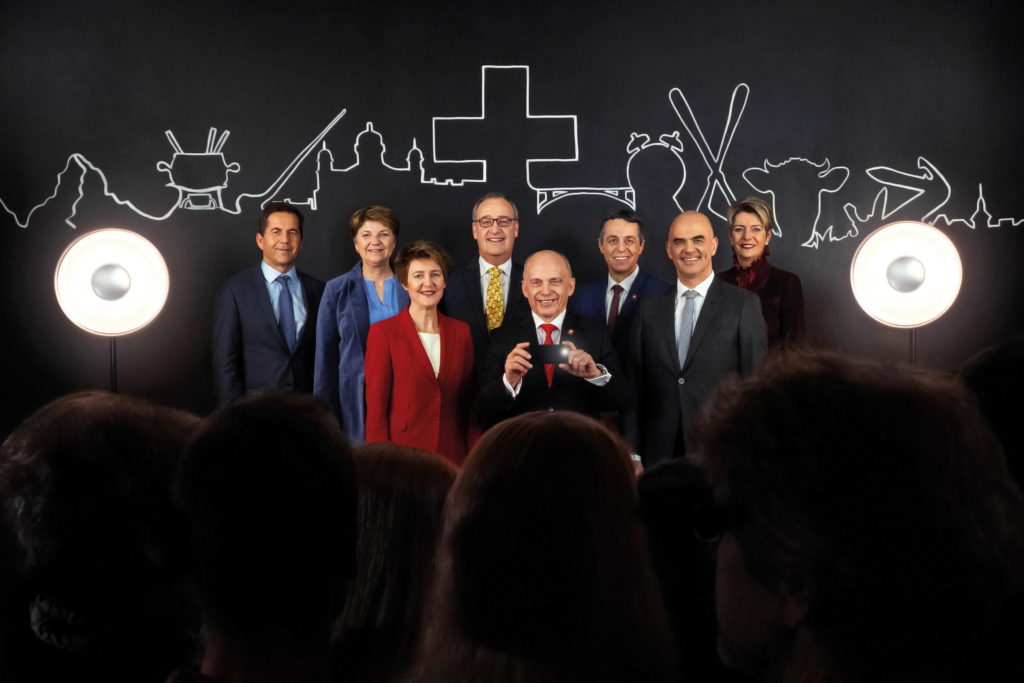
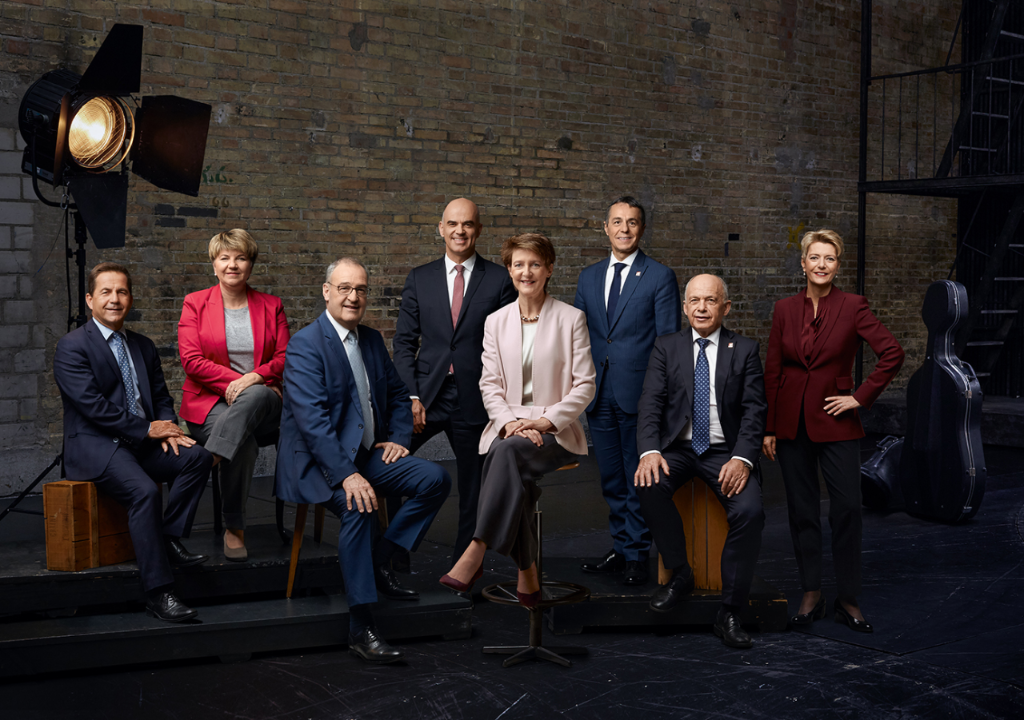
Federal Council of Switzerland

Matthew Cooke on the lies of Donald Trump

I found the video below very insightful in addressing various political concerns accurately, and exposing lies. But I was puzzled by what Cooke was recommending. I agree with him about the desirability of some of the recommendations of “some” of the Democrats. But these recommendations are not shared by the majority of Democratic politicians, because in reality both the Democratic and the Republican Parties serve the interests of the rich, i.e., the 1%. So I am left puzzled by his unstated conclusion: Vote for the lesser of the two evils?

Political Orientation

In the Wikipedia article, Poltical Spectrum, there are described different ways of placing a person’s political orientation.

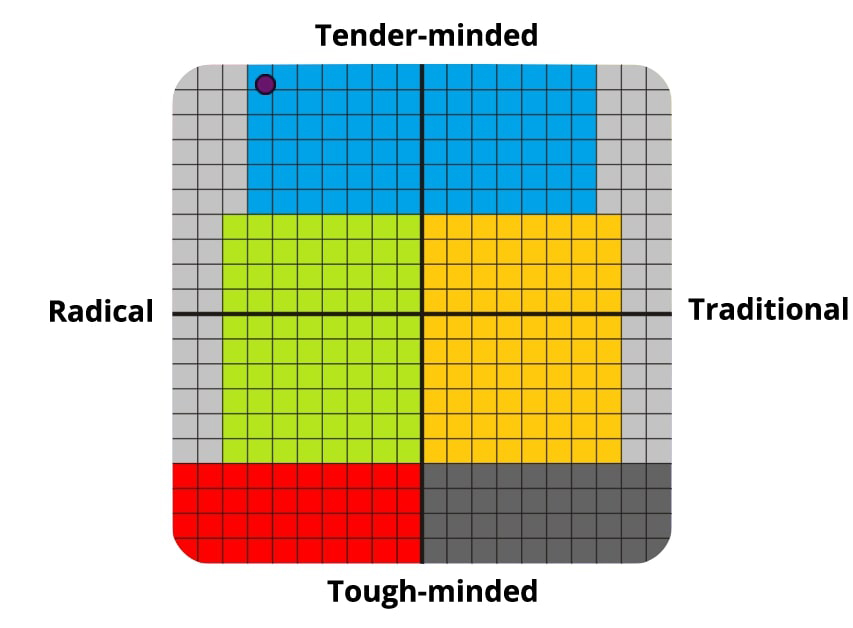
An early one was presented by the psychologist Hans Eysenck “Chapter 7: Politics and Personality,” in Sense and Nonsense in Psychology (1957).

I found a quiz on the internet — allegedly based on Eysenck’s work — which can be taken by anyone to see where they are placed on his scale. Here is the quiz, and below is my own result after taking the quiz:

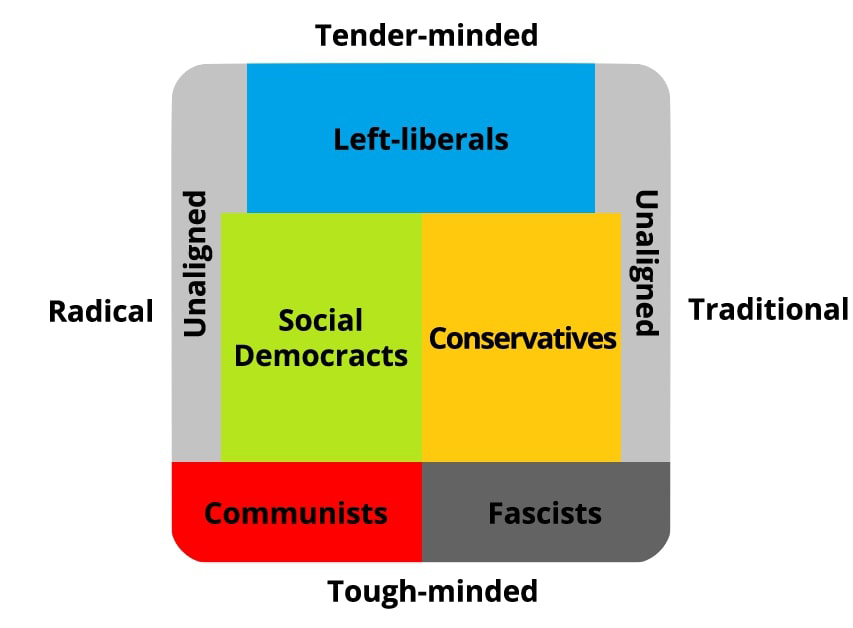
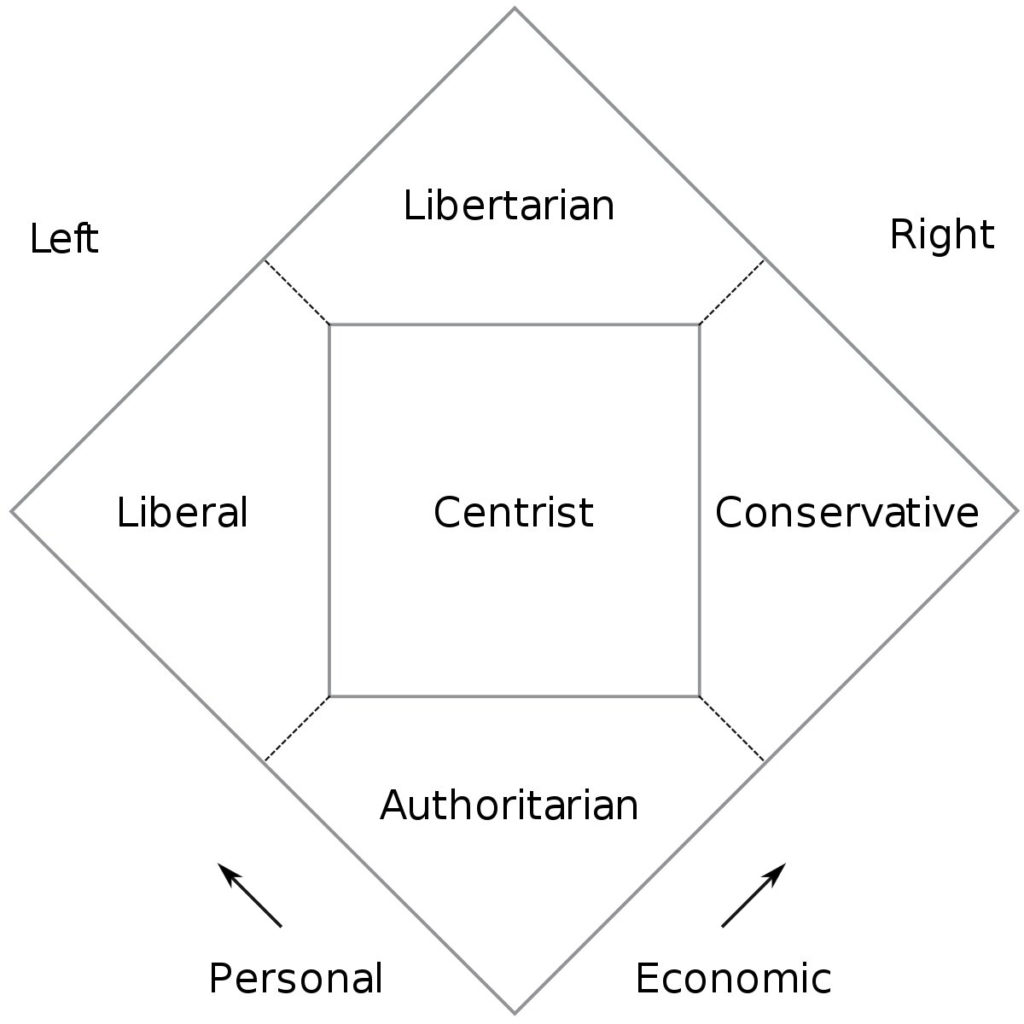
There is also a similar chart, called the Nolan chart, which looks like this:
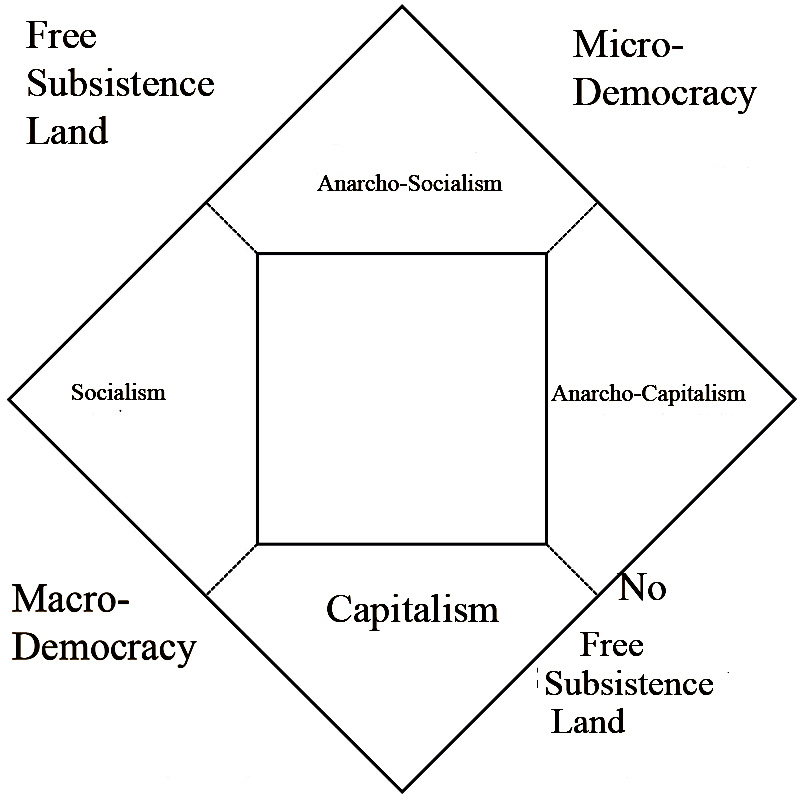
My own approach to political charts is more limited. Since I reject all non-democratic forms of government, that leaves me with two questions:

1. Are you in favor of giving each person a right to free subsistence land? Yes No

2. Are you in favor of micro-democracy? Yes No

I also associate macro-democracy with a centralized government, there are thus four possible alternatives.

Andrew Chrucky’s Politico-Economic Democratic Chart

Why is the government of Switzerland invisible?

Most of the governments of the world have a person with whom we identify a country. The most visible and troublesome ones are Donald Trump, the President of the United States, and Vladimir Putin, the President of the Russian Federation. Then there is the motley crew of Angela Merkel, the Chancellor of Germany; Emmanuel Macron, the President of France; and Boris Johnson, the Prime Minister of the United Kingdom. Then there is Kim Jong-un, the Dictator of North Korea; Nicolas Maduro, the President of Venezuela; Benjamin Netanyahu, the Prime Minister of Israel. Also there are a host of — at least to me — peripheral leaders: Xi Jinping, President of China; Mohammed bin Salman, the Crown Prince of Saudi Arabia; Viktor Orbán, Prime Minister of Hungary; Justin Trudeau, the Prime Minister of Canada; Volodymyr Zelensky, the President of Ukraine. Other leaders are, for me, at the margins — and I have to look them up or be reminded of who they are.

As to Switzerland, the government of Switzerland is basically invisible to me — even if I look up who’s who. Why? Primarily because they do not have a single leader, but a Federal Council consisting of seven individuals, who — unlike the nine-member Supreme Court in the United States who are often quite visible because of their individual identifiable controversial decisions — cannot be individually identified with any decisions because their individual votes are unrecorded and unknown.

Besides, whatever the Federal Council’s decisions are, they are neither controversial nor of international significance. The significant decisions of Switzerland are made through national referendums and national initiatives by the people; not by any leader. The result of this type of government is a prosperous, peaceful, and neutral country in times of war.

Viva la Switzerland!

Der Gesamtbundesrat 2020 (von links nach rechts): Bundeskanzler Walter Thurnherr, Bundesrätin Viola Amherd, Bundesrat Guy Parmelin (Vizepräsident), Bundesrat Alain Berset, Bundespräsidentin Simonetta Sommaruga, Bundesrat Ignazio Cassis, Bundesrat Ueli Maurer, Bundesrätin Karin Keller-Sutter. Foto: Annette Boutellier/Yoshiko Kusano

Inverted Totalitarianism

Below is an eight-part conversation between Chris Hedges and Sheldon Wolin (1922-2015) about, what Wolin called, “Inverted Totalitarianism.” Briefly: Classic Totalitarianism = Politics trumps economics; Inverted Totalitarianism = Economics trumps politics. This is a conversation about political philosophy and a history of, primarily, American “democratic” politics and its precarious social institutions.


Wolin’s major books are:
  • Politics and Vision: Continuity and Innovation in Western Political Thought (Part I – 1960; Part II – 2004)
  • Tocqueville Between Two Worlds: The Making of a Political and Theoretical Life, 2001.
  • Democracy Incorporated: Managed Democracy and the Specter of Inverted Totalitarianism, 2008.

  • The Political Views of Martin Gardner

    If you are like me, you have collected many books which you intend to read, but don’t get to them for years, and then there are those “archaic” books which take up your attention instead. The result is missing out on what is currently published or in fashion.

    Well, I finally read some of Martin Gardner’s “The Whys of a Philosophical Scrivner” (1983); “Postscript” (1999). He tells us that he believes in a God, in soul, in immortality, and in the efficacy of prayers. And he has no justification for any of these beliefs except for the fact that he believes them. Period. So much for the Enlightenment project!

    Well, I am not interested in his personal faith, and so, most of his book is of little interest to me, except for the three chapters in which he expounds his political views. These are chapter 7: The State: Why I am not an Anarchist; chapter 8: The State: Why I am not a Smithian; chapter 9: Liberty: Why I am not a Marxist.

    These three chapters could have been combined with the title: Why I am a Social Democrat.

    He correctly points out that political labels are ambiguous and vague; so we must understand them as used by Gardner. Extreme socialism (which he identifies with Marxism), for him, is a position in which the State owns and operated the means of production; every industry in nationalized, as it was in the Soviet Union. By “Smithian” he mean laissez faire capitalism with a minimal State, as expounded, for example, by Robert Nozick in “Anarchy, State, and Utopia” and by Milton Friedman in “Freedom and Capitalism.” By “anarchism” he means a Stateless society (which he extends to mean “governmentless”).

    He thinks a Stateless society is now unfeasible in view of industrialization. But he does not want industry to be totally in private hands. He wants some industries to be nationalized, private industries to be regulated by government, and he wants a welfare State. And he wants a constitutional democracy. This conglomerate of ideas he calls “social democracy.”

    He points out that most States are a mixture of free enterprise and government control. The problem is to find the right balance between the two.

    In response. From my perspective the problem is “constitutional democracy” — which Gardner talks about only in a peripheral manner. He writes: “Democracy clearly functions best to the degree that voters are intelligent and well informed, which means, of course, that the efficiency of democracy is strongly tied to education.” … “education may not keep pace with extensions of the franchise, that ignorant voting will substitute a rule by boobs for a rule by the wise.” p. 120.

    And we do have rule by boobs.

    But the problem is not simply that we have an uneducated electorate. The problem is many-fold. Given mass democracy (as contrasted with micro democracy), a candidate for office must rely on advertisement (which takes money), and, as Gardner pointed out, in 1967, in Picoaza, Ecuador, a foot powder, called Polvapies, was elected mayor. Gardner confesses to not knowing how to solve this problem except through better education.

    Also given mass democracy and the need for candidates to advertise, the probability is that only the rich and the friends of the rich will be elected. And once elected, they will work for the rich — as is definitely the case in the United States.

    We also have right now in the U.S. a President, who happens to be a boob. In Switzerland they don’t have this problem. They have a Federal Council of seven individuals. So, even if one of them is a boob, there are six others to keep him in his place.

    Gardner, I fear, never understood what was capitalism. It is a free-enterprise system which is aided by a government which forbids people from free access to subsistence land. And given the nature of mass democracy in which the rich rule, there never will be passed a law which gives people a free access to subsistence land.

    This can only occur with anarchism, which is based on micro democracy in which the unit of government is a small community of some 100 families federated with other such communities into a confederation. Gardner was unaware of this form of anarchism in Ukraine under Nestor Makhno during the Russian Civil War 1918-1921; nor of the anarchism which flourished in Spain during their Civil War and Revolution 1936-1939, with worker-controlled enterprises both in industry and agriculture.

    Gardner rejected anarchism because he did not know what it was.