What is the difference between a Mercenary and a Paid Soldier?

“People view soldiers like wives and mercenaries as prostitutes, who turn love into a transaction. But every soldier has a little mercenary in him, and vice versa. Troops often reenlist for big bonuses, a transactional practice common in most militaries. For example, the U.S. Army sometimes offers up to $90,000 for Soldiers to reenlist, enough to make modern mercenaries salivate. The author has also seen mercenaries refuse jobs on political grounds. Some American-hired guns will never take money from Russia, China, Iran, or a terrorist group; America’s enemies are their enemies. The line between soldier and mercenary is fuzzy.” Sean McFate, Mercenaries and War: Understanding Private Armies Today, National Defense University Press, 2019.

Interview with Sean McFate about mercenaries

Jeremy Scahill, Blackwater: The Rise of the World’s Most Powerful Mercenary Army, 2007.

Russian Mercenaries — The Wagner Group

Candace Rondeaux, Decoding the Wagner Group: Analyzing the Role of Private Military Security Contractors in Russian Proxy Warfare, 2019.

On Nation-States and Federalism

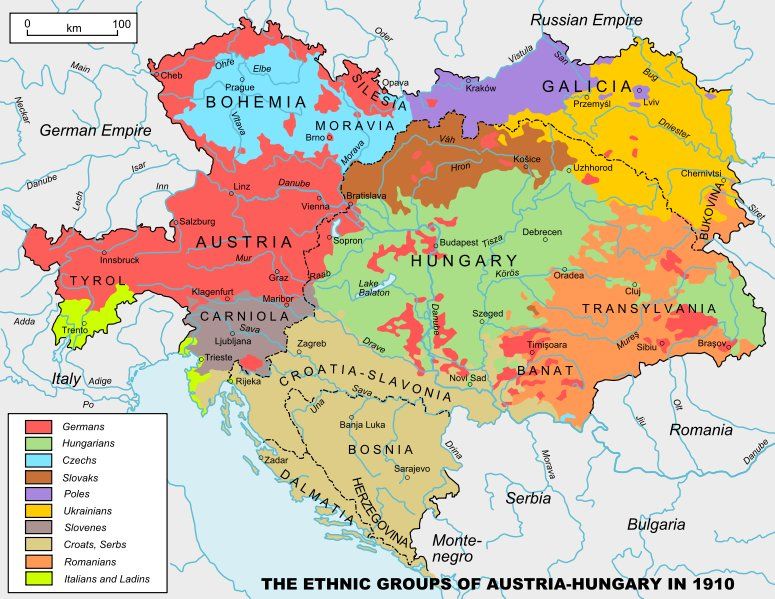
I am reading Oscar Jaszi’s book, The Dissolution of the Habsburg Monarchy, 1929. It is interesting for me from several perspectives. Jaszi’s thesis is that Austria should have been divided along its ethnic or national units into a federated State like that of Switzerland. He enumerates and discusses the various tensions between the various nationalities and “irredentist” aspirations. [An “irredentist” aspiration is one of wanting to unite with one’s ethnic group in an adjoining State (Country).)

Below is a map of the Austro-Hungarian Empire with its various ethnic groups in 1910:

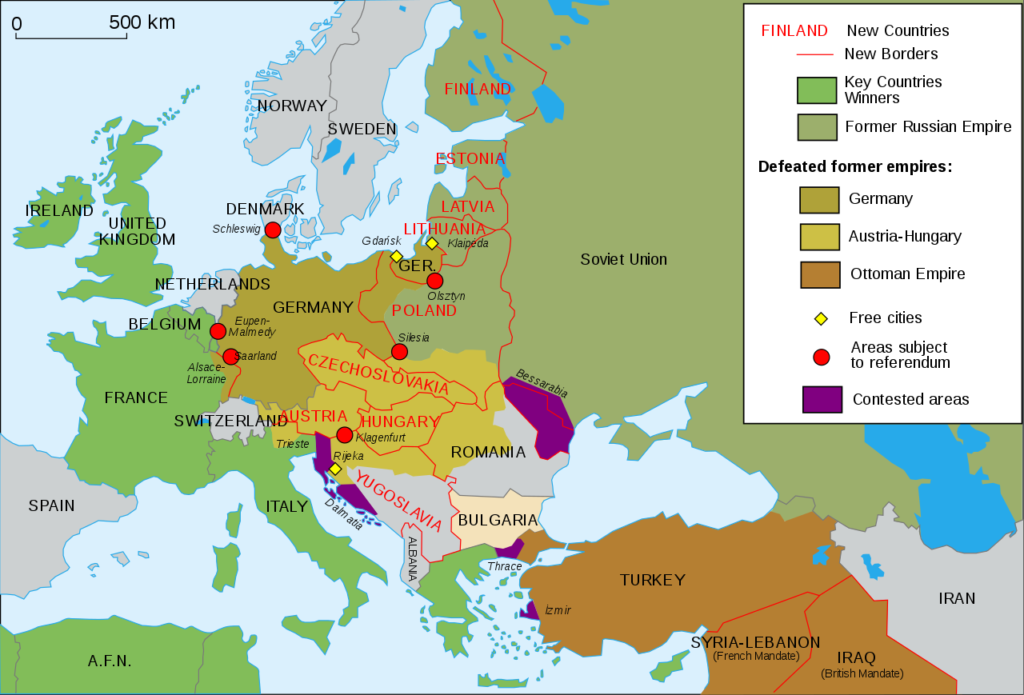
As a result of the First World War, Austria was defeated, and by the Treaty of Versailles its territory was divided more equitably (but not enough) along ethnic groupings as illustrated by the map below:
I am in agreement with Jaszi about federalism — i.e., that a State should be organized on the basis of autonomous smaller units. I take it that he would be satisfied with the example of the United States, and more so with that of Switzerland. Let us call the former, Large Federalism; the latter, Moderate Federalism. However, I advocate a more radical federalism — call it Small or Radical Federalism. Radical Federalism requires the local unit of government to represent about 150 families. Radical Federalism is equivalent to Anarchism. This is why Proudhon’s tract “The Principle of Federation” (1863) is synonymous with anarchism (contrary to those who think otherwise).

The federalism of the United States consists of 50 States. The whole country of over 300 million people elects a President. Each State elects two Senators to Congress — by thousands and millions of people. The number of Representatives to Congress is relative to the population of the State. But this too is by thousands and millions of people voting. As far as the government of a State is concerned, the Governor and the Representative to the State Legislature are also elected by thousands and millions of people.

This huge number of voters is also present on the municipal level. I live in Chicago which has a Mayor elected by the nearly 3 million citizens. There is also a City Council of 50 Alderman, each elected at 50 Wards by some 40,000 voters each.

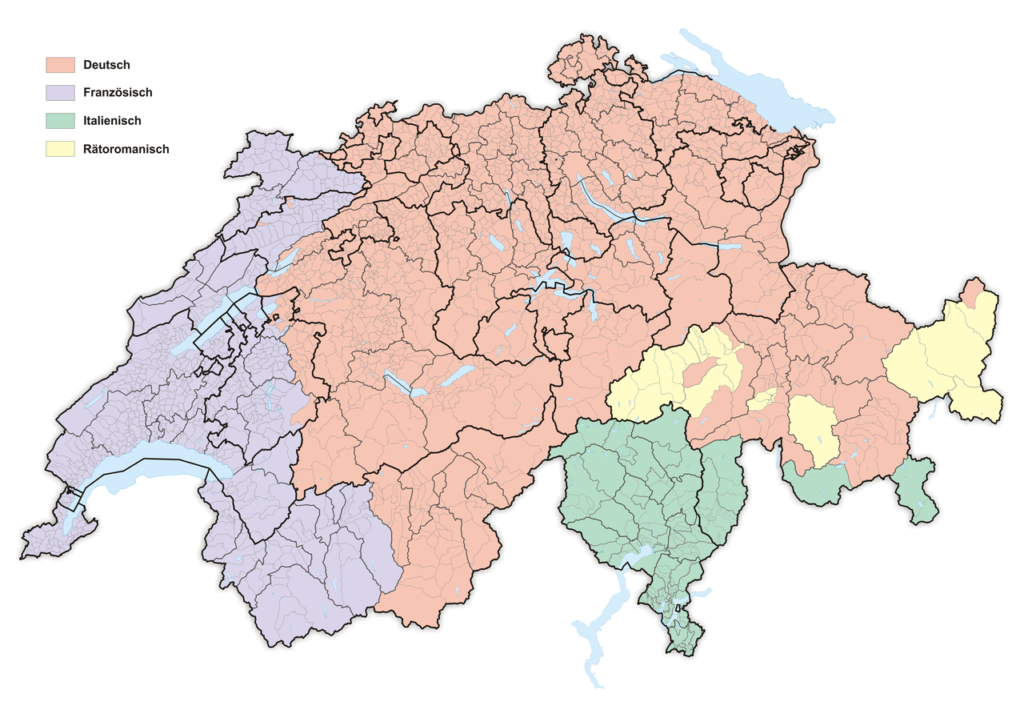
I describe the federalism of Switzerland as Moderate as contrasted with that of the United States. Its territory is much smaller than that of the United States, and its population of nearly 9 million approximates the population of Greater Chicago (i.e., including the surrounding suburbs of Chicago). It consists of 26 Cantons, grouped by languages (German, French, Italian, and Romansh).

Here is a video explaining the Swiss political system: Video

My objection to both the government of the United States as well as to the government of Switzerland is that they base themselves on, what I call, Mass or Macro-Democracy in which thousands and millions of people vote either for politicians or laws. Instead I favor Micro-Democracy as a unit of government of roughly 150 voters. This is my ideal of anarchism. Lately it has been called Participatory Democracy, Municipal Confederalism, Strong Democracy, and a system of Nested Councils. I found the following article clearly explaining this point of view [it also has relevant links!]: Sveinung Legard, Scaling Up: Ideas about Participatory Democracy

The Conquered Earth

I am interested primarily in understanding how our social world operates. By “social” I mean how humans interact with one another. And to do this I will rely on the vocabulary and explanations used by Franz Oppenheimer in his book The State (which is part of the second volume of his four volume Systems of Sociology [never completely translated into English]).

In the past (19th century) there was a constant concern with “the Social Problem.” Although this problem was seen from a symptomatic perspective as poverty, I think this problem can be expresses fundamentally and succinctly in the following way: some people by force prevent other people from taking up and occupying subsistence land. Put thus, all this means pre-historically is that groups of people delimited a territory as their property. This results in a scattering of tribes. Anthropologists study such “stateless people” especially indigenous people which were referred to as “savages” and “barbarians”, as contrasted with “civilized people.” The vocabulary comes from Lewis Morgan’s, Ancient Society (1877), which distinguished people by their tools, and “civilized people” by having a written script.

Now, because, as Oppenheimer calculated, there is and was enough land to go around. The prevention of someone taking up subsistence land can occur only by force. Presently this force is exercised by governments in States.

Oppenheimer believed that such governments and States can occur only by conquest of one external group by another. Some anthropologists quibble about this, contending that States can be formed through internal class divisions. Without entering into this quibble, let me offer the following two claims:
1. a sufficient condition for the formation of States is conquest by an external group.
2. the empirical data in recorded history is of warfare, strife, protest, rebellion, and conquest.

Moreover, these violences are almost invariably associated with particular individuals who are called emperors, kings, princes, rulers, conquerors, presidents, prime ministers, chancellors, and such. It is the deeds of these individuals which constitutes the history of States.

The Social Problem of forceful barring people from a free use of subsistence land is called by Oppenheimer the “political means” as contrasted with a free exchange of goods and services called by him the “economic means.”

Oppenheimer contrasted two ways of getting “honey.” (Honey is his metaphor for economic subsistence.) One is the method of the bear: attack the hive regardless of what happens to the bees and take the honey. The other method is that of the bee-keeper: take some honey, but leave enough so that the bees thrive and produce more honey for further taking.

Oppenheimer distinguished six stages (or ways) of how conquerors deal with the conquered people. The first stage in like that of the bear: kill the people and take the loot. This is illustrated in the Bible as the extermination of the Canaanites by Israelites, early Viking raids and pillages, and generally historic and modern ethnic cleansings and genocides. The second and subsequent stages or ways is that of the bee-keeper: make the conquered people slaves, or demand tribute, or settle among them as in feudalism and require goods and services, and later also payments (taxes), or just fees, licenses, and taxes. The so-called constitutional states attempt to give this class division legitimacy through such myths as the will of the people or a social contract, and finally as mass democracy (where thousands and millions vote for so-called “representatives”).

The essence of capitalism — which predated industrialization — is the continued barring of people from a free access to subsistence land. And since all the earth is now divided into States, the only places to go in order to escape a State are: a war zone, border lands, a frontier, mountains, swamps and jungles — where pursuit is difficult or unprofitable.

Social Diseases and their Symptoms: Reform and/or Revolution

I watch and read what are called “progressive” items. And I tend to cheer for so-called “progressive” politicians. But on reflection they all are — what Eduard Bernstein called — Reformists rather than Revolutionists, as were, for example, Rosa Luxemburg and Karl Liebknecht

What is the difference? To use the analogy with diseases, there are causes of a disease and there are symptoms. A reformist is, in my view, someone who treats the symptoms; a revolutionist is someone who treats the causes.

As concerns public intellectuals, let’s face it: for such people to live fairly well in the modern world requires an income. This includes teachers, writers, journalists, media hosts and internet personalities, and politicians. One way of doing this is to have some kind of public forum, and attract donations, subscriptions, and advertisers. A book, a piece of writing, a performance, or a movie is — more or less — a one time attraction which will generate an immediate income. But a steadier source of income comes from a newspaper, a journal, a “show” — or movie-wise, a “serial.” [I myself after hoping for donations to this site, have turned to monetizing through advertising.]

To make my point about Reformists as contrasted with Revolutionists, let me concentrate on my favorite news hour: “Democracy Now,” which the host, Amy Goodman, calls a “show.” It starts off with a news summary concerned with war and peace, and then proceeds to concentrate on some specific topic or to conduct an interview. It intersperses a piece of music during transitions.

I have no quarrel with the topics covered. They are all concerned with the major symptoms of the social diseases — so many deaths here and there because of a war, a revolution, a disease; so much poverty, unemployment, homelessness here and there; bad leaders elected and corruption here and there; protests and brutal repressions here and there. The litany of evils continues show after show.

The show proposes anodynes: change this politician and change this law. What is missing from consideration are the causes of these social symptoms. And to deal with the causes there is need to transition to a Revolutionary stance. But dwelling on a revolutionary stance is counter-productive to a political “show” — which aims to entertain while delivering some remedial message. Actually the best form of this approach was practiced by George Carlin, the comedian, who couched his social and political commentary in the guise of comedy.

In my view — as was the view of many revolutionaries — the disease is Capitalism, and its sustainer, the State.

Although I think that Noam Chomsky has the best insights into the Social Problems — it takes will power to listen to his monotone voice. I find Chris Hedges’ preacher-like delivery more focused and succinct.

The main immediate global problem, as Chomsky keeps repeating, is that humans are destroying the ecosystem, and thus themselves. And, in my view, the direct cause of this is human overpopulation.

And the power of doing anything about this and other social problems such as capitalism is the central (federal) government — the State. The clearest understanding of how the State arises and its nature is to be found in the small book by Franz Oppenheimer, The State, 1914.
And there are two revolutionary attitudes toward the State: one is to take control of the State (this was done by Napoleon, Lenin, Mussolini, Hitler, among others). This is also the Macro-Democratic parliamentary method of electing a President, Prime-Minister, or other single “deciders.” The other method is to dispense with the State in favor of bottom-up micro-democratic communities (anarchism).

But where in a progressive news show like “Democracy Now,” is there a suggestion that the Swiss government is better than that of the United States? Where is the criticism of the U.S. Constitution as was undertaken by Lysander Spooner? And where among the pundits is there an understanding of Capitalism as a denying people free access to subsistence land?

Can a log-cabin be built in one day?

I read about the Harmonists (aka Rappists), who made their final move to Economy, which today is called Ambridge, Pa. on the Ohio River about 15 miles northwest of Pittsburgh. There is preserved some of the old Harmonist village, including the house of George Rapp, their founder and leader. Anyway, what struck me was the claim that they build log-houses at the rate of one a day! Is this possible? Watch the video clips below.

In 1824 they removed once more. They sold the town of Harmony and twenty thousand acres of land to Robert Owen, who settled upon it his New Lanark colony when he took possession. Owen paid one hundred and fifty thousand dollars not nearly the value of the property, it is said; but the Harmonists had suffered from fever and ague and unpleasant neighbors, and were determined to remove. They then bought the property they still hold at Economy, and in 1825 removed to this their new and final home. One of the older members told me that the first detachment which came up from Indiana consisted of ninety men , mechanics and farmers; and these “made the work fly.” They laid out the town,cleared the timber from the streets and house places ; and during some time completed a log-house every day. Many of these log-cabins are still standing, but are no longer used as residences. The first church, now used as a storehouse, was a log-house of uncommonly large dimensions. (Charles Nordhoff (1830-1901), The communistic societies of the United States, 1875, pp. 76-77)

Ohio Amish Barn Raising – May 13th, 2014 in 3 Minutes and 30 seconds

[Movie] Witness (1985) – ‘Building the Barn’ scene

Capitalism is the cause of Poverty

Watch the following clip in which Milton Friedman addresses the problem of poverty in the United States.

My response:

If Marshall Sahlins is correct about hunter/gatherers forming the original “affluent” society, then poverty must surely be some kind of departure from the hunter/gatherer society. [I include horticulturists and herders.]

There are three characteristics which such primitive or “savage” societies have. The first is that everyone has a free access to subsistence land (socialism). The second is that they form small egalitarian democratic groups (anarchism). The third is that they share freely, and are prone to gift giving (communism).


Today (Dec. 3, 2020), someone posted on Facebook the following story, which for me illustrates the communism of hunter-gatherers:

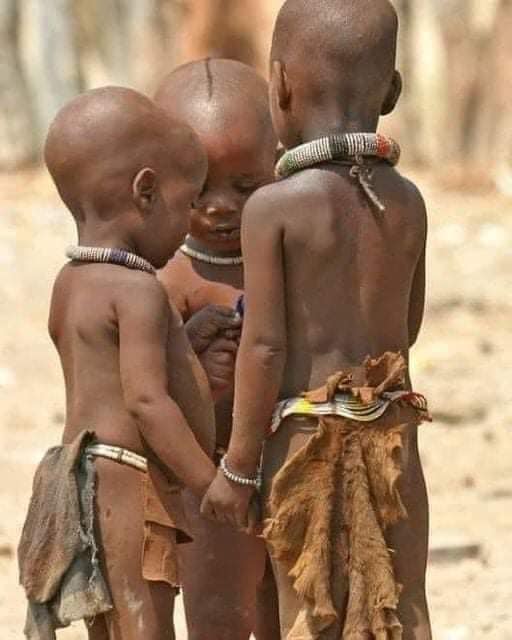
“The anthropologist invited children from an African tribe to play a game. He placed a basket of fruit next to the tree and announced to the children, “The first of you to run to the tree will get all these sweet fruits.” When he motioned for the children to start the race, they clasped their hands tightly and ran all together, and then all sat together and enjoyed the delicious fruit.

The astonished anthropologist asked the children why they all ran together, because each of them could enjoy the fruit for themselves? To which the children replied: “Obonato”. Is it possible for one to be happy if everyone else is sad? “Obonato” in their language means: “I exist because we exist.””


Peter Joseph has characterized poverty as a deprivation of each of these. The first he calls “absolute poverty.” The second he calls “relative poverty.” The third he calls “poverty of the spirit.” [Peter Joseph, The New Human Rights Movement, 2017, pp. 157-59.]

The fundamental one is the deprivation of people of a free access to subsistence land [absolute poverty].

This deprivation — as Franz Oppenheimer has convincingly shown — can occur only through conquest. The conquest results in class divisions between the conquerors and the conquered, which morphs into the governors and the governed, the masters and the slaves, the landlords and the serfs, and now into a tripart system of the governors, the employers, and the employees.

All these systems i.e., slavery, feudalism, and capitalism, have one thing in common: forbidding a free access to subsistence land.

Milton Friedman has claimed that capitalism has been responsible for reducing poverty. If Friedman were conscious of the fact that capitalism requires a mass of proletarians (these are people who do not have a free access to land and subsistence) — something created by the laws of a centralized State — then the fact that some proletarians are given wages by the same system which deprived them of subsistence to begin with, then the situation has the form of taking everything from you, and then returning some of it back to you.

In other words, capitalism creates a proletariat and then takes some of them out of the created poverty by employing them.


See also: Andrew Chrucky, Milton Friedman’s Hidden Anarchism in Capitalism and Freedom, Aug. 8, 2008.

The Danger of Disgruntled Employees and a Lame Duck President

Julian Carlton, on Aug. 14, 1914, set fire to Frank Lloyd Wright’s house, Teliesen, in Wisconsin, and killed seven people, this included killing with an axe.
“Carlton’s motive for the attack was never conclusively determined, as he pled not guilty and refused to explain himself to the authorities before passing away. However, it is most likely that Carlton snapped after learning he would be let go from his job at Taliesin. Witnesses claimed he had been in several disputes with both employees and Borthwick, and that Wright had begun advertising for another worker. Carlton’s wife Gertrude, who also lived and worked on the grounds, further testified that her husband had recently grown agitated and paranoid, and that the two of them were even supposed to travel to Chicago in search of work on the day of the rampage.”TALIESIN MASSACRE (FRANK LLOYD WRIGHT)

It has become a policy when firing an employee to have the employee pack-up his personal belongings under supervision and be escorted out of the building immediately. This is to prevent any time for brooding and performing acts of retaliation, as what seems to have occurred at Teliesen.

President Trump has been given roughly 70 days for brooding and retaliation, until his replacement on Jan. 20, 2021.