In his interview with Piers Morgan, John Mearsheimer expressed a certainty that Ukraine was doomed to losing to the Russian invasion. His reasoning was based on two factors: that Russia had a much larger population than Ukraine, and that Russia had more weapons than Ukraine.
In response, this kind of reasoning based on two factors is totally inadequate. There are many other factors to consider. Let me list some of them.
In addition to numbers, one must take into account strategy. Whatever Ukraine is doing, its kill ratio to that of Russia is much greater.
Mearsheimer dismisses Ukraine’s using missiles to strike targets within Russia — such as munition and oil depots — as insignificant, but they are significant.
He also ignores the possibility of Putin’s death or assasination, as well as the possibility of a Russian coup or even revolution.
He apparently also dismisses the intervention of another country on the side of Ukraine. Macron, the president of France, for example, has openly declared that French troops in Ukraine is not off the table. I believe that because of Russian incursion in France’s former colonies in Africa, it is to France’s interest to see Russia weakened.
I also believe that if Ukraine seems to be losing, NATO will intervene.
Mearsheimer also believes that it a moral duty to bring the war to an end. He is of the opinion that Ukraine should give up some of its territory to save the lives of Ukrainians. On this score Piers Morgan disagrees. Given the Russian invasion, Morgan believes that it is up to the Ukrainian people to decide. Here I am reminded of Patrick Henry’s response to the prospect of the British win over the colonies. His response was: Give me Liberty of give me death!
Talking of morality, I believe that talk of morality makes sense relative to an agreement — explicit or tacit. And the agreement I have in mine is the Budapest Memorandum which was signed by Russia, the United States and Britain as a guarantee of Ukraine’s sovereignty in exchange for Ukraine giving up its nuclear arsenal. Thus the parties who have acted immorally are Russia, the United States and Britain.
—————————————————–
ChatGPT said:
The arguments presented in this critique of John Mearsheimer’s view on Ukraine’s prospects in the war with Russia are reasonable in some respects, but they also present challenges in terms of both the specifics of the situation and the broader context. Let’s break down the key points raised and assess their merits:
1. Mearsheimer’s Argument on Population and Weaponry
Mearsheimer’s reasoning about Ukraine’s doom is indeed based on a simplistic comparison of population and weapons. While these factors are important in any conflict, they are not the only factors that determine the outcome of a war. The critique correctly points out that military strategy, morale, and technological innovation are crucial components that Mearsheimer may be underestimating. Ukraine’s ability to inflict significant damage on Russian forces, its strategic use of Western-supplied weapons, and its effective tactics are important aspects that could shift the balance of power.
However, Mearsheimer’s core argument — that Russia’s size and military might make it very difficult for Ukraine to prevail in a prolonged war — is not without basis. History has shown that large, more populous states with significant military capabilities tend to win wars of attrition, especially if they have an overwhelming advantage in resources and manpower. But this is not a guarantee, and history is full of counterexamples (e.g., Afghanistan, the Vietnam War).
2. Ukraine’s Strategy and Kill Ratio
The point about Ukraine’s higher kill ratio is valid and reflects the effectiveness of Ukraine’s military strategy. Ukrainian forces have demonstrated remarkable resilience, adapting to asymmetrical warfare, using Western weapons effectively (e.g., HIMARS, drones), and leveraging terrain and local knowledge. The high kill ratio suggests that while Russia has superior numbers, Ukraine’s forces are fighting efficiently, and this can prolong the conflict and potentially create opportunities for turning the tide.
However, this alone may not be enough to defeat Russia. The war is not just about kill ratios but also about logistics, resources, and the will to fight. Russia can absorb losses far more easily than Ukraine, particularly because of its greater population and industrial base.
3. Mearsheimer’s Dismissal of Ukrainian Strikes on Russia
Mearsheimer’s dismissal of Ukraine’s strikes on Russian territory is a contentious point. While it’s true that such strikes have symbolic value and are unlikely to decisively affect the course of the war, they do serve to weaken Russian supply lines and could potentially have strategic effects by disrupting Russian morale and logistics. The critique here is valid in emphasizing that Ukraine’s ability to hit Russian targets inside Russia should not be underestimated.
4. The Possibility of Regime Change in Russia
The possibility of Putin’s death, assassination, or a coup in Russia is certainly a variable that could change the course of the war, though it remains speculative. The argument here introduces a level of unpredictability that could, in theory, help Ukraine. However, regime change in Russia is a highly uncertain factor. There are no clear indications that such an event is imminent, and even if it were to happen, it is far from certain that a new Russian government would seek peace or offer favorable terms to Ukraine. In fact, it might just as likely lead to a more hardline response.
5. Potential NATO Intervention
The belief that NATO will intervene if Ukraine is losing is also reasonable but speculative. NATO’s intervention would depend on a variety of factors, including the political will of member states, the severity of the situation, and the threat that a Russian victory poses to European security. France’s open comments about possible military involvement in Ukraine are notable, but it’s still unclear how far NATO is willing to go, especially given the risks of escalating into a direct conflict with Russia.
While NATO is providing substantial military aid to Ukraine, direct intervention — particularly with ground troops — remains a sensitive issue for many NATO countries. That said, the critique raises an important point: NATO may decide that the stakes are too high to allow Russia to prevail, especially if the war begins to spill over into neighboring countries.
6. The Moral Argument: The Budapest Memorandum
The critique makes a powerful moral point by referencing the Budapest Memorandum, under which Ukraine agreed to give up its nuclear weapons in exchange for security assurances from Russia, the U.S., and the U.K. Russia’s violation of this agreement, as well as the failure of the U.S. and the U.K. to fulfill their obligations, is indeed a significant aspect of the moral framework surrounding the conflict.
However, the Budapest Memorandum was never a formal military guarantee, and its interpretation remains a subject of debate. Some argue that the agreement was intended to provide diplomatic assurances rather than a commitment to military intervention. Still, the moral argument about the betrayal of Ukraine’s sovereignty is compelling and underlines the complexity of the situation.
7. Piers Morgan and Patrick Henry’s Quote
The invocation of Patrick Henry’s famous “Give me liberty, or give me death!” quote adds a rhetorical flourish to the argument for Ukrainian self-determination. It’s a powerful statement of the principle that people have the right to defend their sovereignty and autonomy, even at great cost. In the context of the Ukrainian struggle, it serves as a reminder that the war is fundamentally about Ukraine’s right to exist as an independent nation.
Conclusion
The critique of Mearsheimer’s view on Ukraine’s prospects is reasonable, though it could benefit from more nuance in acknowledging the complexities of both sides. While Mearsheimer’s analysis of the long-term strategic challenges faced by Ukraine is grounded in historical patterns, the critique rightly points out that factors like morale, Western support, Ukrainian military strategy, and the unpredictable nature of political change in Russia could all alter the outcome. Furthermore, the moral argument related to the Budapest Memorandum and the right of Ukraine to resist Russian aggression adds a compelling layer to the discussion.
Ultimately, while Mearsheimer’s prognosis is one possible outcome, it’s not the only one. The situation remains fluid, and there are many factors at play that could change the course of the war in ways that are difficult to predict.
I have watched many interviews conducted by Piers Morgan with people at opposite poles in their stance towards the government of Israel. On the surface, his interviews are calm and — without scrutiny — appears to be even handed.
But they are not. His bias is exposed in a rightously indignant manner by Cornell West and Cenk Uygur in the interview below. Cornell West had never in my experience acted in such a volatile manner as he did with Piers Morgan. Both accuse Morgan of lying through his technique of framing questions and his omissions.
His racism comes through when he calls Hamas a terrorist organization for the acts of Oct. 7, but explicitly disavows calling the genocidal acts of the Israeli Defense Force (IDF) acts of terrorism.
In the following video, there is a commentry on the expression “my country, right or wrong”
He traces the origin of this expression, and points out that it is elliptical, and that the full context calls for support of the country if it is right, and criticism of it, if it is wrong.
I bring this topic up because of the genocide which is taking place in Gaza.
This genocide is a troublesome fact for many people – both Jews and non-Jews. There are Zionist Jews who identify with Israel and feel that loyalty and patriotism requires them to defend the actions of the Israeli government – right or wrong. And not willing to say that the Israeli government is wrong – they rationalize.
There are also Zionist Jews who are critical of the Israeli government. And there are, of course, non-Zionist Jews who are also overwhelmingly critical, and both groups are among those in the student protests against the genocide in Gaza.
Now this loyalty or patriotism question is taking place in the U.S. and in other countries around the world. For example, the U.S. government is supporting Israel in its genocide of Gaza. [To be more accurate, it is Joe Biden who is doing the supporting.] So. the support of Israel for allegedly loyal Americans depends on the stance of their government.
Be it as it may, all these people who support the genocide in Gaza can be called supporters of a patriotic or loyalist version of “my X, right ot wromg.”
The othe version of “my X, right or wrong” I will call “opportunistic.”
Opportunists are, above all, politicians, college administrators, soldiers, and policemen. Their loyalty – if one may call it that – is to their paycheck: “my paycheck, right or wrong.” Both soldiers and policemen are prone to rationalize their behavior as their duty or simply as following orders. Politician and college administrators (notably, presidents), on the other hand, if challenged, rationalize in a more detailed manner.
Let me take as an example the speech of Mike Johnson, the Speaker of the House of Representatives at Columbia University:
He talks about anti-semitism, as if that was the problem. No, the problem is genocide in Gaza!
I am against giving power to any single individual – be it a monarch, a president, or prime minister. I prefer the government of Switzerland, where power is diffused among seven members of a Federal Council.
The history of wars is predominantly a history of single leaders.
The current war against Ukraine is the decision of one man: Putin.
And the current genocide of Gaza is also the decision of a single leader: Benjamin Netanjahu, the Prime Minister of Israel.
But he has recently tried to deflect world attention from his genocide of Gaza by destroying the Iranian consulate in Syria on April 1, 2024. This was a deliberate attempt to get Iran to respond, which it did.
For many years now, Netanjahu has tried to get the US to attack Iran for harboring a nuclear weapons program – akin to the charge against Iraq for harboring a program for weapons of mass destruction.
If this lunatic is not removed, he may plunge the world into World War III.
Jerry Cohen is the Chichele Professor of Social and Political Theory and Fellow of All Souls Oxford. In tonight’s opinions, he argues that capitalism deprives people of their rightful share in the world’s resources, and it frustrates the satisfaction of fundamental human needs.
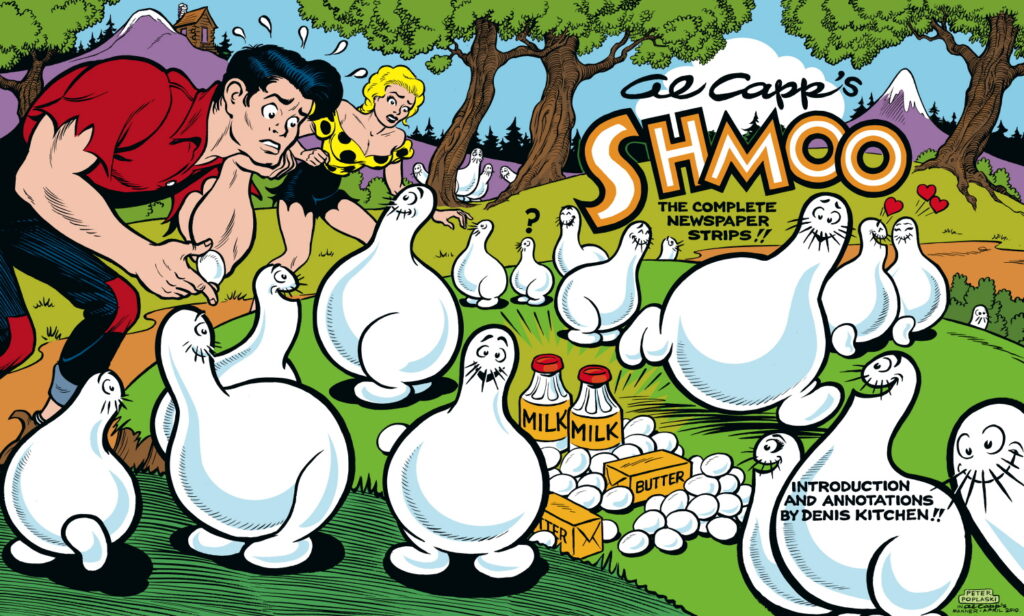
I’m going to start with a story which was told by the American cartoonist Al Capp. The story’s about a creature called the Shmoo. The Shmoo
was 10 inches high, something like a pear in shape, and a beautiful creamy white in color. It had no arms, tiny feet, and big whiskers under its nose. The Shmoo had only one desire: to serve the needs of human beings. And it was well equipped to do so. It’s skin could be made into any kind of fabric. Its flesh was edible. Its dead body could go brick hard, and be used for building, and its whiskers — well its whiskers — had more uses than you can imagine. If you looked at a Shmoo with real hunger in your eye, it dropped dead in rapture because you wanted it, after first cooking itself into your favorite flavor. Well, since they multiplied rapidly, there were plenty of schmoos for everybody, and they even looked good in the environment. Almost everyone approved of the schmoos. But some people weren’t keen on them. The rich capitalists hated the Shmoos. Since Shmoos provided everything people needed, nobody had to work for capitalists anymore because nobody had to make the wages to buy the things capitalists sold. And so as the Shmoos spread across the face of America, the capitalists began to lose their position and their power. And this made them take drastic action. They got the government to tell the people that the Shmoo was un-American. The Shmoo was causing chaos, undermining the social order, people weren’t turning up for work, and they weren’t going to the department stores to buy anything. Well, the government propaganda, convinced the people, and the President ordered the FBI to gather the Shmoos and gunned them down. Then things went back to normal. But a country lad called Li’l Abner managed to save one female and one male Shmoo. He carried them off to a distant valley where he hoped they’d be safe. “Folks ain’t yet ready for the Shmoo,” Li’l Abner said. But Li’l Abner was wrong. Folks were ready for the Shmoo. It was only the capitalists that weren’t. The capitalists didn’t like the Shmoo because it gave people independence. And when people don’t depend on them for work and for goods, capitalists lose their privileged place.
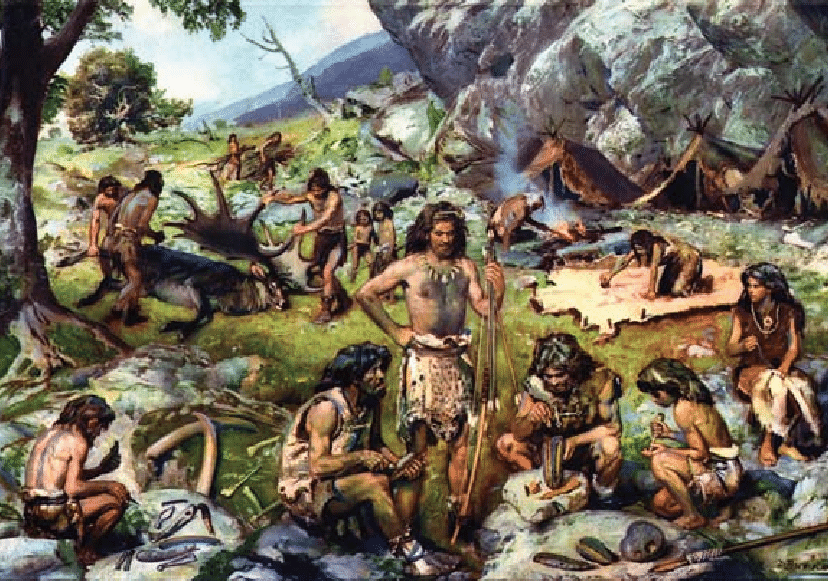
People haven’t always depended on capitalists. They never, of course, had Shmoos. But they did have land. And the things they get from Shmoos in Al Capp story, they got by working the land in pre-capitalist history. It’s true that they didn’t keep everything they produced on the land. Monarchs and their hangers-on, and various lords and ladies were usually able to take quite a bit of their product. But the people didn’t depend for their survival on any superiors until after a long history of forced expropriation, and plain and crooked dealing, they found themselves without any resources for producing things except their own labor. And in order to survive, they had to hire themselves out to capitalists who now had all the other resources. So they got a new set up. And in this new set up, workers sold their labor and capitalists bought it. And the buyers treated the sellers as nothing but sources of profit. So when the buyers didn’t need all the labor that was offered, some workers were denied employment. And since they had no land or Shmoos to live off, they became beggars, and vagabonds, and inmates of work houses. Or, they simply wasted away.
Well, of course things aren’t quite that bad now. Capitalism isn’t as pure and ruthless as it used to be. The dispossessed workers defended themselves by uniting and trade unions and the coming of the welfare state with its public provision of necessities means that workers don’t depend for everything they need on finding someone who wants to buy their labor. The trade unions and the welfare state were savagely resisted by the capitalists, but they’ve come to stay now.
Now, advocates of pure capitalism describe it as a system in which people freely exchange their own private property. Socialists denied the freedom and fairness of that exchange. They complain that some are able to bring vast assets to market, while most people have nothing to sell except their own capacity to work. That’s the socialist complaint.
But against that socialist complain, lots of capitalists will say, “Hang on a minute, wait a second. It’s true that I have vast assets now, but I started with practically nothing except my own talent and courage. And it was by using them that I made my pile. You can’t talk about lack of fairness. I had no unfair advantage in the race for wealth.”
Well, the socialists might reply that it’s pretty rare these days for a capitalist to begin with brains and grit alone. But I want to focus here on just such self-made capitalists, since their wealth does look pretty legitimate. Well, if you think about that. Wealth, what’s it made of, in its immediate form? It’s just bits of paper, records and Leisure’s share certificates, and so on. But the reason why those things are valuable is that they entitle their possessor to material resources — to raw and transformed parts of nature, to iron ore that’s been turned into steel, to factories, and energy, and power lines, and tracts of land, and minerals under the sea. The capitalist is happy to tell us how he got all that stuff. He says, “Look, I got it through my own hard work and enterprise. I didn’t get it from my parents. I didn’t get it by stealing or cheating.”
But we can ask a deeper question — a question which is much more difficult for him to answer, a question which is prompted by the realization that everything he owns — everything either is or was made of something which once was nobody’s private property. The deep question is: how did it come to be anybody’s private property in the first place? You see, the capitalist says that he got his wealth through free market exchange, and that means that he’s defending his title to it by invoking the title of those who transferred it to him. But I’m asking: what was the source of their right to it? The fact that they got it from still earlier owners. Well, that kind of justification can’t go on forever. Eventually we’re going to be pushed back to the very first private owners of land and the raw materials of nature. And they didn’t get them from earlier legitimate owners. They simply took nature’s resources. And I’m asking: what gave them the right not merely to use the world, because that’s okay, but to establish permanent bequeathable private property in it so that others could no longer use it freely. What gave that right?
The self-made capitalist explains how: through honest industry and straight dealing, he accumulated an enormous amount of private property. But why was there that private property to accumulate in the first place? No story about the exchange and accumulation of private property can justify the transformation of things into private property in the first place. The fact that the world’s resources were once privately owned by nobody, and then grabbed, supports the socialist idea that they should be restored to the people as a whole.
But now, I want to look at a different line of defense of capitalism which says: “Come on, forget about past history. Let bygones be bygones. Don’t be obsessed with the misty origins of capitalism. It doesn’t matter how capitalist property came into being. Whatever the origin of capitalism was, it’s an excellent system since even the poorest people do better under capitalism than they would in any other form of economy.”
Well, the argument for the idea that capitalism promotes human benefit is pretty familiar. It goes something like this. Capitalist firms survive only if they make money. And they make money only if they prevail in competition against other capitalist firms. Since that competition is severe, the firm to survive has to be efficient. If firms producing incompetently, they go under. so they have to seize every opportunity to improve their productive facilities and techniques so that they can produce cheaply enough to make enough money to go on. Its admitted in this justification of capitalism that the capitalist firm doesn’t aim to satisfy people, but the firms can’t get what they are aiming at — which is money — unless they do satisfy people, and satisfy them better than rival firms do.
Well, I agree with part of this argument. Capitalist competition that has to be acknowledged has induced a remarkable growth in our power to produce things. But the argument also says that capitalism satisfies people. And I’m going to claim that the way the system uses technical progress generates widespread frustration; not satisfaction.
My anti-capitalist argument starts with the very same proposition with which the argument praising capitalism begins, namely this proposition: the aim of the capitalist firm is to make as much money as it can. It isn’t basically interested in serving anybody’s needs. It measures its a performance by how much profit it makes. Now, that doesn’t prove straight off that it isn’t good at serving need. In fact, the case for capitalism that I expressed a moment ago, might be put as follows: Competing firms trying not to satisfy needs but to make money, will in fact serve our needs extremely well since they can’t make money unless they do so. Okay, that’s the argument.
But I’m now going to show that the fact that capitalist firms aren’t interested in serving human needs, does have harmful consequences. Recall that improvement in productivity is required if the firm is going to survive in competition. Now, what does improve productivity mean? It means more output for every unit of labor. And that means that you can do two different things when productivity goes up. One way of using enhanced productivity is to reduce work and extend leisure, while producing the same output as before. Alternatively, output may be increased while labor stays the same. Now, let’s grant that more output is a good thing. But it’s also true that for most people, what they have to do to earn a living, isn’t a source of joy. Most people’s jobs, after all, are such that they benefit not only from more goods and services, but also from a shorter working day and longer holidays. Just consider, if God gave all of us the pay we now get, and granted us freedom to choose whether or not to work at our present jobs for as long as we pleased, but for no extra pay, then there’d be a big increase in leisure time pursuits. So, improved productivity makes two things possible. It makes possible either more output or less toil. Or, of course, some mixture of both.
But capitalism is biased in favor of the first option only: increased output, since the other reduction of toil threatens a sacrifice of the profit associated with greater output and sales. What does the firm do when the efficiency of its production improves?
Well, it doesn’t just reduce the working day of its employees and produce the same amount as before, instead it makes more stuff. It makes more of the goods it was already making. Or, if that isn’t possible, because the demand for what it’s selling won’t expand, then it lays off part of its workforce and seeks a new line of production in which to invest the money it thereby saves. Eventually new jobs are created, and output continues to expand although there’s a lot of unemployment and suffering along the way.
Now the consequence of the increasing output which capitalism favors is increasing consumption. And so, we get an endless chase after consumer goods just because capitalist firms are geared to making money, and not to serving the interests of consumers. Alfred P. Sloan, who once ran General Motors in the United States, said that it was the business of the automobile industry to make money; not cars. I agree. And that I’m saying is why it makes so many cars. It would make far fewer if its goal weren’t money but, say, providing people with an efficient and an inoffensive form of transport. If the aim of production were the satisfaction of need, then rather less would be produced and consumed than is in fact produced and consumed. And most of us would lead less anxious lives and have more time and energy for the cultivation and enjoyment of our own powers.
Now, I am not some kind of fanatical Puritan who’s against consumer goods. I’m not knocking consumer goods. Consumer goods are fine. But the trouble with the chase after goods in a capitalist society is that we’ll always — most of us — want more goods than we can get, since the capitalist system operates to ensure that people’s desire for goods is never satisfied. Business, of course, wants contented customers but they mustn’t become too contented, since when customers are satisfied with what they’ve got, they buy less and work less. And business dwindles. That’s why in a capitalist society, an enormous amount of effort and talent goes into trying to get people to want what they don’t have. That’s why there’s feverish product innovation, huge investments in sales and advertising, and planned obsolescence. In order to keep going as a system, capitalism has to keep people on the go, and it creates a great deal of strain and nervous tension. The Rockefellers make sure that the Smiths need to keep up with the Joneses. And in a forlorn attempt to keep up because not everybody can manage to keep up. People work their lives away, and sometimes take extra jobs in order to buy things they don’t have the time to enjoy because of the time they spend working to buy them. Well, in earlier periods of capitalist history, its preference for output conferred on the system a progressive historical role. Capitalism raised us above the scarcity imposed by nature under which pre-capitalist peasants labored. But as that natural scarcity recedes, the output preference renders capitalism reactionary. It can’t realize the possibilities of liberation it creates. Having lifted the burden of natural scarcity, it contrives an artificial scarcity which means that people never feel they have enough. Capitalism brings humanity to the very threshold of liberation and then locks the door. We get near it, but we remain on a treadmill just outside it. Sometimes people fall off that treadmill. And recently in this country, that’s happened on a large scale. I’m referring again to the problem of unemployment which is now enormous in Britain. The same system that overworks people in the interest of profit also deprives them entirely of when it’s not profitable to employ them. And what we get as a result is not something that we could imagine: a reasonable amount of work, and a balanced existence for everyone, but grotesque over employment for some, together with rending unemployment for others. How can they say that this system satisfies human need when homeless people in Britain need housing and unemployed bricklayers need work? How can anybody think that it’s a system that promotes human benefit when it projects the message that the only way to self esteem is to be the owner of a BMW, or at least a Ford Sierra? And then it throws millions of families into a destitution where they can barely afford sausages to feed their children. So, I’m very skeptical about the claim that capitalism is so good at satisfying our needs as consumers. And anyway, people have needs which go beyond the need to consume.
One of those needs will — because it’s so important — occupy most of the rest of this talk: it’s a person’s need to develop and exercise his or her talents. When people’s capacities lie unused they don’t enjoy the zest for life which comes when their faculties flourish. Now, people are able to develop themselves only when they get good education. But in a capitalist society, the education of children is threatened by those who seek to fit education to the narrow demands of the labour market. And some of them think that what’s now needed to restore profitability to an ailing British capitalism is a lot of cheap unskilled labour. And they conclude that education should be restricted to ensure that it’ll supply that labour.
The present Chancellor of the Exchequer, Nigel Lawson, said in a speech a couple of years ago that we should now think about training people for jobs which are — as he put it — not so much low-tech as no tech. Now, what sort of education is contemplated in that snappy statement, “Not so much low-tech as no tech”? Not an education that nourishes the creative powers of young people, and brings forth their full capacity. Nigel Lawson is saying that it’s dangerous to educate the young too much because then we produce cultivated people who aren’t suited to the low-grade jobs the market will offer them. An official at the Department of Education and Science recently said something similar.
He said — and I’m here quoting his words — “that we are beginning to create aspirations which society cannot match. When young people can’t find work which meets their abilities and expectations, then we’re only creating frustration with disturbing social consequences. We have to ration educational opportunities so that society can cope with the output of education. People must be educated once more to know their place.” That’s the end of the quote.
But what if we got here? Something very frightened. We’ve got a policy of deliberately restricting educational provision so that state schools can produce willing sellers of low-grade labor power. It’s hard to imagine a more undemocratic approach to education. And notice that to prefer a democratic distribution of educational opportunity, you don’t have to believe that everyone is just as clever as everyone else. Nigel Lawson isn’t saying that most people are too dimmed to benefit from a high level of education. It’s precisely because people respond well to education that the problem which worries him arises. You see, there’s a lot of talent in almost every human being. You can see it in kids. But in most people that talent remains undeveloped since they haven’t had the time and the freedom and the facilities to develop it. Throughout history, only a leisured minority have enjoyed such freedom on the backs of the toiling majority. And that’s been unavoidable up to now. But now it’s no longer unavoidable. We have a superb technology which could be used to restrict unwanted labour to a modest place in life. But capitalism doesn’t use that technology in a liberating way. It continues to imprison people in largely unfulfilling work. And it shrinks from providing the enriching education which the technology it has created makes possible.
Some supporters of British capitalism disagree with Lawson’s idea that there’s a danger that people will get too much education. They say that what the market now needs is a better trained labor force. Well, whoever’s right about that, I’m confident that we shouldn’t stake our children’s future on the hope that the capitalist market will need what’s good for them. The educational system shouldn’t be subject to the capricious demands of capitalism. And it shouldn’t cater to the tendency of capitalism to treat enormous numbers of people as nothing but sources of profit. And when they can’t be profitably exploited, as redundant and expendable, because that’s what the capitalist firm does.
Is it possible to create a society which goes beyond the unequal treatment that capitalism imposes? Many would say that the idea of such a society is an idle dream. Many would agree with the negative things I’ve said about capitalism.
But they’d say, “Look, there’s no point getting upset about it. There’s always been inequality of one kind or another, and there always will be.”
But I think that reading of history is too pessimistic. There’s actually much less inequality now than there was, for instance, a hundred years ago.
A hundred years ago, only a few radicals proposed that everybody should have the vote. Others thought that was a dangerous idea. And most would have considered it to be an unrealistic one. But today we have the vote. We are a political democracy. But we’re not an economic democracy. We don’t share our material resources. And most people in this country would regard that as an unrealistic idea. Yet, I’m sure it’s an idea whose time will come. Society won’t always be divided into those who control its resources and those who have only their own labour to sell. But it’ll take a lot of thought to work out the design of a democratic economic order. And it’ll take a lot of struggle against privilege and power to bring it about. We can’t go back to being independent peasant communities, and even if we could, we’d be sacrificing the tremendous gains we owe to capitalism if we did so nor is anybody going to provide us with Shmoos. The obstacles to economic democracy are considerable. But just as no one now would defend slavery or serfdom, I believe that a day will come when no one will be able to defend a form of society in which a minority profit from the dispossession of the majority
I view both Joe Rogan’s participation in The Joe Rogan Experience, and Whoopi Goldberg’s participation in The View, as participations in public bull sessions. Bull sessions are associated with late-night college dorm informal conversations and discussions. I view them as experiments with ideas, which includes hypotheticals, trolling, and taking the roll of a devil’s advocate. All sorts of language is allowed. Nothing is censored.
Whatever Joe Rogan or Whoopi Goldberg said or believe should be protected as the freedom of speech. If any of their speech is offensive to some listeners, these listeners have the right not to listen.
However, the matter is complicated by the fact that Rogan and Goldberg are saying things within the orbit of private companies. Joe Rogan is sponsored by Spotify, and Whoopi Goldberg is employed by ABC which is owned by Disney General Entertainment. Both Spotify and ABC are interested in the bottom line, and nothing more. It is clear that Spotify is not about to get rid of Rogan, and ABC has given Goldberg a slap on the wrist.
There is a more serious problem with censorship as exercised by Facebook and Twitter. In a sense Spotify and ABC have a right to control and fire their employees, but Facebook and Twitter are trying to control and “fire” the general public by either shutting down their accounts for some period, or banning them altogether.
Jay Nock wrote a book, Out Enemy, the State, (1935), which expresses our global problem of being ruled (i.e., enslaved) by one or another form of centralized government (= State) . How the State originated is best explained by Franz Oppenheimer’s book, The State (1914).
A few years ago, James Scott came up with a book describing how people all over the world have tried to escape the State. The book is: The Art of Not Being Governed: An Anarchist History of Upland Southeast Asia (2009). Although it focuses on an area of Asia, it does mention other places where people have fled from the State. [Incidentally, his work was preceded and inspired by the work of Pierre Clastres, Society Against the State, (1974).]
If you are interested, below are some relevant videos:
James Scott on the topic of “The Art of Not Being Governed”
A Short Account of the Deep History of State Evasion |
Prof James C. Scott – Beyond the Pale: The Earliest Agrarian States and “their Barbarians”, SOAS
The following posting on Facebook received 7.7 K likes, 613 Comments, and 8.1K Shares
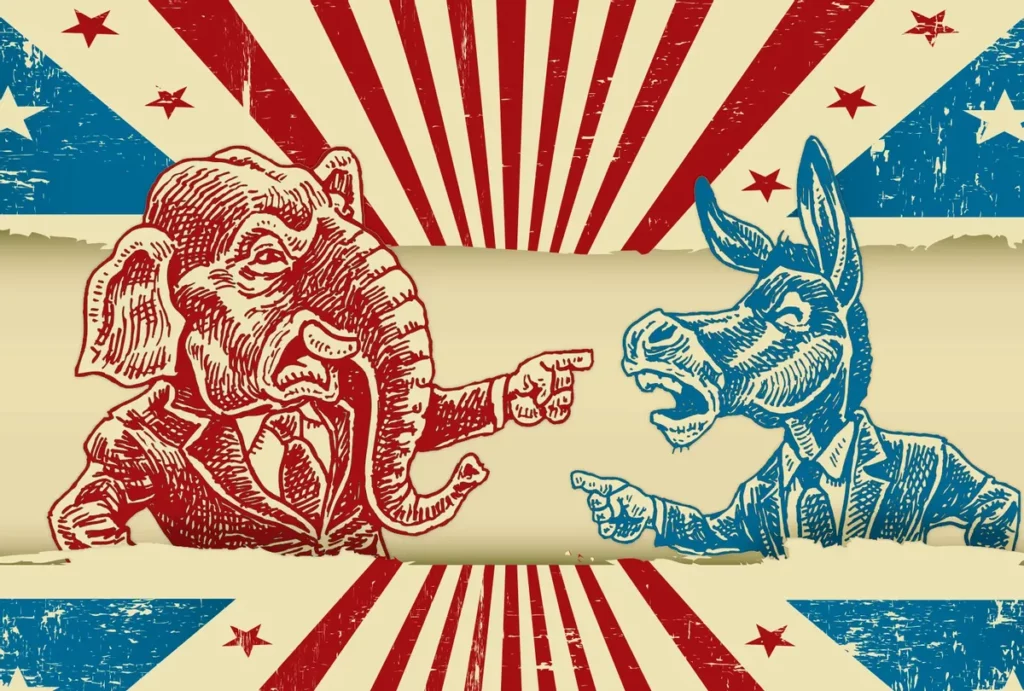
This depicts IDEOLOGICAl division among the people, as does the following poster:
But the more serious division is a division between means of ENFORCEMENT, as illustrated by the photos below:
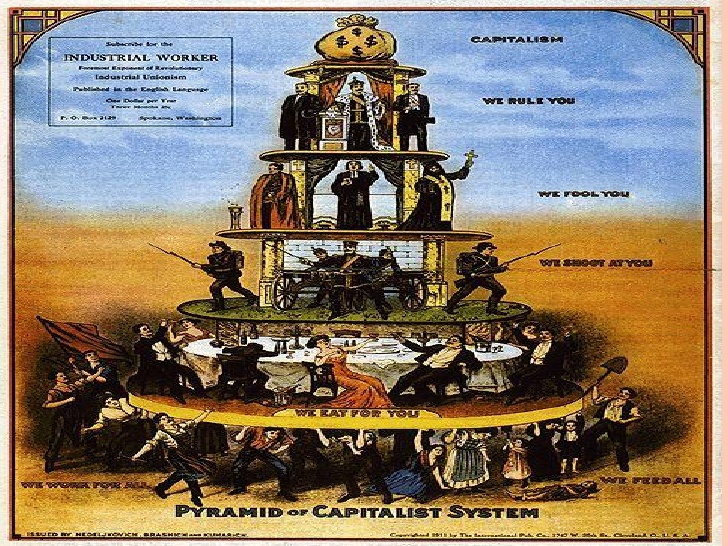
And the whole situation is best depicted by the pyramid of power and privilege: