
Identifying default intellectuals

Richard Wolff keeps repeating that in trying to assess the merits of some claim, it is wise to listen to the proponents and the opponents of the claim. His interest is in the evaluation of capitalism. However, he does not tell us who he thinks is the best proponent of capitalism, but he does tell us that a formidable opponent of capitalism was Karl Marx.

Well, I am not ready to become a Marx scholar — there is too much to read. I want some trustworthy intellectual to tell me in a succinct formulation what I should learn from Marx. Who should I listen to?

And the above reasoning applies to all claims. The problem is this. It is living people who are writing and speaking on popular media and making an impact. And this is what creates something like “current popular opinions.” Couple this with a belief that the new is better than the old — a sort of belief in the inevitability of progress — and the “old” is placed in the dustbin of the antiquated.

It is true that the natural sciences and technologies advance, but this does not seem to be true of the moral and social studies where there is ongoing controversy.

To deal with this problem, I have sought to find intellectuals who have an aura of wisdom and authority. In the past — until the scientific revolution — Plato and Aristotle played such a role. They acted as a “benchmark” for evaluating claims. A few years ago I advocated treating the views of the British philosopher C. D. Broad for this role of a “benchmark,” giving the name “default philosopher” to such a role.

This is not to deprive other philosophers of a high status, but the fact remains that someone who lives later and can critically evaluate the scholarship of the past — has an advantage, provided he has done so well.

For topics not dealth with by C. D. Broad, I would extend the status of a default philosopher to Bertrand Russell.

As to present global affairs — involving war, economics, and politics — the current “default intellectual” — if I may use this phrase — is, for me: Noam Chomsky.

What is the practical implication of this view? One should read Chomsky, and when listening or reading where a claim is made about present global affairs, ask yourself: What is Noam Chomsky view on this?
How I view Marxism

Marx and Engels wrote a lot, and on all sorts of topics. What they had to say about science, metaphysics, epistemology, ethics, etc., may be interesting, but, to me, none of this is Marxism. Marxism, to me, is a definition and analysis of what Marx understands as “capitalism.” Moreover, it is not a characterization of capitalism under government control, but an analysis of “laissez faire capitalism” or what currently goes by the name of “anarcho-capitalism.” Capitalism is the market system composed of two classes — the bourgeoisie (his name for entrepreneurs and business owners) and the proletariat (workers or people who do not have access to subsistence other than selling their labor services). There are in some countries and regions of the world people who are neither bourgeois-es nor proletarians (i.e., people who do not live under capitalism). These are indigenous people and free peasants. By a “free peasant” I mean one who is not renting, who does not have a mortgage, and does not pay taxes. Are there such people? James Scott wrote a study of such people (look here)

What does Marxism say about these people? Nothing. Why? Because they are not part of the capitalist economy, and Marxism is an analysis of the capitalist economy. And what does Marx say about the capitalist economy? That it has the seeds of its own destruction. And that is all that Marxism means to me. Mind you, what Marx wrote about was a model of pure capitalism, i.e., anarcho-capitalism, as we may call it today. He was not writing about capitalism with government intervention (i.e., the welfare state or crony capitalism).

Marx anticipated a classless state which he called communism. But such anticipations or predictions are not essential to the claim that pure capitalism will self-destruct. This prognosis is the “scientific” socialism of Marxism, as contrasted with a moral ideal of a classless society espoused by so-called “utopian” or libertarian socialists.

After the Russian Revolution in 1917, people seized land from large estates — creating a country of relatively free peasants. What would Marx say about such peasants? I suppose he would congratulate them for their freedom; and if they organized themselves by regional councils — still more congratulations. [See the Marx-Zasulich Correspondence (1881)]

Now what did the Bolsheviks in Russia, who called themselves “Marxists” do? Under Stalin, they liquidated the peasants in Ukraine by the millions. I ask: by what diabolical train of reasoning can you get such a policy from Marx?

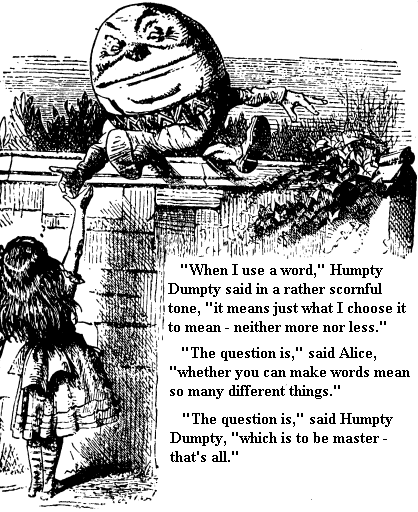
Humpty Dumpty Bullshit

I am still trying to recover from Jordan Peterson’s condemnation of Marxism because of what Stalin did.

Jordan Peterson by rejecting Marxism, contextually implied that he knows what Marxism is. But he can’t because the term “Marxism” is ambiguous and vague. If we try to clarify, here are some of the issues which will face us.

Someone may say that Marxism is the view of Karl Marx and Friedrich Engels. Such a claim would assume that their views were if not identical, at least so close as to be equivalent. Now, to determine whether this is so, requires doing scholarship — reading all of the writings of Marx and Engels. Someone who does such a thing may be called a Marx and Engels scholar, and this does not make them Marxists unless they also agree with what they read.

Now, in reading any text, there is an element of interpretation. And if there is any inconsistency in the texts, the interpretation, in order to restore consistency, must take a stand. I suppose a systematization of the writings of Marx and Engels will be akin to something akin to a systematized theology. But formulating a coherent system — even if one agrees with it — will not be Marxism, unless some of the claims are peculiar only
to Marx, and are adhered to.

In short, there are as many “Marxisms” as there are interpretations of Marx. Furthermore there may be some who, like Humpty Dumpty, call themselves “Marxists” (like Stalin) by sheer prescription or fiat.

The Nature of a Cynic

George Carlin, in one of his skits [see below], concluded with “fuck hope,” and went on to explain: “And please don’t confuse my point of view with cynicism -– the real cynics are the ones who tell you everything’s gonna be all right.”

Although Carlin was careful and precise about the use of language, I think he was wrong about cynicism.

Cynicism is in the ball park of pessimism and skepticism, so we must distinguish them. A skeptic is someone who expresses doubt about the truth of some claim. Let us say the claim is that everything will be all right. His attitude is one of uncertainty one way or the other; whereas the optimist is confident that everything will be all right, and the pessimist is equally confident that it will not. So, where does the cynic fit in?

It has to do with what one believes about human nature. There is a position believed by some called “psychological egoism.” This is the position that humans, by nature, are selfish and do everything with their personal interest in mind. If this position is correct, then so-called altruistic actions are only apparently so.  If now everything turning out all right depends on genuinely altruistic actions, then the cynic denied this possibility, and therefore is a convinced pessimist.

We must, in view of this, view the normal pessimist and optimist as both subscribing to the view that genuine altruistic actions are possible; with the pessimist saying that they are not probable in the situation; whereas the optimist saying that they are probable. And the cynic saying that real altruistic actions will not occur — not because they are improbable, but because they are impossible.

If the cynic then tells you that things will be all right, he is speaking ironically or sarcastically.  So, what Carlin is calling a real cynic, is an ironic or a sarcastic cynic.

George Carlin was both ironic and sarcastic at times, but he was never an ironic or sarcastic cynic. He did not believe that human doom was inevitable, only that it was probable.

Disambiguation of Socialism

Just now I came across a video by Thomas diLorenzo, whom I admire about his expose of Abraham Lincoln. In this video he talks about his new book , The Problem with Socialism (2016), which criticizes socialism.  I think his criticisms are worth considering — and I am going to get a copy of his book.  Jokingly,  he says that his talk could be about how to argue with your Bernie Sanders roommate in college.  He defines “socialism”, roughly,  as “state managed means of production.”  This includes both state controlled industries, as in the Soviet Union, Cuba, and Venezuela; and what is called Social Democracy, which we have in the United States and Europe.  These kinds of Socialisms are to be contrasted with, what in the United States is called, Libertarianism.

Watch this video, but make sure you also watch the next video by Cameron Watt, who contrasts these kinds of state or authoritarian socialisms with “libertarian socialism” or “anarchism.”  ‘”Socialism” here does not mean state owned or managed industries, but worker-owned and managed industries; and “libertarian” does not mean private ownership of industries, but refers to a political structure rooted in direct democracy in small scale communities, federated into larger units.

Finally, watch Noam Chomsky’s explanation of how the word “socialism” traditionally has been used to refer to worker-controlled work-places, which is the view of “libertarian socialism.”


Bullshit as Unintelligibility

Saying that some claim is bullshit is to negatively appraise the claim. But to appraise or evaluate a claim presupposes that you understood what was claimed. But what is the situation when you don’t understand the claim? There are two possibilities: (1)either there is something amiss with you or (2) there is something amiss with the alleged communication.

Now I don’t know most foreign languages, and when I encounter situations in which people are speaking an unknown foreign language, I know that the problem lies with me. What is said is unintelligible to me because I do not know this language. A similar problem arises when I hear people talking, using a technical language with its jargon, as, for example, physicists or mycologists. (If you do not know what I am talking about, this is because you don’t know what a mycologist is. I have just used some technical vocabulary.) In both these cases, the problem is similar. You don’t understand the language; therefore, whatever is talked about, is, as we say, “Greek to me.” (It’s a foreign language that I don’t understand.)

On the other hand, there are situations in which the problem does not lie with you, but with the communication itself. And this can happen in different ways. One way is to think that someone is speaking in a foreign language — but what you are hearing only sounds like a foreign language — but it is not. Sid Caesar was great at making sounds which seemed like a foreign language — but it was meaningless. Here is an example:

There is also the phenomenon which is called “double-talk.”  Even though it seems to be normal English, it contains nonsense words and nonsensical combination of words.  Here is an example:

;

A famous nonsense poem is Lewis Carroll’s “Jabberwocky.”  It sounds English because it is grammatically constructed, but some of the words are pure inventions. Here it is:

Sometimes after an allegedly philosophical lecture, a person may say “It was deep.  I am afraid it was too profound for me to understand.”  My reply could be: “You did not understand because it was intrinsically nonsensical.”

Then there is also the phenomenon of rambling: stringing together unconnected ideas and words. Here is Sarah Pahlin endorsing Donald Trump:

Political manipulation through metaphors and frames (George Lakoff)

George Lakoff explains how metaphors and frames are used by Conservatives (Republicans?) to win elections, including the creation of think tanks and various media to advance their political agenda. He himself identifies with Progressives and Liberals (Democrats?) and gives pointers about how to win elections. It is clear to me that he is a reformer, meaning that he wants to change things through the existing institutions. I am with him in this regard. But he fails to talk about, or even mention, how the very structure of the American government (as presented in the Constitution) fosters oligarchic rule. Pitting Democrats over Republicans is futile; because given the institutions of mass democracy and the institution of one person ruling as President, Governor, and Mayor, oligarchy and corruption will win.