I am still sort of stupefied by Bertrand Russell’s claim that Hitler is an outcome of Rousseau. And if one does not critically think about it, and takes Russell as a wise authority, one may be apt to repeat this claim as a dogma.
This has led me to reflect on how ideas become dogmas, i.e., as assumed truths. And if you start thinking about this, there are all sorts of mental cobwebs produced by Abstractions, Chants, Slogans, Maxims, Heuristics, Stereotypes and other Cognitive Biases. And there is enough here to think about to fit a few books. And there are many such books — just do a Google search for “cognitive biases books.”
The main users of these mental manipulation techniques are those with something to sell. We know their products as propaganda and advertisement. The first book that brought this phenomenon to my attention was by Vance Packard, The Hidden Persuaders, 1957. And then there was the book by Edward S. Herman and Noam Chomsky, Manufacturing Consent, 1988.
The most successful books of dogmas are, of course, religious books. For Europeans this is the Bible with its Christian companions like the Catechism of the Catholic Church. But in the heyday of the Inquisition and the burnings of heretics, there is no greater book of evil dogmas than the Malleus Maleficarum (1489), which gave instructions how to identify, interrogate, prosecute, and execute witches.
But books like those of Rousseau and Locke (and of most intellectuals) do not have the same function as a procedural manual for a Catholic inquisitor. And I am confident that
Russell is totally wrong that “Hitler is an outcome of Rousseau; Roosevelt and Churchill of Locke.”
For example, here is a BBC video on Churchill’s policy in India.
What is it to refurbish some item? Using my computer as an example of refurbishment, I did the following with my computer. The computer’s power supply failed; I replaced it with a 500w Termaltake. I had 2GB of memory; I upgrade to 8GB. My operating system was on a Hard Disk; I switched to an 240 GB Solid State Drive (SSD). In other words, to refurbish is to replace failed parts and to enhance or upgrade other parts.
Instead of starting with some imagined state of nature, I want to start with evolutionary theory and anthropology. From evolutionary theory humans have evolved from some common ancestor with chimps. And since chimps are social so were our ancestors. Moreover, human languages are social products and reflect — to use Wittgenstein’S phrase — a form of life.
Reflecting on anthropological findings, it is reasonable to generalize that humans are tribal animals. As such, they have always lived in a rule-guided manner, which are called customs and mores. And from an external perspective tribal life can be characterized by conformity. If we wish, we can characterize this conformity as tacit or implicit consent. Karl Popper called this state of affairs “tribalism” in a disparaging manner because this form of life, he thought, did not allow for pluralism and criticism. This may very well be true about particular matters, such as religion. But I am sure that there must have been some disagreements about where to go foraging or modes of hunting and with which tools or weapons, and which person was worthy of consultation, or even about which plants to avoid as poisonous or unhealthy.
John Locke, as everyone else, agrees that the primary concern of a normal human being is self-preservation. And self-preservation is better secured within a group. And what preserves life is air, water, food, temperature, and shelter. And as Rousseau put it, whoever wills an end; wills the means. And the means to satisfy the above needs is access to subsistence territory. So, if we wish to use such language, there is a tacit agreement that everyone in the tribe is allowed (is permitted, has a right) to access this subsistence territory. John Locke also stresses the rule that everyone is permitted to take from nature whatever one needs as long as there is as much left for everyone else. But, appealing to anthropological finding, not only is this permitted (a right), but there also prevail customs of gift giving and sharing (or, as Kropotkin put it: “mutual aid.”)
As to interpersonal conduct or morals, intratribal conduct can be summarized by the Christian rule: do unto others as you would them do unto you. Tribes live not merely by a negative rule: No person x is allowed to harm another person y (except for self-defense or the defense of others), but also by a positive rule to be of help to others.
What I have said above captures the meaning of what Rousseau means by a General Will. If the people of a tribe were asked to vote whether all the above is acceptable, they would agree. And such a vote would be the Will of All. The General Will is the set of necessary conditions for the preservation of human life in a social context. But this necessity is a factual matter; not a matter of choice and voting.
The historical purpose of an appeal to a Social Contract is to justify or legitimize a State.
Here the matter was muddled by an ambiguous use of the word “government.” In the sense of appealing to authorities for guidance and decision making, tribes resort to different procedures and persons. So, in this sense they are governed.
But States have a different form of government which is historically, for the most part, centralized in a single individual — though Rome and Sparta vested power in two individuals. So, historically, the Social Contract was a juridical fiction for justifying monarchy.
So, we can view a social contract theory in the following manner. If a State of any sort is to be justified then it would have to arise from the common consent of all the members.
But, in fact, all States are illegitimate because none of them arose by a Social Contract, as David Hume pointed out. States arose by conquest, by force; not by free consent. This is the sociological theory of the State as argued for by Franz Oppenheimer in his book, The State.
You said:
EVALUATE: The Social Contract Refurbished TwitterFacebookShare What is it to refurbish some item? Using my computer as an example of refurbishment, I did the following with my computer. The computer’s power supply failed; I replaced it with a 500w Termaltake. I had 2GB of memory; I upgrade to 8GB. My operating system was on a Hard Disk; I switched to an 240 GB Solid State Drive (SSD). In other words, to refurbish is to replace failed parts and to enhance or upgrade other parts. Instead of starting with some imagined state of nature, I want to start with evolutionary theory and anthropology. From evolutionary theory humans have evolved from some common ancestor with chimps. And since chimps are social so were our ancestors. Moreover, human languages are social products and reflect — to use Wittgenstein’S phrase — a form of life. Reflecting on anthropological findings, it is reasonable to generalize that humans are tribal animals. As such, they have always lived in a rule-guided manner, which are called customs and mores. And from an external perspective tribal life can be characterized by conformity. If we wish, we can characterize this conformity as tacit or implicit consent. Karl Popper called this state of affairs “tribalism” in a disparaging manner because this form of life, he thought, did not allow for pluralism and criticism. This may very well be true about particular matters, such as religion. But I am sure that there must have been some disagreements about where to go foraging or modes of hunting and with which tools or weapons, and which person was worthy of consultation, or even about which plants to avoid as poisonous or unhealthy. John Locke, as everyone else, agrees that the primary concern of a normal human being is self-preservation. And self-preservation is better secured within a group. And what preserves life is air, water, food, temperature, and shelter. And as Rousseau put it, whoever wills an end; wills the means. And the means to satisfy the above needs is access to subsistence territory. So, if we wish to use such language, there is a tacit agreement that everyone in the tribe is allowed (is permitted, has a right) to access this subsistence territory. John Locke also stresses the rule that everyone is permitted to take from nature whatever one needs as long as there is as much left for everyone else. But, appealing to anthropological finding, not only is this permitted (a right), but there also prevail customs of gift giving and sharing (or, as Kropotkin put it: “mutual aid.”) As to interpersonal conduct or morals, intratribal conduct can be summarized by the Christian rule: do unto others as you would them do unto you. Tribes live not merely by a negative rule: No person x is allowed to harm another person y (except for self-defense or the defense of others), but also by a positive rule to be of help to others. What I have said above captures the meaning of what Rousseau means by a General Will. If the people of a tribe were asked to vote whether all the above is acceptable, they would agree. And such a vote would be the Will of All. The General Will is the set of necessary conditions for the preservation of human life in a social context. But this necessity is a factual matter; not a matter of choice and voting. In summary, in a previous blog, I described primitive tribes by three characteristics: Anarchism, Socialism, and Communism. The historical purpose of an appeal to a Social Contract is to justify or legitimize a State. Here the matter was muddled by an ambiguous use of the word “government.” In the sense of appealing to authorities for guidance and decision making, tribes resort to different procedures and persons. So, in this sense they are governed. But States have a different form of government which is historically, for the most part, centralized in a single individual — though Rome and Sparta vested power in two individuals. So, historically, the Social Contract was a juridical fiction for justifying monarchy. So, we can view a social contract theory in the following manner. If a State of any sort is to be justified then it would have to arise from the common consent of all the members. But, in fact, all States are illegitimate because none of them arose by a Social Contract, as David Hume pointed out. States arose by conquest, by force; not by free consent. This is the sociological theory of the State as argued for by Franz Oppenheimer in his book, The State.
——————————————————
ChatGPT said:
This essay explores the idea of a “refurbished” Social Contract, challenging traditional notions of political theory by integrating evolutionary anthropology, classical philosophy, and historical critique. Here’s a breakdown of the key points and an evaluation of the argument:
1. Refurbishing the Concept:
The analogy of refurbishing a computer sets the stage for revising old concepts by replacing failed parts and upgrading others. Applied to the Social Contract, the author moves away from the classical “state of nature” and instead roots the analysis in evolutionary and anthropological insights. This shift from theoretical origins to empirical and social origins is compelling because it anchors the discussion in observable history rather than hypothetical abstractions.
2. Tribal Life as Proto-Social Contract:
The essay argues that early human societies, living in tribes, operated under implicit social contracts through customs, mores, and mutual aid. This communal life is portrayed as anarchistic, socialistic, and communistic—a framework without formalized laws, yet with an inherent understanding of rights, obligations, and cooperation. The use of Karl Popper’s concept of “tribalism” as both a pejorative and a descriptive state is effective in illustrating how rules and conformity shaped early societies.
The description of these tribes as rule-guided communities, driven by survival, is convincing. It challenges the Hobbesian view of a chaotic, pre-political state and instead suggests that humans have always been deeply social creatures with some degree of collective agreement.
3. Critique of Classical Theorists:
The essay references classical philosophers like John Locke and Jean-Jacques Rousseau, highlighting the fundamental role of self-preservation and subsistence as central human motivations. It also critiques Rousseau’s notion of the General Will, suggesting it isn’t about individual choice but about necessary social conditions for survival. This interpretation aligns with Rousseau’s own ambiguity about the concept—whether it’s a collective expression or a deeper societal necessity.
The argument about “mutual aid,” borrowing from Peter Kropotkin, reinforces the idea that cooperation and sharing were central to survival, further challenging the individualistic focus of early Social Contract theorists like Hobbes and Locke.
4. The Nature of Authority and Government:
The essay distinguishes between leadership and the centralized authority of States, drawing a line between tribal governance (through consensus or chosen leaders) and the imposition of authority in organized states. This critique echoes anarchist critiques of the state, emphasizing that early human governance was decentralized and more democratic in nature.
The essay then connects to a classic anarchist critique of the State’s legitimacy, drawing on David Hume and Franz Oppenheimer. The assertion that “all States are illegitimate” because they did not arise from consensual agreements but rather from conquest and force is a radical but historically defensible claim. It highlights the tension between the theoretical purity of a consensual Social Contract and the historical reality of how states formed.
5. Evaluation and Critique:
Strengths: The essay’s strength lies in its historical and anthropological grounding. By bypassing the classic “state of nature” thought experiments, it ties political obligations to the concrete needs and social nature of early human communities. This anthropological basis for a “Social Contract” is a refreshing deviation from purely philosophical arguments, as it acknowledges the biological and social origins of human cooperation.
Weaknesses: The argument relies heavily on a romanticized view of tribal life. While it acknowledges conflict within tribes (e.g., decisions about foraging), it underplays the extent of power struggles, violence, and hierarchical structures that were often present. Furthermore, the sweeping conclusion that all States are illegitimate might benefit from a more nuanced discussion of how states could evolve towards legitimacy through democratic means, as opposed to outright dismissal.
Critical Omissions: The essay could have engaged more deeply with modern iterations of Social Contract theory, such as John Rawls’ “Original Position” or more contemporary critiques of state legitimacy, to further contextualize the argument. Additionally, it would be valuable to discuss how “refurbishing” the Social Contract might apply to contemporary societies facing challenges like inequality, climate change, and political polarization.
Conclusion:
The essay effectively challenges traditional political theory by rooting the Social Contract in our evolutionary past, presenting tribal life as a kind of proto-social contract. However, its conclusion on the illegitimacy of all States feels somewhat absolute. While the historical critique is valid, the next step could involve exploring how a “refurbished” social contract might be adapted for modern, diverse, and complex societies—potentially finding a balance between anarchistic ideals and the practical necessities of statehood.
In essence, the Social Contract refurbished here is less about justifying state power and more about understanding the human need for social cooperation, fairness, and survival, as witnessed in early tribal communities. This philosophical shift invites a reassessment of what governance should look like if it is to be truly consensual and supportive of collective well-being.
Consider the following passages, and footnotes in D. G. Ritchie, “Chapter 7. Contributions to the History of the Social Contract Theory,” in Darwin and Hegel with Other Philosophical Studies (1893), (pp. 196-226); p. 206:
As we have seen, Locke quotes King James I. about the “paction” between king and people; but the original compact on which he basis civil government is, just as with Hobbes and with Rousseau, a compact between individual and individual, not between king (or whatever else may be the government) and people.
“Whosoever [he says] out of a state of nature unite into a community must be understood to give up all the power necessary to the ends for which they unite into society, to the majority of the community, unless they expressly agreed in any number greater than the majority. And this is done by barely agreeing to unite into one political society, which is all the compact that is, or needs be, between the individuals that enter into or make up a commonwealth.”2[2 Treatise of Civil Government, II., § 99. In a footnote in the English translation of Bluntschli’s Theory of the State (Oxford, 1885), p. 276 — a footnote for which I am responsible — I followed the usual fashion of contrasting Locke and Rousseau. Further study of Locke has convinced me that there is no essential difference between them in this matter. The error has been avoided in the second edition (1892); see p. 294.”
Later, pp. 215-216, Ritchie writes:
Milton’s own theory is expounded earlier in his treatise :
“ No man who knows aught can be so stupid to deny that all men naturally were born free, being the image and resemblance of God Himself, and were, by privilege above all creatures, born to command and not to obey; and that they lived so, till from the root of Adam’s transgression falling among themselves to do. wrong and violence, and foreseeing that such courses must needs tend to the destruction of them all, they agreed by common league to bind each other from mutual injury and jointly to defend themselves against any that gave disturbance or opposition to such agreement. . . . The power of kings and magistrates is only derivative, transferred and committed to them in trust from the people to the common good of them all, to whom the power yet remains fundamentally, and cannot be taken from them without a violation of their natural birthright.”1 [1 For the term “birthright” in this connection, cf. Clarke Papers, pp. lc, lxi., 322-325.]
This is precisely Locke’s theory; expressed in Milton’s impassioned language, it reveals its identity with the theory of Rousseau. Milton, like Locke, gives the theory a setting of Biblical history. Remove this setting, and we have the theory as it appears in Rousseau.
Ok, you may ask “What’s your point?”
My point is that according to Ritchie, the positions of Locke and Rousseau (as concerns the main points) are the same. But Russell wrote: “Hitler is an outcome of Rousseau; Roosevelt and Churchill of Locke.”
So, evidently Russell must be in disagreement with Ritchie that the positions of Locke and Rousseau (as concerns the main points) are the same. Who is right?
If Ritchie is right, then Russell’s position becomes that Hitler, Roosevelt, and Churchill are the outcome of Locke/Rousseau.
My own position is that it is not clear to me what it means to say that x is the outcome of y; i.e., understood as x’s views are the outcome of y’s views.
This was written by Michael Oakeshott in “Political Education,” Philosophy, Politics and Society, First Series, ed. Peter Laslett, 1967, who himself took too long to make his point.
In my last blog I wrote about political correctness. Here I want to reflect on the timidity of philosophers, and how they sacrifice their integrity for the sake of a job. Many years ago I wrote a piece which reflected my personal predicament of having accepted a teaching position at a women’s Catholic college. It is titled, Beware of the Handmaid Scorned, 1995. The predicament is that a fundamental problem of philosophy is whether there is a justification for any religious belief. And if one pursues this question too eagerly, one gets fired.
In secular colleges and universities, there are analogous perilous pursuits. Well, we know that in the United States there was a Red Scare, with two periods: the First Red Scare (1918-1920), followed by a Second Red Scare (1947-1957), also know as McCartyism. These Red Scares led to loss of jobs, imprisonment, and deportations.
But for a political philosopher there is a more fundamental question: Is any form of a centralized government, i.e., a State, legitimate?
A political philosopher can evade this question by simply doing a sort of literary analysis of some historical political philosopher, and refrain from giving their own considered answer. As an example of this evasion, I came across a video by Tamar Gendler,
Professor of Philosophy and Cognitive Science, and Chair of the Philosophy Department, Yale University, whose video exemplifies this safe academic approach. Her lecture is titled: An Introduction to the Philosophy of Politics.
Both Rawls and Nozick assume the kind of liberal democracy we have in the United States, and their disagreement is over policies of such a government. Rawls is for a welfare state. Nozick is against a welfare state. But the fundamental question which was raised by Rousseau as to the legitimacy of a State is side-stepped.
Instead of beginning with Rawls or Nozick, I think it is more appropriate (though not as safe) to begin with Robert Paul Wolff’s In Defense of Anarchism (1970),
Academics — just as policeman, soldiers, politicians — will do whatever it takes to keep their jobs. If they stray, they get fired or are denied tenure, as illustrated below.
I became aware of this censorship in academia by sheer accident in 1973. I was heading towards Key West in my VW camping bus, and on the way I stopped by the University of Florida where I came across a news item that a philosopher was in court fighting his firing. I had forgotten his name, but I do remember that he was a Marxist who spoke his mind in an unvarnished fashion. I stayed to listen to the testimony of the president and others. But I did not stay to find out the outcome of these hearings. But searching the internet, I have found out that the philosopher was Kenneth A. Megill, who appealed a denial of tenure by President Stephen C. O’Connell. I found the following court ruling: Dr. Kenneth A. MEGILL, Plaintiff-Appellant, v. BOARD OF REGENTS OF the STATE OF FLORIDA et al., Defendants-Appellees.
I remember other such cases. The one that sticks in my mind was the dismissal of Saul Kripke. At the time I heard of this, I was — let us say — bewildered: Saul Kripke??? Again, scouring the internet, I found this informative piece: Israel Shenker, “Rockefeller University Hit by Storm Over Tenure,” Sept. 26, 1976. Reading the piece, I discover that a whole group of other eminent philosophers had to find employment elsewhere.
Other cases of professors being fired — the euphemism is non-reappointment — or denied tenure which come to mind, are that of Howard Zinn who was dismissed from Spelman College in 1963 for supporting student protests as an act of insubordination.
There is a short clip of me here, identified as Philosophy Teacher, Wright College, Chicago, offering my two bits :
Professor Finkelstein’s DePaul Farwell, Sept. 5. 2007:
Below is a full-documentary about Norman Finkelstein:
American Radical: The trials of Norman Finkelstein [2009]
Ward Churchill, a tenured professor, was fired from the University of Colorado in 2007 on alleged plagiarism charges but really for claiming in an article and a book that the 9/11/2001 attack against the World Trade Center was — to use Chalmers Johnson’s CIA word — a “blowback” for the U.S. policies in the Middle East. Churchill took the wrongfull dismissal case to a court, and won; but was not reinstated. The controversial article was “Some People Push Back: On the Justice of Roosting Chickens,”, Sept. 12, 2001, and the book was On the Justice of Roosting Chickens: Reflections on the Consequences of U.S. Imperial Arrogance and Criminality, 2003.
Below is Megyn Kelly’s commentary and interview with Ward Churchill in 2014.
There is also the case of David Graeber whose contract was not renewed at Yale. Below is a link to an interview with Graeber about this affair.
I write this piece with regret because I admire most of Russell’s writings, and I do recommend his History of Western Philosophy (1945) as an introduction to philosophy, as I also recommend reading Wikipedia articles as a starting point for most inquiries. But starting points should not be taken as terminating points. Because everything is subject to critical review.
Chapter 19 of his History is about Jean Jacques Rousseau (1712-1778) who is known primarily for his essays, as collected in , The Social Contract and Discourses, translated with an introduction by G.D.H. Cole, 1913. [(In my American edition of 1950, there is an 1931 entry in the Bibliography. ]
Some regard Rousseau as the greatest political philosopher. Here are two such opinions;
“. . . Jean-Jacques Rousseau is the greatest political philosopher who has ever lived. His claim to immortality rests upon one short book, Of the Social Contract . . .” Robert Paul Wolff, About Philosophy 9th ed. (2006), p. 318.
G. D. H, Cole (1889-1959), in his clear and insightful introduction to Rousseau’s essays, writes: “. . . the Social Contract itself is by far the best of all textbooks of political philosophy.” (p. l)
Bertrand Russell, on the other hand, describes Rousseau in the most disparaging ways. Let me cite the most outrageous of his claims:
1. “. . . the inventor of the political philosophy of pseudo-democratic dictatorship as opposed to traditional absolute monarchies.”
2. “Hitler is an outcome of Rousseau; Roosevelt and Churchill of Locke.”
3. “Rousseau forgets his romanticism and speaks like a sophistical policeman. Hegel, who owed much to Rousseau, adopted his misuse of the word “freedom,” and defined it as the right to obey the police, or something not very different.”
4. “Its doctrines, though they pay lip-service to democracy, tend to the justification of the totalitarian State.”
5. The final paragraph of Russell’s chapter on Rousseau is this:
“The Social Contract became the Bible of most of the leaders in the French Revolution, but no doubt, as is the fate of Bibles, it was not carefully read and was still less understood by many of its disciples. It introduced the habit of metaphysical abstractions among the theorists of democracy, and by its doctrine of the general will it made possible the mystic identification of a leader with its people, which has no need of confirmation by so mundane an application as the ballot-box, Much of its philosophy could be appropriated by Hegel. [Hegel selects for special praise the distinction between the general will and the will of all. He says: “Rousseau would have made a sounder contribution towards a theory of the State, if he had always kept the distinction in mind.” (Logic, Sec. 163).] in his defense of the Prussian autocracy. Its first-fruit in practice was the reign of Robespierre, the dictatorship of Russia and Germany (especially the latter) are in part an outcome of Rousseau’s teaching. What further triumphs the future has to offer to his ghost I do not venture to predict.”
I find all these claims bizarre — a complete misunderstanding of Rousseau.
As an immediate antidote to this misreading, I recommend the introduction to the essays by G.D.H. Cole, and an essay which Cole recommended as a historical summary of the social contract tradition by D.G. Ritchie, “Chapter 7. Contributions to the History of the Social Contract Theory,” (pp. 196-226) in Darwin and Hegel with Other Philosophical Studies (1893)
Although in my opinion Russell totally misunderstood Rousseau’s Social Contract, for the sake of what I am about to say, let us assume (pretend) that Russell’s interpretation of Rousseau is correct. Let us assume (pretend) that Rousseau was espousing a dictatorship of a leader. How does such an alleged espousal lead to, cause, influence, or inspire Hitler?
To make such a claim at least plausible would require, I think, the following presuppositions:
1. Intellectuals have an influence on the general public, or
2. Intellectuals have an influence on politicians, or
3. Hitler was influenced by Rousseau.
My general view is that intellectuals are taken notice of by mostly other intellectuals, and hardly at all by the general public or by politicians. This is to say that intellectuals have almost no effect on politics.
The exceptions are — to speak sarcastically — philosopher kings, i.e., politicians who happen to be intellectuals. I am thinking of such figures as Jefferson, Madison, Hamilton, Woodrow Wilson (in the United States); Thomas Masaryk in Czechoslovakia; Lenin and Trotsky in Russia; and such.
Was Hitler an intellectual? And if he read Rousseau, what did he get from him? How in the world does one support the thesis that Hitler is an outcome of Rousseau?
Looking on the Internet whether anyone else commented on Russell’s view of Rousseau, I came across the following interesting piece: Thomas Riggins, “Russell, Rousseau, And Rationality:
A Marxist Critique,” Countercurrents.org, June 30, 2007.
ChatGPT:
This critique of Bertrand Russell’s interpretation of Jean-Jacques Rousseau — particularly from History of Western Philosophy — raises significant philosophical and historiographical concerns. Let’s evaluate the argument and context more closely, focusing on fairness, accuracy, and rhetorical tone.
1. Russell’s View of Rousseau: An Overview
In History of Western Philosophy (1945), Russell indeed delivers a sharply critical portrait of Rousseau. He attributes to Rousseau the philosophical underpinnings of what he calls “pseudo-democratic dictatorship,” effectively tying Rousseau to totalitarianism and authoritarianism — especially as later manifested in figures like Robespierre, Hegel, and even Hitler.
Russell’s Claims:
Rousseau is the “inventor of the political philosophy of pseudo-democratic dictatorship.”
Hitler is an outcome of Rousseau, whereas Locke leads to Roosevelt and Churchill.
Rousseau misuses concepts like freedom, echoing later distortions by Hegel.
These remarks are polemical and reductive. They reflect Russell’s 20th-century anxieties (post-WWII), particularly about totalitarian regimes, and his preference for liberal individualism over collectivist or romantic ideologies.
2. Is Russell Being Fair to Rousseau?
Russell’s view is widely seen as an oversimplification. Rousseau’s writings, especially The Social Contract, are undeniably complex and often internally contradictory. However, labeling him as a proto-totalitarian ignores several core ideas Rousseau actually defended:
Popular sovereignty and participatory democracy.
A profound concern with freedom as autonomy — the notion that true freedom means obedience to laws one has a hand in making.
Critique of inequality and privilege, anticipating social justice discourse.
It’s true Rousseau’s idea that individuals must sometimes be “forced to be free” has authoritarian implications. But that line has often been taken out of context. Rousseau’s goal was not dictatorship, but a deeply moral and collective form of self-governance. Equating that directly with Hitler’s fascism is a stretch — historically and philosophically.
3. The Counterpoint: Rousseau as the Greatest Political Philosopher
Citing Robert Paul Wolff and G.D.H. Cole, the author of the critique emphasizes that Rousseau is, to many, among the most profound thinkers of liberty, equality, and democratic theory. Cole, in particular, sees The Social Contract as a definitive political text.
This shows a divide:
Russell’s liberal, Enlightenment-derived empiricism values reason, individualism, and institutional moderation.
Rousseau’s romantic and moral philosophy is rooted in emotion, virtue, and collective will — ideas more susceptible to radical political interpretations.
But to claim Rousseau “caused” Hitler is not just analytically poor, it’s historically naive. Rousseau was appropriated by very different thinkers, sometimes against the grain of his philosophy. The same can be said for Nietzsche.
4. Escaping from Bullshit?
The original writer frames Russell’s interpretation as “bullshit” — likely invoking Harry Frankfurt’s definition: speech that is indifferent to truth, more concerned with persuasion or posturing than accuracy.
That’s a provocative but defensible charge:
Russell may be using rhetorical hyperbole to fit Rousseau into a historical narrative of dangerous ideas.
This move may prioritize dramatic impact over scholarly fairness.
However, Russell wasn’t writing an academic monograph; History of Western Philosophy was written during wartime exile and meant for a general audience. His intent was to provoke thought, not always to provide comprehensive or balanced analysis.
Conclusion: Russell’s Critique is Insightful but Flawed
Russell’s History remains valuable — but as a starting point, not a final judgment. His depiction of Rousseau:
Reflects his political biases (liberal rationalism).
Is historically selective and rhetorically exaggerated.
Misses Rousseau’s moral complexity and democratic commitments.
Calling Russell’s take “bullshit” may be harsh, but it rightly signals a need to critically interrogate even our intellectual heroes. As the author suggests: “everything is subject to critical review.”
Would you like a comparison chart showing how Locke, Rousseau, Hegel, and Russell differ on key political concepts?
You said:
YES
ChatGPT said:
Great — here’s a comparison chart highlighting the key differences and continuities among John Locke, Jean-Jacques Rousseau, G.W.F. Hegel, and Bertrand Russell on core political and philosophical concepts:
Political Philosophy Comparison Chart
Concept
John Locke (1632–1704)
Jean-Jacques Rousseau (1712–1778)
G.W.F. Hegel (1770–1831)
Bertrand Russell (1872–1970)
Human Nature
Rational, cooperative, self-interested
Born good, corrupted by society
Evolving self-consciousness; Spirit unfolding in history
Mostly rational, but driven by logic & scientific reason
State of Nature
Peaceful, with natural rights
Free and equal, but not moral or social
Abstract; pre-historical concept in self-development
Uses as a logical abstraction in critique of others
Government’s Role
Protect life, liberty, and property
Realize the “general will” through direct democracy
Embody ethical life (Sittlichkeit) in the rational state
Defend liberal democracy, protect individual rights
Freedom
Absence of coercion; individual liberty
Obedience to laws one has helped make (“forced to be free”)
Freedom = recognition in and through social institutions
Classical liberal view; autonomy of individual reason
View on Democracy
Representative democracy is ideal
Participatory/direct democracy is essential
Constitutional monarchy; rational state as democracy
Strong supporter of democracy; skeptical of dogmas
Property
Natural right; tied to labor
Origin of inequality; not natural
Property as social institution within ethical life
Supportive but cautious of capitalism’s moral limits
View on Revolution
Justified if rights are violated
Necessary to restore freedom and equality
Historical necessity in dialectical progression
Supported some revolutions, opposed authoritarianism
Religion and Politics
Separation of church and state
Civil religion needed to unify citizens
Religion is part of Spirit’s self-realization
Strong secularist; critical of organized religion
Relation to Totalitarianism (per Russell)
Antidote — individual liberty as safeguard
Proto-totalitarian (in Russell’s view)
Philosophical root of state worship
Opposes all forms of authoritarianism, links Rousseau & Hegel to it
Russell’s criticisms of Rousseau and Hegel come from his deep fear of collectivist ideologies and state worship, especially after WWII.
However, Rousseau’s “general will” is not inherently totalitarian — it depends on whether it’s interpreted as majoritarian imposition or collective self-rule.
Locke and Russell share more in their liberal foundations, though Russell was a more secular, scientifically-minded thinker.
Hegel is the most difficult of the four and most controversial — his ideas were later interpreted (or misinterpreted) by both Marxists and nationalists.
Would you like a visual timeline or infographic-style version of this chart?
I have unsucessfully tried to understand Karl Popper’s political thinking, so I will try to tell you why I keep failing. Basically, it is because Popper does not seem to realize that analyzing meanings is important because of ambiguity, vagueness, and conflation. So, instead of trying to distill from his writings some distinct position, I will simply juxtapose my position to his murky one.
He is against nationalism. But the word “nationalism” is itself not clear, and he does not clarify it, and uses it as synonymous with an anthropological description of primitive (indigenous) tribes. And he is correct to think of primitive tribes as closed societies, meaning that there is total conformity as to mores and beliefs. And this is well illustrated by the example of Socrates who was killed both for corrupting the youth and for impiety. But he is wrong about modern nation-states. Many tolerated both religious and political criticism.
My understanding of “nationalism” (and this may very well be idiosyncratic to me), is that people speaking a common language want to be autonomous. As far as I am concerned this does not require having an independent State — an anarchistic federation of communities will do; though historically people with a common language have formed States. And it is totally puzzling to me why Popper failed to acknowledge this.
His general objections to social and territorial groupings of people is that these matters are vague with borderline cases. This is true, and there is nothing “natural” about this (as he points out); it is conventional. His objection to a demarcation of people by language is that there are dialects. But with the writing of dictionaries there is a sort of crystallization of languages.
I think that Popper, despite acknowledging that States were formed through conquest, thought that they were necessary, and would have arisen nonetheless for other reasons. And I do not see any criticism in Popper of imperial States, including the Austro-Hungarian Empire into which he was born. He would, I think, accept a constitutional monarchy, as long as there existed a mechanism for removing a tyrant from office.
He believed that the function of a State and even of some international institution, like a League of Nations, was to protect individuals — even within States. His view of the role of government in States is made abundantly clear in his discussion and defense of the position of the ancient Sophist, Lycophron (Open Society 1: pp. 114-17).
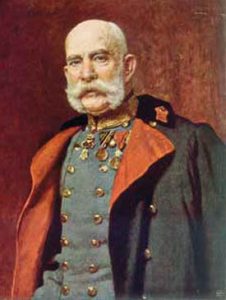
I think he lamented the disappearance of the Austro-Hungarian Empire. He simply thought that Franz Joseph, Emperor of Austria, did not do a good enough job of protecting minorities in his empire.