Marshall Sahlins (1930-2021)

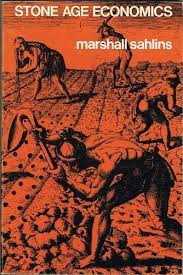
Marshall Sahlins, Stone Age Economics, 1972.

Chapter 1: The Original Affluent Society

If economics is the dismal science, the study of hunting and gathering economies must be its most advanced branch. Almost universally committed to the proposition that life was hard in the paleolithic, our textbooks compete to convey a sense of impending doom, leaving one to wonder not only how hunters managed to live, but whether, after all, this was living? The specter of starvation stalks the stalker through these pages. His technical incompetence is said to enjoin continuous work just to survive, affording him neither respite nor surplus, hence not even the “leisure” to “build culture.” Even so, for all his efforts, the hunter pulls the lowest grades in thermodynamics-less energy/capita/year than any other mode of production. And in treatises on economic development he is condemned to play the role of bad example: the so-called “subsistence economy.”

The traditional wisdom is always refractory. One is forced to oppose it polemically, to phrase the necessary revisions dialectically: in fact, this was, when you come to examine it, the original affluent society. Paradoxical, that phrasing leads to another useful and unexpected conclusion. By the common understanding, an affluent society is one in which all the people’s material wants are easily satisfied. To assert that the hunters are affluent is to deny then that the human condition is an ordained tragedy, with man the prisoner at hard labor of a perpetual disparity between his unlimited wants and his insufficient means.

For there are two possible courses to affluence. Wants may be “easily satisfied” either by producing much or desiring little. The familiar conception, the Galbraithean way, makes assumptions peculiarly appropriate to market economies: that man’s wants are great, not to say infinite, whereas his means are limited, although improvable: thus, the gap between means and ends can be narrowed by industrial productivity, at least to the point that “urgent goods” become plentiful. But there is also a Zen road to affluence, departing from premises somewhat different from our own: that human material wants are finite and few, and technical means unchanging but on the whole adequate. Adopting the Zen strategy, a people can enjoy an unparalleled material plenty-with a low standard of living.

That, I think, describes the hunters. And it helps explain some of their more curious economic behavior: their “prodigality” for example-the inclination to consume at once all stocks on hand, as if they had it made. Free from market obsessions of scarcity, hunters’ economic propensities may be more consistently predicated on abundance than our own. Destutt de Tracy, “fish-blooded bourgeois doctrinaire” though he might have been, at least compelled Marx’s agreement on the observation that “in poor nations the people are comfortable,” whereas in rich nations “they are generally poor.”

This is not to deny that a preagricultural economy operates under serious constraints, but only to insist, on the evidence from modern hunters and gatherers, that a successful accomodation is usually made. After taking up the evidence, I shall return in the end to the real difficulties of hunting-gathering economy, none of which are correctly specified in current formulas of paleolithic poverty.

…………………………..
Free Access to Subsistence Land = Socialism

If Socialism is to be viewed as the antithesis of Capitalism, then the following must serve as foundational axioms of each. Socialism is a political system which allows (i.e., gives a right to a) free access to subsistence land. Capitalism is a political system which does not allow (i.e., forbids) a free access to subsistence land.

Why is this important? Because human beings are animals, and all animals must eat to live. And all animals get their food from their environment, as do all foraging human beings and those who have learned to cultivate their source of food. But with the establishment of States and industrial production, humans have been driven into cities, which Desmond Morris, in the following video views as Human Zoos.

Whether such laws allowing or denying free access to subsistence land are enacted by a single individual (a monarch, a dictator, a president, a prime minister) or a group (a parliament, a congress, a council) is irrelevant.

How power is exercised (i.e., who grants or denies this right) is a different question from whether you are granted this right or not. And one answer to this question of power is given by the word “democracy.” But I distinguish Mass Democracy in which thousands and millions vote for some official (as is practically a universal political practice), from Micro Democracy where the units of government are about 150 voters. A federated Micro Democracy is the ideal of theoretical Anarchism (as expounded, for example, in Proudhon’s The principle of federation, 1863.)

“We have everything but we have no money.”

All over the world there are people who live in small villages, grow their own food and raise animals for food as well. I am especially interested in how this is possible in eastern Europe. It is possible, of course, if one has access to free subsistence land. And, without the infrastructure of water pipes, gas pipes, or an electric grid, or a sewer system, this is comparable to living on a homestead in the 19th century American frontier. Water is obtained from wells or a spring, heating is by burning wood, and a toilet is an out-house.

I have previously posted: “A documentary of how an American lived for 6 weeks in a Ukrainian village”. This gives you a good feel of how such a life is lived in a Ukrainian village.

But I keep looking for other videos. Recently I watched the following video:

Village Life in Romania

What struck me and stuck in my brain in this video was the comment of an old woman living in a remote village. She said, “”We have everything but we have no money.” She did not mean this literally because she was receiving a small pension from the government. The way I interpret what she said is this: We have all the necessities for life, but we have no money for luxuries. By “luxuries” I mean to include all those things which lessen the burdens of living.

What has puzzled me about village life in eastern Europe is: What about property taxes?

I found the following facts about property taxes in Ukraine. Unlike the property taxes in the United States, and most of Europe, which are based on an assessment of the worth of your property on the real estate market, in Ukraine property taxes are based on the square meter of your dwelling. An apartment dwelling of 60 square meters (645.8 square feet) and a house of 120 square meters (1291.6 square feet) are not taxed at all. And each additional square meter is taxed at the rate of 1.5% of the minimum national living wage. [This is about $216 dollars a month; so, each additional square meter of space would cost about $3.24.] My house in Chicago is 121 square meters and the assessed property value in 2017 was $303,220. My property tax in 2017 was $5,772.80 (this is with an exemption for our ages). In Ukraine, my property tax would have been $3.24

In addition, according to Article 121 of the Ukrainian Land Code each citizen has a right to get land for free. [See: “How to get land in Ukraine for free?”]

So, at least in Ukraine, it is still possible to live without money.


You may be wondering why this an issue?

I view city-life as being precarious. What happens when the infra-structure collapses as it did in New Orleans during Hurricane Katrina in 2005:

In general, a city is a Technology Trap.